

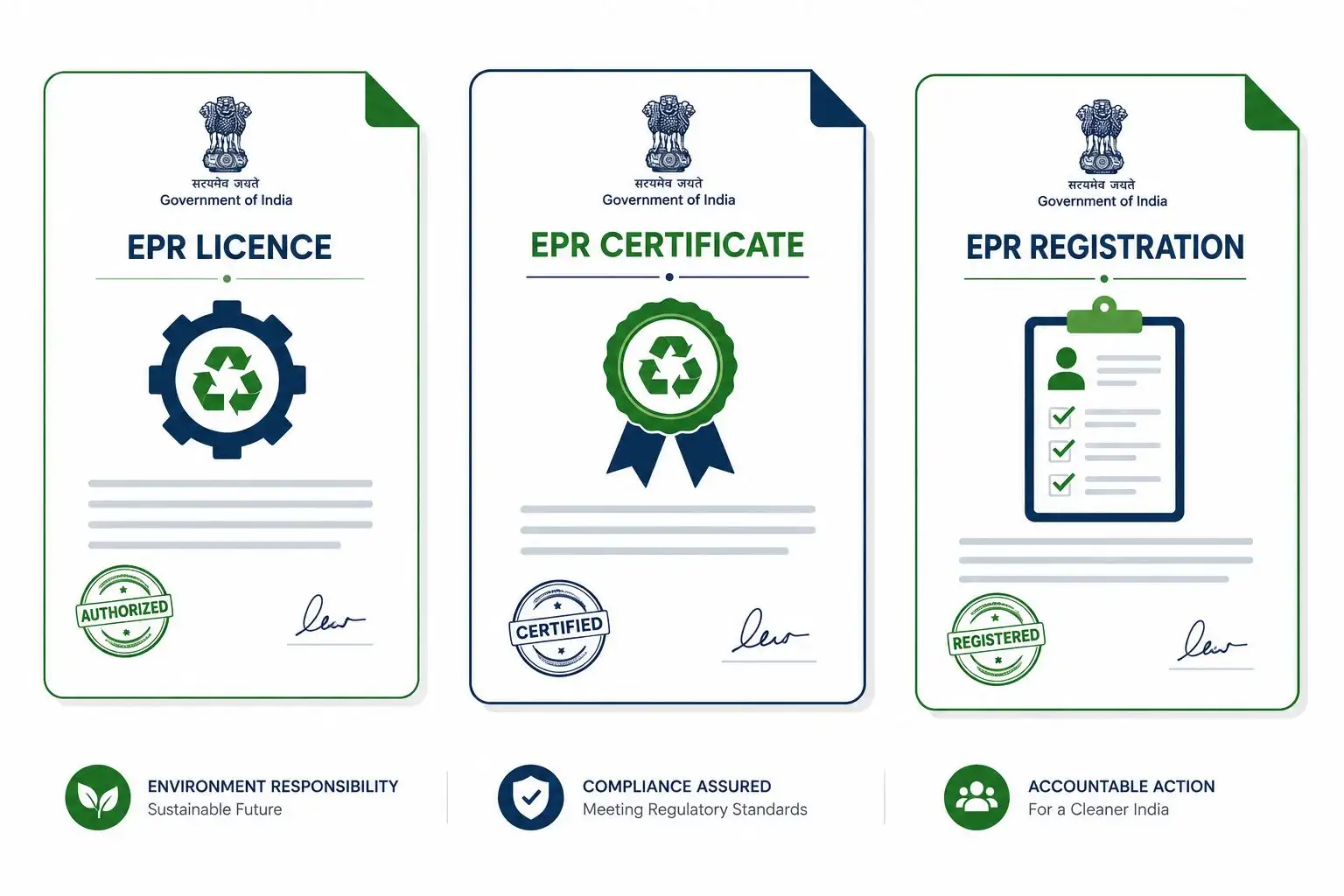
This blog helps you clearly understand EPR terms and how they differ.
EPR rules in India apply to businesses that handle products such as plastics, electronics, batteries, and more. These rules make companies responsible for managing the waste their products create.
During compliance, terms such as EPR Licence, EPR Certificate, and EPR Registration Certificate are commonly used. Most businesses treat them as the same, which creates confusion.
But these terms are not identical. Mixing them up can lead to a wrong understanding of compliance needs and delays in approvals. Even searches like “CPCB EPR Registration Online” often yield mixed explanations, adding to the confusion.
This guide breaks it down in simple terms, so you clearly understand what each one means.
What is EPR in Simple Terms?
EPR stands for Extended Producer Responsibility. It is a system in which businesses are responsible for the waste generated by the products they make, import, or sell. In simple terms, it means companies must take care of their product waste after customers use it, not just sell the product and move on.
This rule mainly applies to importers, manufacturers, and brand owners dealing with products such as plastic packaging, electronics, batteries, and tyres.
The government introduced EPR to reduce pollution and improve the country’s waste recycling systems. The Central Pollution Control Board (CPCB) manages and monitors this compliance process.
Businesses usually begin their compliance journey with the CPCB EPR registration online, the official starting point of the process.
EPR Registration — The First Step Every Business Must Take
EPR registration certificate is the first official step for any business entering the EPR compliance system in India.
It simply means your business is registered with the Central Pollution Control Board (CPCB) to manage waste responsibility under EPR rules.
Without this registration, a company cannot legally operate under EPR guidelines for products such as plastics, electronics, batteries, or tyres.
This process is done through the CPCB EPR registration online, where businesses submit basic company and product details for approval.
Once approved, the business is officially recognised under the EPR framework. However, it is important to understand that registration alone is not full compliance.
Registration does not mean full compliance is complete. It only means your business has officially entered the EPR system.
What is an EPR Certificate?
An EPR Certificate is a document that confirms your business is officially approved under the EPR system after registration.
It shows that your company has been recognised by the Central Pollution Control Board (CPCB) for compliance under EPR rules.
This certificate is often required during audits, documentation checks, and while working with vendors or recyclers. In simple terms, it acts as proof that your business is part of the EPR framework.
It is important to note that the certificate is a confirmation document, not the start of the process.
What is an EPR Licence?
The term EPR Licence is widely used in the industry, but it is not always a separate official document issued by CPCB.
In most cases, businesses use “licence” to refer to EPR approval or authorisation under the compliance system.
It is commonly used interchangeably with registration or authorisation, which creates confusion. In official terms, the CPCB mainly uses “registration” or “authorisation” rather than “licence”.
Simply put, “EPR Licence” is a general industry term, not a distinct certificate in its own right.
EPR Registration vs EPR Certificate vs EPR Licence — Key Differences
To understand these terms better, here is a simple breakdown along with practical details:
| Term | What it means | When it is used | Key point |
| EPR Registration | Initial approval from CPCB to enter EPR system | At the start of compliance | Mandatory first step for all businesses |
| EPR Certificate | Official document confirming approval under EPR | After registration is approved | Used for audits, records, and verification |
| EPR Licence | Common industry term for EPR approval | Informal usage in business communication | Not a separate CPCB-issued document |
In simple terms, all three are connected to the same compliance system, but they are used differently in practice.
Why Businesses Need EPR Compliance
EPR compliance is not optional for many businesses in India. It is a legal requirement that directly impacts how products are sold, imported, and managed after use.
Here are the key reasons why it matters:
- Legal requirement under Indian regulations
EPR is mandated by the government for businesses dealing with products that generate waste. Without compliance, a company may face legal issues or restrictions on operations.
- Avoid penalties and regulatory action
Non-compliance can lead to fines, penalties, or rejection of applications. In some cases, it can also affect business approvals and future registrations.
- Improves brand credibility
Following EPR rules shows that a business is responsible and environmentally compliant, which builds trust with clients, vendors, and authorities.
- Required for product imports and manufacturing
Businesses importing or manufacturing items such as plastic packaging, electronics, batteries, or tyres must have EPR compliance in place before operations begin.
EPR compliance is not just a rule; it is a fundamental requirement for running and growing a regulated, product-based business in India.
CPCB EPR Registration Online Process
The online CPCB EPR registration process is managed through the Central Pollution Control Board (CPCB) portal. It is the official system where businesses apply for EPR approval.
Here is how the process generally works:
- Company details submission
Businesses provide basic information such as company name, PAN, GST, and business category.
- Selection of waste category
The applicant selects the type of waste they generate, such as plastic, e-waste, batteries, or tyres.
- Documentation upload
Required documents, such as product details, authorisation papers, and business registration, are submitted.
- CPCB application review
The application is verified and checked for accuracy by authorities.
- Approval and issuance
Once approved, the business receives its EPR registration certificate under the EPR framework.
The online process is structured but requires correct documentation to avoid delays or rejection.
Common Mistakes Businesses Make in EPR Compliance
Many businesses face delays or rejections in EPR applications due to simple but avoidable mistakes.
Here are the most common ones:
- Confusing the EPR licence with registration
Many assume both are the same, leading to a misunderstanding of the requirements.
- Incorrect waste category selection
Choosing the wrong category (plastic, e-waste, etc.) can result in the application being rejected.
- Incomplete documentation
Missing or incorrect documents can delay the entire approval process.
- Delays in filing applications
Late applications can affect business operations and compliance timelines.
- Not consulting an expert
Many businesses try to manage the process without an EPR consultant, leading to errors and delays.
Why Work with an EPR Consultant?
Managing EPR compliance can feel complicated, especially for businesses handling multiple products or categories. This is where an EPR consultant plays an important role.
Here’s how they help:
- Simplifies the entire process
From documentation to approval, everything is handled in a structured way.
- Ensures correct EPR registration certificate
Helps avoid errors that can delay or cause applications to be rejected.
- Reduces compliance mistakes
Proper guidance ensures the right waste category, documentation, and filings.
- Saves time and effort
Businesses do not need to manage complex CPCB procedures internally.
- Helps with CPCB coordination
Communication and follow-ups with authorities become easier and faster.
An EPR consultant ensures that the compliance process is smooth, accurate, and stress-free.
How an EPR Authorization Consultant in India Helps
An EPR authorization consultant in India supports businesses beyond just registration. Their role covers the complete compliance journey.
Here is what they typically handle:
- End-to-end registration support: Assistance from the initial application through final approval under CPCB rules.
- EPR planning and strategy: Helps businesses understand their waste obligations and the scope of compliance.
- Audit and documentation support: Ensures that records are properly maintained for inspections or audits.
- Renewals and updates: Keeps compliance active by managing renewals and necessary updates.
- Ongoing compliance guidance: Supports businesses even after approval to maintain EPR requirements.
A Simple Way to Remember EPR Terms
EPR compliance often feels confusing at the start, especially when terms like EPR registration certificate, EPR Licence, and EPR Certificate are used interchangeably.
But once simplified, the meaning becomes clear:
- Registration is the entry into the system
- A certificate is proof of approval
- Licence is a commonly used industry term
All of them belong to the same compliance framework under CPCB and are not separate systems.
For businesses, the key focus should be on completing the CPCB EPR registration online correctly and maintaining proper documentation throughout the process. Small errors in understanding these terms can lead to delays, rejections, or compliance gaps.
This is where expert support becomes important. An experienced EPR consultant helps businesses handle registration, documentation, and ongoing compliance in a structured way, especially when dealing with multiple waste categories and regulatory updates.
Kar Parivartan supports businesses as a compliance partner in this space, assisting with EPR and CPCB registrations, as well as regulatory requirements, in a clear and systematic manner. The focus is on simplifying complex compliance steps so that businesses can stay aligned with legal requirements without confusion or delay.


