

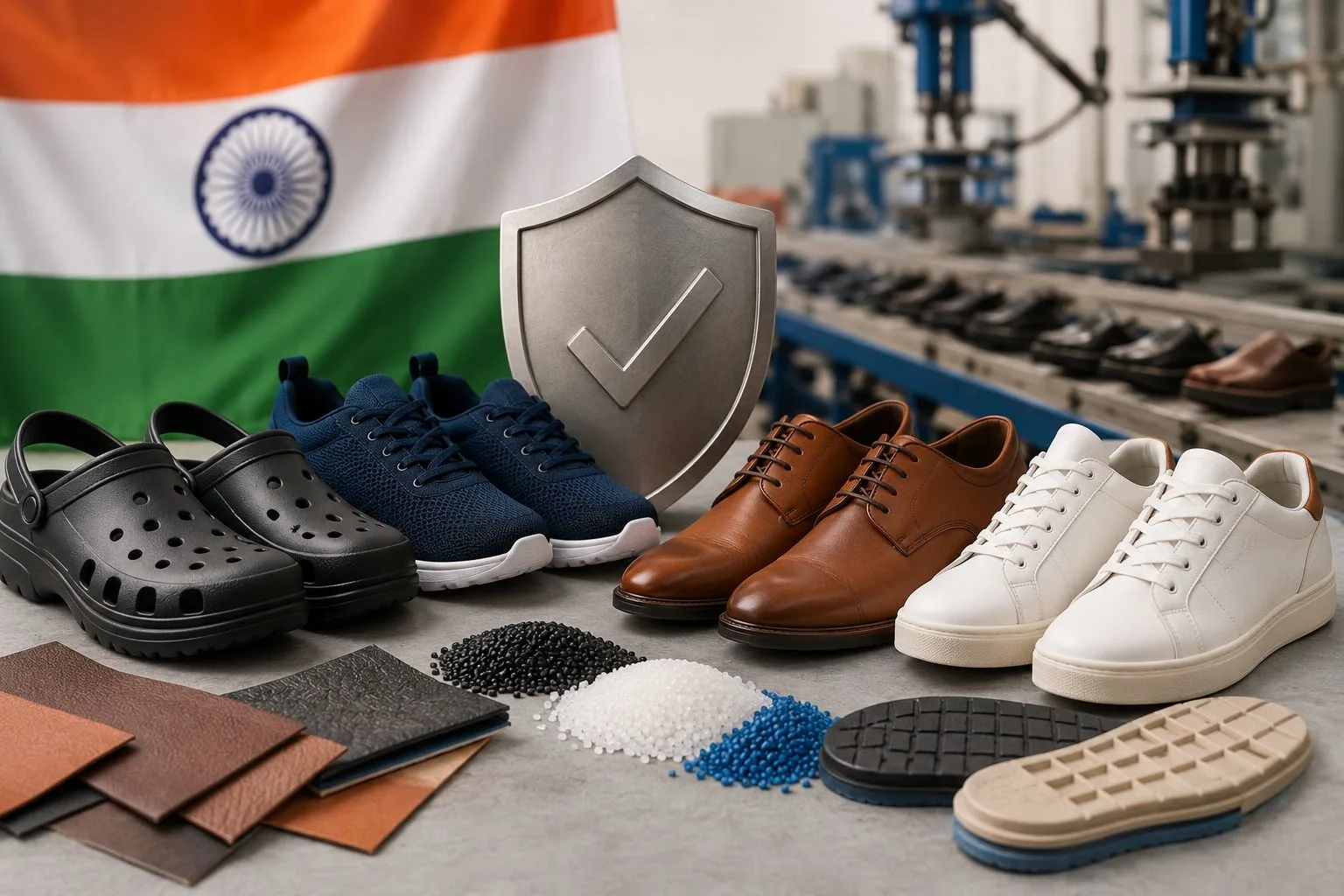
The Government of India has made BIS Certification mandatory for various categories of footwear through the Footwear Made from all Rubber and all Polymeric Material and its Components (Quality Control) Order, 2022. The objective is to improve product quality, ensure consumer safety, and eliminate substandard footwear from the Indian market.
Under this Quality Control Order (QCO), manufacturers must obtain a BIS license and use the ISI Mark on covered footwear products before they can be manufactured, imported, sold, or distributed in India. The Order came into force on 1 July 2023.
As a leading BIS compliance consultant, Kar Parivartan helps Indian and foreign manufacturers obtain BIS Certification efficiently and ensure uninterrupted market access in India.
What is the Footwear QCO 2022?
The Ministry of Commerce and Industry, DPIIT, issued the Footwear QCO 2022 under the Bureau of Indian Standards Act, 2016, making BIS certification mandatory for specified footwear products manufactured using rubber, polymeric materials, and their components.
Products covered under the Order must comply with the applicable Indian Standard and bear the ISI Mark under a BIS license granted under Scheme-I.
Who Must Obtain BIS Certification?
The following entities must comply:
Indian Manufacturers
Manufacturers producing footwear covered under the QCO for sale in India.
Foreign Manufacturers
Overseas manufacturers exporting covered footwear products to India.
Importers and Brand Owners
Companies importing footwear under their own brand name.
E-commerce Sellers
Online sellers dealing in regulated footwear products.
Exemptions Under the Notification
The QCO does not apply to:
✔ Products manufactured exclusively for export.
✔ Micro and Small Manufacturing Units are exempted under the Amendment Order, 2022.
Products Covered Under the QCO
The following footwear and footwear components require BIS Certification:
| Product | Applicable Standard |
| Industrial & Protective Rubber Knee and Ankle Boots | IS 5557:2004 |
| Rubber Gum Boots & Ankle Boots | IS 5557 (Part 2):2018 |
| Moulded Solid Rubber Soles & Heels | IS 5676:1995 |
| Rubber Microcellular Sheets for Soles & Heels | IS 6664:1992 |
| Solid PVC Soles & Heels | IS 6719:1972 |
| PVC Sandals | IS 6721:1972 |
| Rubber Hawai Chappal | IS 10702:1992 |
| Rubber Slippers | IS 11544:1986 |
| PVC Industrial Boots | IS 12254:1993 |
| Polyurethane Sole (Semi-Rigid) | IS 13893:1994 |
| Unlined Moulded Rubber Boots | IS 13995:1995 |
| Polyurethane Boots for Industrial Use | IS 16645:2018 |
| Footwear for Municipal Scavenging Work | IS 16994:2018 |
Implementation Date
The Footwear QCO became effective from:
📅 1 July 2023
From this date, covered products require BIS Certification before being sold in the Indian market.
BIS Certification Procedure for Footwear
Step 1: Product Applicability Assessment
Determine whether the product falls under the notified footwear category and identify the applicable Indian Standard.
Step 2: Documentation Preparation
Prepare:
- Factory Registration Certificate
- GST Certificate
- Manufacturing License
- Trademark Certificate (if applicable)
- Process Flow Chart
- Raw Material Details
- Machinery List
- Quality Control Documents
- Testing Equipment Details
Step 3: Product Testing
Samples are tested in BIS-recognized laboratories as per the applicable Indian Standard.
Testing verifies:
- Physical properties
- Material quality
- Durability
- Performance requirements
- Safety parameters
Step 4: BIS Application Submission
Application is filed through the BIS portal along with:
- Test reports
- Technical documents
- Factory information
- Manufacturing details
Step 5: Factory Inspection
BIS officials conduct an audit to verify:
- Production process
- Testing facilities
- Quality management system
- Manufacturing capability
Step 6: Grant of BIS License
Upon successful evaluation and compliance verification, BIS grants the license allowing the manufacturer to use the ISI Mark.
Timeline for BIS Certification
Indian Manufacturers
| Activity | Timeline |
| Documentation Preparation | 1–2 Weeks |
| Sample Testing | 2–4 Weeks |
| Application Review | 1–2 Weeks |
| Factory Inspection | 2–3 Weeks |
| License Grant | 1–2 Weeks |
Expected Timeline
⏳ 4–6 Weeks
Foreign Manufacturers (FMCS)
| Activity | Timeline |
| Documentation & AIR Appointment | 2–4 Weeks |
| Product Testing | 3–6 Weeks |
| BIS Audit Scheduling | 2–4 Weeks |
| Factory Audit | 1–2 Days |
| License Approval | 2–4 Weeks |
Expected Timeline
⏳ 10–16 Weeks
Consequences of Non-Compliance
Failure to comply with the QCO may result in:
❌ Product seizure
❌ Market withdrawal
❌ Import restrictions
❌ Financial penalties
❌ Legal action under the BIS Act, 2016
❌ Suspension of business operations for covered products
Why Manufacturers Should Apply Early
Many footwear manufacturers wait until the implementation date approaches, resulting in:
- Laboratory testing delays
- Application backlogs
- Audit scheduling issues
- Product launch disruptions
Applying early helps ensure smooth compliance and uninterrupted market access.
How Kar Parivartan Can Help
Kar Parivartan offers complete BIS certification support for footwear manufacturers:
✅ Product applicability review
✅ Standard identification
✅ Documentation preparation
✅ Laboratory testing coordination
✅ BIS application filing
✅ Audit preparation support
✅ Foreign Manufacturer Certification Scheme (FMCS)
✅ Post-license compliance management
With extensive experience in BIS regulations, our team helps manufacturers achieve certification quickly and efficiently.
Need BIS Certification for Footwear?
Kar Parivartan LLP – Your Trusted BIS Compliance Partner
FAQs
Is BIS Certification mandatory for footwear products?
Yes. Products covered under the Footwear QCO 2022 must obtain BIS Certification before being sold in India.
Which BIS scheme applies to footwear products?
Certification is granted under BIS Scheme-I (ISI Mark Scheme).
Are imported footwear products covered?
Yes. Foreign manufacturers exporting covered products to India must obtain BIS Certification.
Are exports covered under this QCO?
No. Products manufactured exclusively for export are exempt.
Are MSMEs exempt?
Micro and Small Manufacturing Units are exempt under the Amendment Order, 2022.
How long does BIS Certification take?
Typically:
- Indian Manufacturers: 6–10 weeks
- Foreign Manufacturers: 10–16 weeks
Can one BIS license cover multiple footwear products?
Separate product categories and applicable standards may require separate evaluations depending on the scope of the license.
What is the validity of a BIS license?
The BIS license remains valid subject to compliance with renewal requirements and surveillance by BIS.
What is the validity of a BIS license?
The BIS license remains valid subject to compliance with renewal requirements and surveillance by BIS.


