
Delhi is home to one of the largest concentrations of manufacturers, importers, traders, and brand owners in the country — which also means it’s home to one of the highest volumes of EPR registrations in India. If your business deals in plastic packaging, e-waste, batteries, tyres, used oil, end-of-life vehicles, or you’re a developer managing construction & demolition waste, you’ve likely already been told you need EPR registration. What most people aren’t told clearly is how the process actually works.
CPCB has published a Standard Operating Procedure (SOP) for each of these categories, and while the paperwork language can feel dense, the actual process follows a fairly consistent logic once you break it down. That’s what we’re doing in this blog — walking through the registration process the way it’s actually laid out in the SOPs, in plain language, the way we walk our own clients through it at Kar Parivartan.
First, a Quick Recap: What Falls Under EPR?
EPR in India currently spans seven verticals, each with its own dedicated CPCB portal and SOP:
- Plastic Packaging – Plastic Waste Management Rules (portal: eprplastic.cpcb.gov.in)
- E-Waste – E-Waste (Management) Rules (portal: eprewaste.cpcb.gov.in)
- Battery Waste – Battery Waste Management Rules (portal: eprbattery.cpcb.gov.in)
- End-of-Life Tyres – Hazardous & Other Wastes Rules (portal: eprtyres.cpcb.gov.in)
- Used Oil – Hazardous & Other Wastes Rules
- End-of-Life Vehicles (ELV) – ELV Rules, 2025
- Construction & Demolition (C&D) Waste – C&D Waste Management Rules, 2025
Each portal has its own SOP document, but they’re all built around the same broad skeleton: sign-up, application form, document upload, review by the authority, certificate issuance, target fulfilment, and annual returns. Let’s go through each stage.
The General Process, Stage by Stage
Stage 1: Sign-Up and Account Creation
Every portal starts the same way — you create a login using the authorized signatory’s email ID and mobile number, verify it via OTP, and set up your account before you can even open the application form.
Stage 2: Selecting Applicant Type
Next, you select what you’re registering as — Producer, Importer, Brand Owner, Recycler, Refurbisher, or Retreader, depending on the vertical. Several SOPs are explicit that if your business falls under more than one category — say, a manufacturer that’s also a recycler — you need to register separately for each one. You can’t cover both under a single application.
Stage 3: Filling the Application Form
This is usually broken into parts:
- General/entity details — company name, business address (must match your GST registration), PAN, CIN, IEC (for importers), and authorized person details
- Production/consumption details — quantities produced, imported, or sold, usually for the last two financial years
- Facility details (where applicable) — for producers with a manufacturing unit, this includes process flow diagrams, geo-tagged facility photos, machinery details, and consent details under the Air/Water Act
- Procurement and sales data — details of raw material sourced from registered vs. unregistered entities, and products sold onward
The portal typically auto-calculates your EPR target for the year based on the numbers you’ve entered — so accuracy at this stage directly decides your obligation going forward.
Stage 4: Document Upload
Documents vary slightly by vertical, but the common set includes:
- PAN, GST, and CIN of the company
- Aadhaar/PAN of the authorized signatory
- IEC (for importers)
- Consent to Operate, if you have a manufacturing facility
- Signed covering letter
- Category-specific technical documents (process flow diagrams for plastic/e-waste producers, recycling capacity details for recyclers, dismantling/depollution facility details for RVSFs, and so on)
Stage 5: Fee Payment
Application fees are usually tiered by scale — for plastic, for instance, they range based on annual waste generation volume, with three slabs depending on tonnage. Fees are paid online through the portal’s payment gateway at the time of submission.
Stage 6: Scrutiny and Review by CPCB
Once submitted, the application goes to a designated officer or division within CPCB (or, for state-routed applications, the relevant SPCB). They check the application and documents, and either forward it for approval or send it back with queries. Review timelines differ by vertical — e-waste applications, for example, are meant to be reviewed within 25 working days, with the applicant expected to respond to any query within 7 working days. Plastic packaging applications generally follow a similar review window.
Stage 7: Certificate Issuance
Once approved, the digitally signed EPR Registration Certificate is issued through the portal. This certificate typically states your registration number, applicable EPR category, and the year’s target.
Stage 8: Meeting Annual Targets
This is where the real work begins. Depending on the vertical, you meet your targets by:
- Buying EPR certificates from registered recyclers/processors (plastic, e-waste, battery, tyre etc.)
- Working with Registered Vehicle Scrapping Facilities, who issue certificates based on recovered steel weight (ELV)
- Engaging authorized re-refiners for used oil
- Using recycled material in new construction and procuring certificates from registered C&D processors (for large projects)
Stage 9: Annual Returns and Renewals
Nearly every vertical requires annual returns — commonly due by 30th June for the previous financial year — reporting what was sold/generated against what was actually recycled or processed. Tyre registrations additionally require quarterly returns. Missing this filing is one of the most common compliance failures, since it directly affects next year’s target calculation and can trigger environmental compensation for shortfalls.
A Few Vertical-Specific Things Worth Knowing
Plastic packaging applications are split into Parts A through D, with built-in cross-checks — for instance, the pre- and post-consumer waste quantities you report must reconcile with your procurement and sales figures, or the portal flags a discrepancy before you can proceed. EPR Registration for Plastic Waste Management.
E-waste and battery registrations are structured similarly to each other, with a defined review timeline and a fixed validity period after which renewal becomes mandatory — not something you can let lapse quietly. EPR Registration For Battery Waste Management.
Waste tyres distinguish between multiple producer categories (domestic manufacturer, importer, and so on), and recyclers/retreaders must file monthly or quarterly data in addition to annual returns. EPR Registration for Tyre waste.
ELVs work differently from the others — producers don’t directly manage the physical scrapping. Instead, RVSFs process the vehicle, calculate recovered steel, and issue certificates that producers use to offset their targets. If certificates aren’t available, the producer becomes directly responsible for vehicle collection.
C&D waste obligations sit with the developer/project owner rather than a manufacturer, and the registration is tied to the project (built-up area of 20,000 sq. m. or more) rather than to an ongoing business entity — meaning a single company may need separate registrations for separate qualifying projects.
Where Businesses in Delhi Usually Get Stuck
Multiple categories, one business. Companies unknowingly falling under two or more verticals — say, plastic packaging and e-waste — and managing only one.
Data mismatches. Numbers declared in the application not lining up with GST filings or actual production/sales records, which is one of the most common reasons for portal-flagged discrepancies or CPCB queries.
No plan for targets. Getting the certificate and then having no real arrangement with a PRO, recycler, or processor in place until the target deadline is close.
Missed renewals. E-waste and tyre certificates especially — since these have fixed validity periods — lapsing because no one’s tracking the renewal window internally.
Developers unaware they’re covered. With C&D EPR obligations only effective from April 2026, many developers in Delhi’s active construction market don’t yet realize their project falls under a producer obligation.
Why Work With an EPR Consultant in Delhi for This
Given how many stages are involved, and how differently each vertical’s SOP is structured, most businesses find it more efficient to have a consultant manage the full lifecycle rather than piecing it together internally. A good consultant will:
- Correctly classify your business across all applicable verticals
- Prepare documentation that matches the specific Part-wise structure each portal expects
- Track the application through CPCB’s review stage and respond to queries within the stipulated window
- Set up a realistic plan for meeting annual targets through PROs, recyclers, re-refiners, RVSFs, or C&D processors
- Keep your renewal and annual return calendar on track, vertical by vertical
How Karparivartan Helps
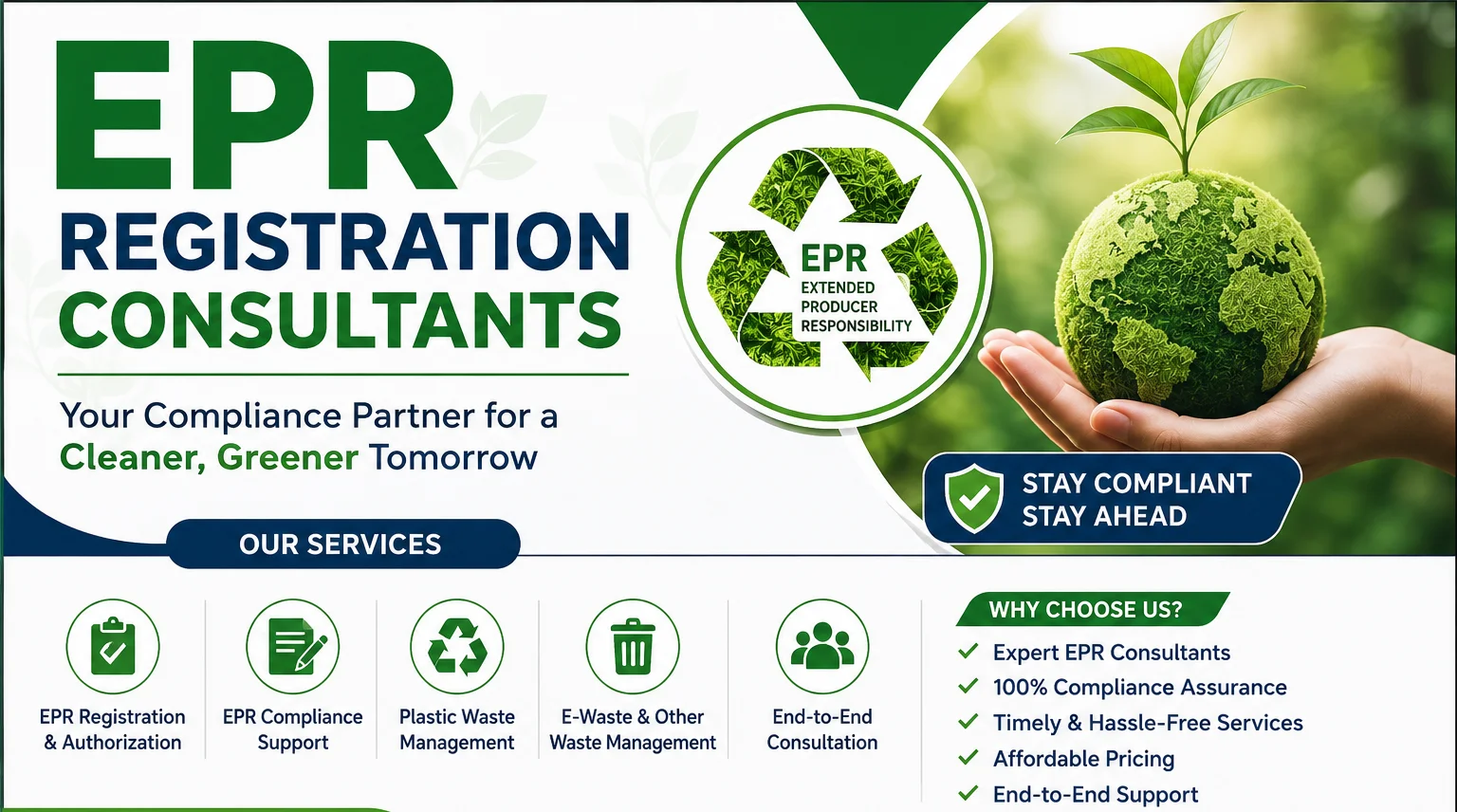
At Karparivartan, we manage the entire EPR registration process for businesses in Delhi — from figuring out where you stand, to filing the application exactly as each SOP requires, to keeping your certificate active year after year.
Our support covers:
- Applicability assessment across all seven EPR verticals
- Documentation and portal-specific application filing
- Coordination during CPCB’s review and query stage
- Target planning with PROs, recyclers, re-refiners, RVSFs, and C&D processors
- Annual/quarterly return filing and renewal tracking, so nothing lapses unnoticed
In Short
The EPR registration process isn’t complicated because any single step is hard — it’s complicated because each vertical’s SOP has its own structure, timelines, and validity rules, and one missed detail in any one of them can stall the whole thing.
If you’re a business in Delhi trying to get this right — whether it’s plastic, e-waste, battery, tyre, used oil, ELV, or C&D waste — Karparivartan can walk you through the entire process, start to finish, exactly as the CPCB SOPs require.


