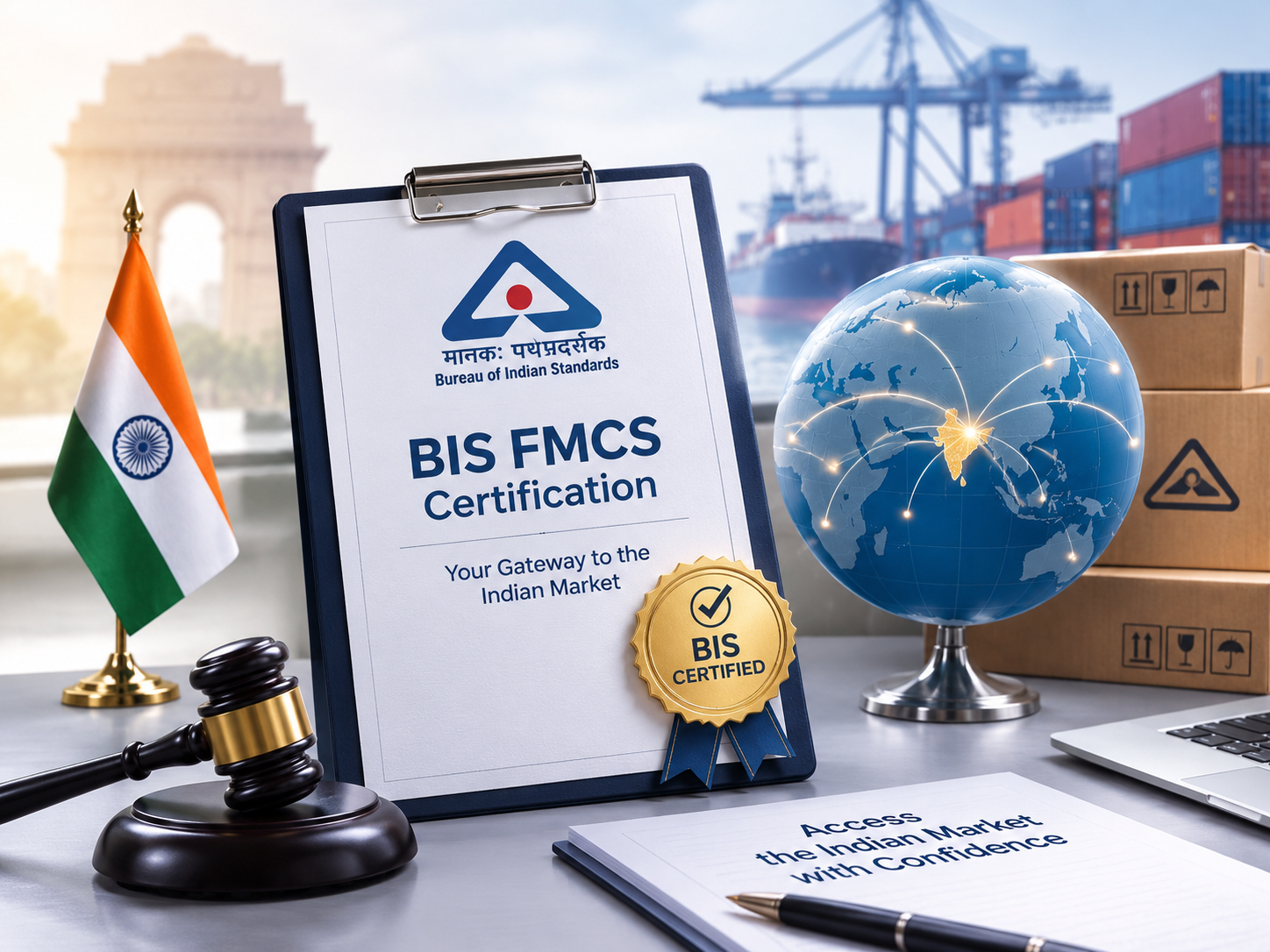
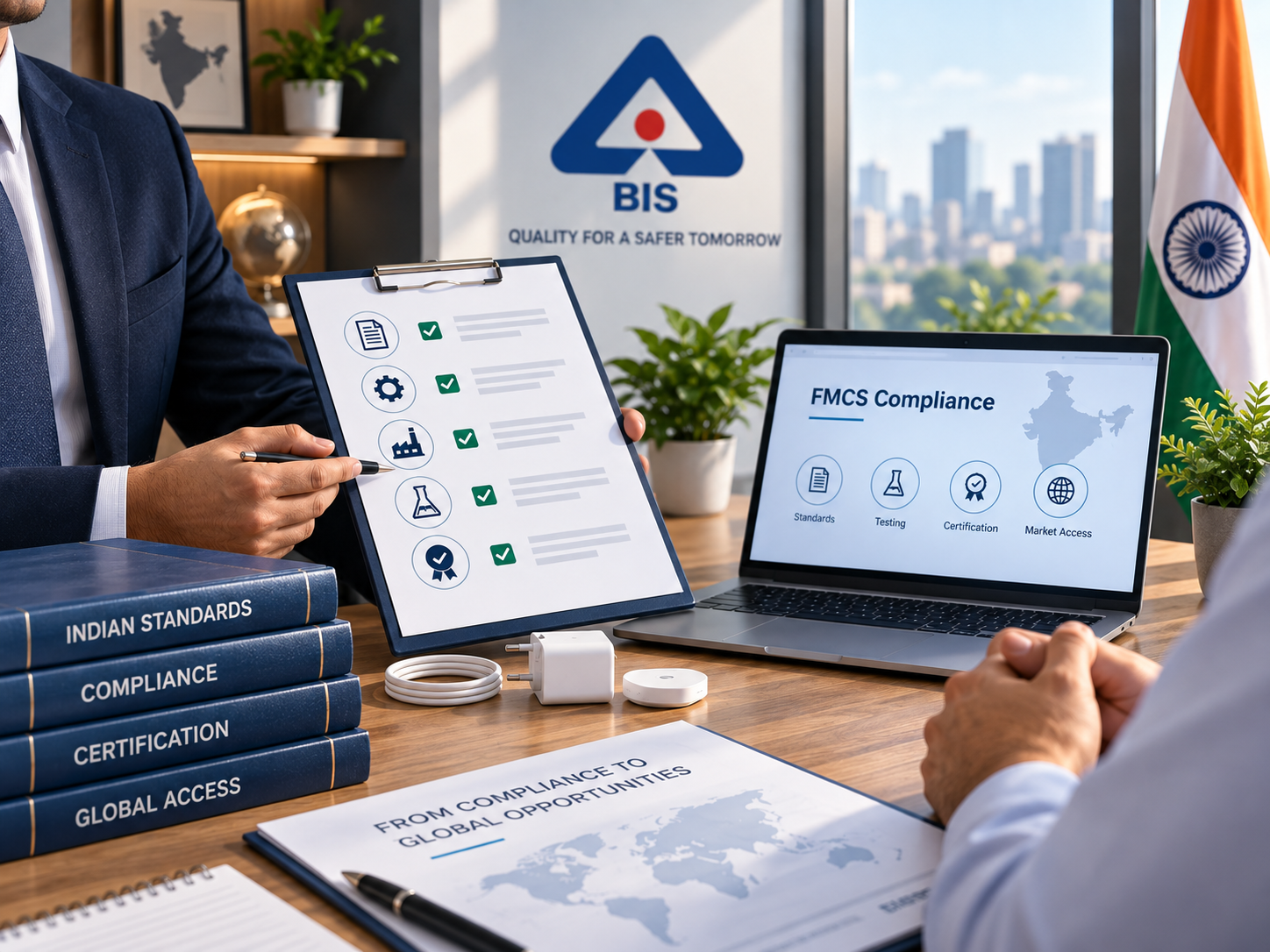
BIS FMCS Registration is a certification process under the Foreign Manufacturers Certification Scheme (FMCS) that allows overseas manufacturers to obtain a BIS FMCS Certificate and use the BIS Standard Mark (ISI Mark) on products exported to India. The certification involves factory inspection, product testing, compliance verification, and licence approval by the Bureau of Indian Standards (BIS).
“The Indian market offers huge opportunities for manufacturers around the world to scale up. However, products cannot be imported, marketed, or distributed in India until they have met the regulations of the Bureau of Indian Standards (BIS). This is facilitated by the Foreign Manufacturers Certification Scheme (FMCS) in the case of foreign manufacturers. It is a certification scheme regulated by BIS. BIS FMCS Certification enables overseas manufacturers to get a BIS licence and affix the Standard Mark (popularly called the ISI Mark) on items that conform to relevant Indian Standards. The certification is a proof that a product conforms to the quality, safety and performance norms established by India.
The Foreign Manufacturers Certification Scheme (FMCS) was developed so as to ensure that the quality of the imported items entering Indian market is at par with the quality of the products manufactured within India. Under this plan, eligible foreign manufacturers can get a BIS FMCS Certificate following successful review, factory inspection, product testing and compliance verification. Presently, a large number of products included under Quality Control Orders (QCOs) are essential to have BIS Certification for Foreign Manufacturers before import into India. Importers that do not receive the necessary certification may encounter difficulties in customs clearance, regulatory penalties, product seizures, or market entry limitations.
The BIS Act, 2016 and the Bureau of Indian Standards (Conformity Assessment) Regulations govern the FMCS framework and provide the legal basis for product certification, surveillance, enforcement and consumer protection in India. If you are a manufacturer of electrical equipment, chemicals, steel goods, cement, automotive components, household appliances or industrial products, acquiring a BIS Certificate for Foreign Manufacturer is typically an important step towards entering the Indian market.
BIS FMCS Registration India is the choice of foreign manufacturers who want to build their business in India long term since it provides:
With India's continuous focus on enhancing the country's quality infrastructure with new Quality Control Orders and statutory certification standards, the need for a BIS FMCS License has become crucial for worldwide firms.
The FMCS Scheme (Foreign Manufacturers Certification Scheme) is a certification scheme maintained by the Bureau of Indian Standards that permits overseas manufacturing facilities to receive a BIS license for products to be marketed in India. A foreign manufacturer can immediately apply to BIS under FMCS Scheme and demonstrate compliance to the applicable Indian Standard (IS).
BIS allows the use of ISI Mark on the authorized products after satisfactory completion of BIS certification process. The domestic manufacturers apply through the BIS certification schemes in India while the international manufacturers are assessed by the specialist international Manufacturers Certification Department (FMCD) of BIS
Many firms consider that the BIS certification standards are the same for domestic and foreign applicants. However, the applications of FMCS include distinct responsibilities even though the basic principles are similar.
Thus, getting a BIS FMCS Certificate needs meticulous planning, technical preparation, and collaboration between the manufacturer, Authorized Indian Representative, testing labs and BIS officials.
India has created a range of regulatory measures to guarantee imported products do not threaten consumer safety, the environment or product quality.There are several items that have required Quality Control Orders issued by ministries and regulatory bodies. Such products cannot be legally imported without the requisite BIS Licence under FMCS.
Adhering to statutory Indian standards is non-negotiable. Foreign manufacturers must obtain a BIS Certificate to legally export and sell notify-list products within India.
Guarantees that products entering the Indian market comply with high standards of public health and ecological safety, minimizing potential hazards.
Establishes a rigorous quality monitoring mechanism directly at manufacturing sites overseas, maintaining consistent production standards.
Enhances consumer trust and credibility. The BIS Standard Mark on FMCS products signals high premium value and genuine verification.
Smoothens cross-border logistics. Indian Customs authorities strictly audit shipments for BIS conformance, and FMCS prevents costly port delays.
Failing to acquire proper registration initiates massive business operational hazards and official legal actions, including:
As the Government of India continues to implement more quality control measures across sectors, the list is increasing.
FMCS certification is often required for foreign manufacturers doing business in the following sectors:
As the Government of India continues to implement more quality control measures across sectors, the list is increasing.
Getting a BIS FMCS Certificate means much more than regulatory compliance. It delivers strategic business benefits that contribute to long-term market growth.
India is one of the largest and fastest developing marketplaces in the world; FMCS certification allows legal entry into regulated industries.
The BIS Standard Mark shows conformity to Indian standard quality norms.
Certified manufacturers generally have a better market position than non-certified ones.
The certification process enhances devotion to product quality and regulatory compliance.
Many distributors, importers, and institutional buyers desire BIS certification.
FMCS accreditation helps reduce the chances of import interruptions, regulatory actions and non-compliance.
With the accreditation, manufacturers can enhance their product portfolios and develop their position in the Indian market.
Government departments, public sector undertakings and large industrial clients normally insist on BIS marked products.
Before seeking BIS Certification for Foreign Manufacturers in India, candidates must satisfy certain eligibility criteria as prescribed by BIS. These standards serve to ensure that the producers have the infrastructure, technical capacity and quality control mechanisms to produce compliant products consistently.
Eligibility to meet these requirements is the first step to getting a successful FMCS BIS License and permission to use the BIS Standard Mark in India.
One of the most critical steps to get CRS Licence under Compulsory Registration Scheme (CRS) is complete and accurate documentation. Incomplete or incorrect documentation can result in delays, additional queries from the Bureau of Indian Standards (BIS) or even rejection of the application.
The specific documentation may vary as per the product category and manufacturing setup however Indian firms are normally needed to present the following documents while seeking for BIS Registration.
A well-prepared application considerably improves the odds of a smooth BIS Licence Grant Process.
The Authorized Indian Representative (AIR) plays a vital role in the Foreign Manufacturers Certification Scheme (FMCS). Since BIS requires a responsible organization within India to manage regulatory matters, every foreign producer must designate an AIR before seeking certification.
An Authorized Indian Representative for BIS FMCS is a person or an entity based in India, who functions as an agent of the foreign manufacturer for matters connected to certification. The AIR is the official communication line between BIS and the overseas manufacturer.
The AIR requirement exists to ensure that:
Foreign producers cannot process BIS FMCS Registration India without appointing an AIR.
A structured overview of core responsibilities managed locally
The right AIR is very crucial as typically certification continuance depends on competent local representation.
Many overseas manufacturers look for the correct BIS FMCS Application Process before entering the Indian market. The certification process consists of several steps, such as application assessment, factory inspection, testing and licence approval.
Before submitting an application, the maker should verify: Applicable Indian Standard (I.S.), if certification is mandatory, related Quality Control Orders, scope and coverage of product. This first review prevents unnecessary delays later in the certification process.
The manufacturer hires an AIR to represent them with BIS. Key actions: AIR selection, signing of the authorization papers, assignment of compliance responsibility.
The applicant gathers all technical, legal, manufacturing and quality-control papers. Documents are analyzed for: completeness, consistency of technology, conformance to standards, production capacity.
The application is filed by the manufacturer through the prescribed method of BIS. It normally consists of: applicant information, factory details, product details, testing information, AIR data, supporting evidence.
The Foreign Manufacturers Certification Department (FMCD) reviews: completeness of the application, eligible products, technical documents, records of quality system.
Once BIS accepts the initial application, a factory visit is scheduled. The audit team checks: the manufacturing unit, testing facilities, quality assurance plan, manufacturing process.
BIS provides the license after satisfactory review. The maker is allowed to use: BIS Standard Mark, ISI Mark (if applicable), License No.
Testing is one of the most technically hard parts of getting a BIS FMCS Certificate. Even if a product is already certified under foreign standards, BIS demands conformity with the relevant Indian Standard.
Testing is an objective demonstration of product conformity to the requirements for certification.
One of the most typical queries posed by overseas manufacturers is ‘What is the BIS FMCS Cost?’ The cost of getting a BIS FMCS Certificate or BIS FMCS License is based on the product category, the relevant Indian Standard, the location of the factory, the testing requirements, and the complexity of the certification process. Unlike many certification systems that rely mainly on application fees, FMCS includes a range of costs — factory inspection costs, product testing costs, licensing fees and compliance-related costs.
The FMCS Certification Timeline is affected by a range of technical and administrative factors. Some simple programs may move rapidly, while others may take more time because of the complexity of testing, documentation concerns or audit observations.
Actual timelines vary significantly depending on product category and certification readiness.
Issuance of a BIS FMCS Licence is not a one-off transaction. Manufacturers need to be compliant throughout the whole certification lifecycle.
The length of validity of an FMCS licence is set out in the relevant BIS regulations and certification requirements. Manufacturers should be aware of the expiry dates of licenses and start the renewal process before expiry.
Generally, the BIS FMCS Renewal Process consists of:
While many manufacturers achieve certification successfully, other applications are delayed, suspended or rejected because of concerns that could have been avoided. Knowing frequent reasons for rejection can help enhance your odds of approval.
Overseas manufacturers may find BIS Certification more challenging than many international certification schemes. There are a number of practical issues that arise along the certification route.
FMCS certification entails various regulatory, technical and operational criteria, hence many manufacturers choose to collaborate with an experienced BIS FMCS Consultant. FMCS BIS consultants are your strategic compliance partner across the whole certification lifecycle.
Getting a BIS FMCS Certificate is an extensive process and not just about submitting an application. Certification is only achieved successfully when there is proper planning, technical understanding, correctness of documentation, audit preparedness and continuing compliance management. At Kar Parivartan we support foreign manufacturers in all the steps of the FMCS certification procedure.
Evaluating your foreign manufacturing unit against Indian standards and confirming certification scope.
Preparation, review, and compilation of all necessary legal and technical dossiers for a seamless submission.
Providing and coordinating Authorized Indian Representative support as mandatorily required by BIS.
Preparing your plant and team for strict physical factory audits and tests conducted by Indian auditors.
Facilitating sample testing in designated Indian labs with precise protocols and compliance mapping.
Ensuring ongoing compliance, documentation reviews, and seamless management after licence issuance.
Our services extend beyond licence approval and include:
From obtaining your first BIS FMCS License to adding to a current product portfolio, our team helps to streamline the certification process, while meeting all Indian regulatory standards.
The BIS FMCS Certification is a standard process of grant of BIS license managed by the Bureau of Indian Standards.
Full form of FMCS is Foreign Manufacturers Certification Scheme, a certification scheme specifically created for manufacturers outside India who want to export their products to India.
Yes. If your product is covered under the mandatory product list of BIS then it is mandatory to obtain a BIS FMCS Certificate.
FMCS Scheme is open for any foreign manufacturer who is engaged in manufacturing outside India and producing items covered by the relevant Indian Standards.
BIS Certification requires a point of contact between FMCD and the manufacturer — an Authorized Indian Representative (AIR) is that point of contact.
No. BIS dictates that every foreign manufacturer must appoint an AIR before they can start the certification procedure.
The BIS FMCS Timeline is based on the quality of documentation, timing of audits, testing needs and complexity of the product.
Typical documents are: firm registration certificates, factory paperwork, quality manuals, product specifications, testing records, calibration certificates and AIR authorisation documents.
Yes. Factory audit is also a compulsory step in the process of BIS certification.
The product testing is important to meet the required safety, quality and performance standards.
No. Compliance with international standards does not automatically mean compliance with the Indian Standards. BIS certification is mandatory to comply with the respective Indian Standard.
BIS Standard Mark or ISI Mark is a certification mark that can be used by a manufacturer on their products after getting the BIS license.
Costs include: Application fee, Factory audit charges, Product testing charges, Licence fee, Marking fee, Performance Bank Guarantee, and Consultant fees (if applicable).
In case a product does not pass testing, corrective actions are required before the final factory inspection.
The BIS license is generally valid for 1 year, after which the manufacturer can renew their license for up to 5 years.
Kar Parivartan is an environmental solutions and regulatory compliance company on a mission. We help businesses all over the world meet their statutory, sustainability, and circular economy obligations with confidence and clarity. We don't just document regulations — we enable enterprises with the knowledge to navigate complex regulatory landscapes, deploy compliant frameworks, and demonstrate tangible, ethical, and transparent impact.
Our compliance division supports foreign companies and international businesses to navigate complex national standards with broad expertise of Indian regulatory affairs.
Copyright © 2026 Kar Parivartan LLP . All Rights Reserved.
WhatsApp us