

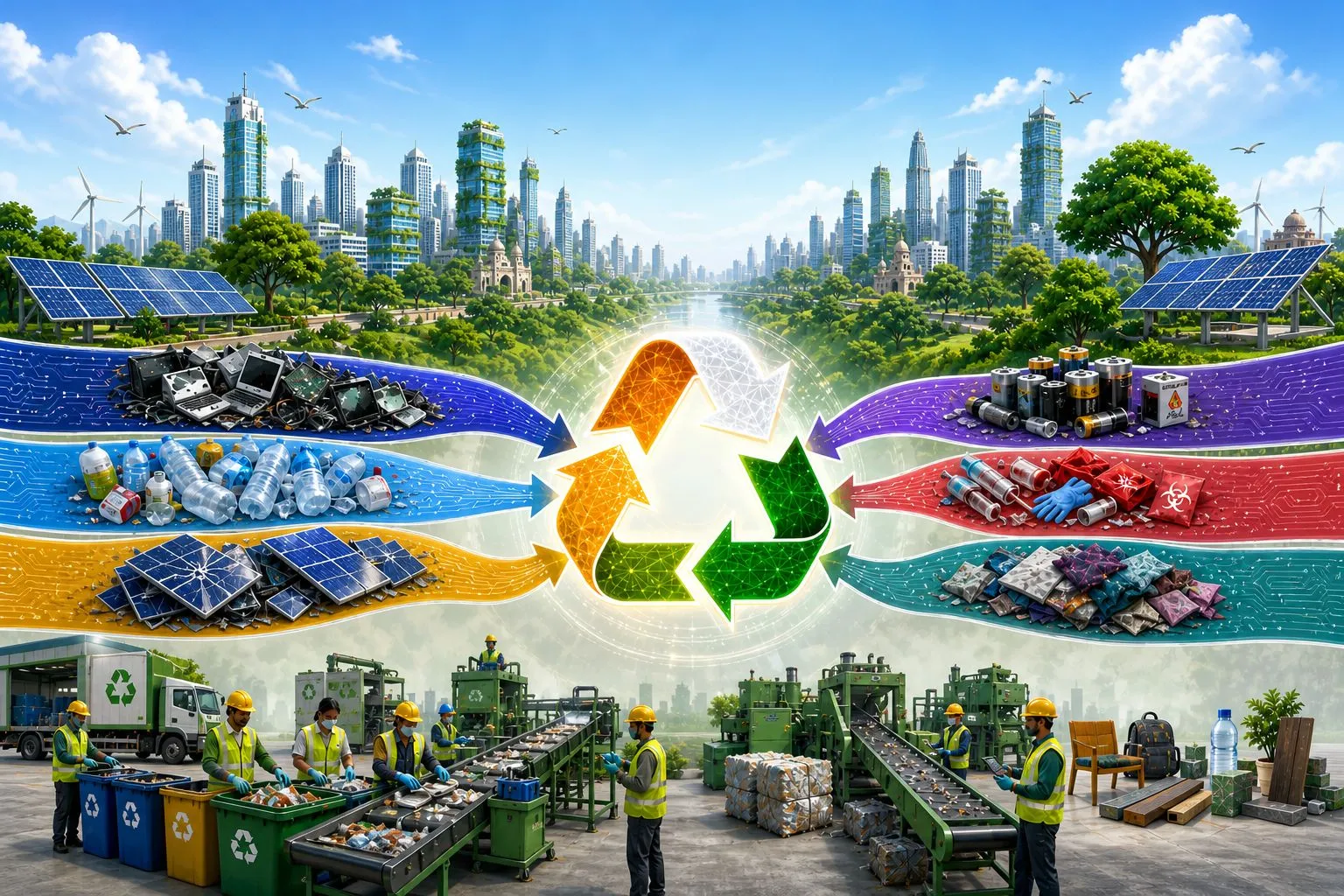
India’s transition toward a circular economy is accelerating, and Extended Producer Responsibility (EPR) is at the center of this transformation. Initially introduced for plastics and later expanded to e-waste, batteries, tyres, and used oil, EPR is now evolving to cover multiple new waste streams, reshaping how industries manage environmental responsibility.
With regulatory bodies like the Central Pollution Control Board (CPCB) driving compliance frameworks, India is moving toward a more integrated, accountable, and technology-driven waste management ecosystem.
What is EPR and Why Does It Matters?
Extended Producer Responsibility (EPR) is a policy approach where producers, importers, and brand owners (PIBOs) are made responsible for the entire lifecycle of their products, especially post-consumer waste.
This means:
- Collection of waste
- Recycling or disposal
- Meeting legally defined targets
- Maintaining traceability through digital portals
EPR shifts the burden from municipalities to producers, ensuring sustainable production and consumption patterns.
Existing EPR Waste Streams in India
Currently, EPR is implemented across several key sectors:
- Plastic Waste
- E-Waste
- Battery Waste
- Tyre Waste
- Used Oil Waste
- End-of-Life Vehicles (ELV)
Each category has specific targets, registration requirements, and recycling obligations, monitored via centralized portals.
Expansion to New Waste Streams
India is now expanding EPR to include additional categories, reflecting global sustainability trends:
1. Textile Waste
The textile sector is among the largest contributors to global solid waste, driven by fast fashion, short product lifecycles, and low recycling rates. In India, a significant portion of textile waste ends up in landfills or is informally processed, leading to microfiber pollution, dye contamination, and greenhouse gas emissions.
Upcoming EPR regulations are expected to:
- Mandate producer-led collection systems, including take-back programs, reverse logistics, and retailer responsibility
- Introduce quantified recycling and reuse targets, promoting fiber-to-fiber recycling technologies
- Restrict the destruction or landfilling of unsold inventory, encouraging donation, resale, or recycling
- Promote eco-design principles, such as use of mono-materials and recyclable fibers
This shift will push the textile industry toward circular fashion models, including reuse, repair, and recycling ecosystems.
2. Construction & Demolition (C&D) Waste
C&D waste is one of the fastest-growing waste streams due to rapid urbanization, infrastructure expansion, and redevelopment activities. It includes concrete, bricks, metals, wood, and debris, much of which remains underutilized despite high recycling potential.
Under EPR, the sector may see:
- Mandatory material recovery targets, ensuring reuse of concrete, bricks, and metals
- Increased adoption of recycled aggregates in construction projects, reducing demand for virgin materials
- Development of formal C&D waste processing facilities and recycling plants
- Integration with green building standards and sustainability certifications
This will significantly reduce resource extraction, energy consumption, and landfill burden, while promoting a closed-loop construction economy.
3. Ferrous & Non-Ferrous Metals
Metal waste, including iron, steel, aluminum, copper, and other alloys, is highly recyclable with substantial energy savings (e.g., recycling aluminum saves up to 95% energy compared to primary production). However, the sector is currently fragmented and heavily reliant on informal scrap systems.
EPR implementation can:
- Establish structured scrap collection and channelization systems
- Improve traceability and accountability across the recycling value chain
- Promote secondary metal markets, reducing dependence on mining
- Encourage standardization and quality control in recycled materials
This will strengthen India’s resource security while reducing carbon emissions from metal production.
4. Paper & Cardboard Waste
With the growth of e-commerce and packaging industries, paper and cardboard waste has increased significantly. Although recycling rates are relatively higher than plastics, inefficiencies remain in collection, segregation, and fiber recovery.
EPR expansion is expected to:
- Introduce mandatory recycling targets for producers and brand owners
- Strengthen collection systems, particularly for post-consumer packaging waste
- Improve fiber recovery efficiency, especially for multi-layered or contaminated paper products
- Encourage use of recycled content in packaging materials
This will enhance resource efficiency, reduce deforestation pressures, and support a sustainable packaging ecosystem.
5. Hazardous & Chemical Waste
Hazardous and chemical waste includes industrial residues, solvents, heavy metals, and toxic by-products that pose serious environmental and public health risks if not managed properly.
Under an expanded EPR framework:
- Producers will face strict compliance requirements for safe handling, treatment, and disposal
- Implementation of end-to-end tracking systems (digital manifests) to prevent illegal dumping
- Promotion of advanced treatment technologies, such as incineration, stabilization, and secure landfilling
- Increased accountability for life-cycle management of hazardous substances
This will ensure environmental protection, regulatory transparency, and risk minimization.
6. Solid Waste (Integrated Approach)
The inclusion of a broader solid waste category under EPR represents a holistic and integrated waste management strategy, aligning with national sustainability goals.
This approach may:
- Integrate municipal solid waste (MSW) streams into producer responsibility frameworks
- Enforce source segregation (wet, dry, hazardous fractions) to improve processing efficiency
- Set collection, recycling, and recovery targets across multiple waste categories
- Encourage collaboration between urban local bodies (ULBs), producers, and waste management agencies
- Promote waste-to-resource technologies, including composting, biomethanation, and energy recovery
An integrated EPR model will enable a transition from a linear “take-make-dispose” system to a circular resource economy, maximizing material recovery and minimizing environmental impact.
Regulatory Timeline & Enforcement
- 2025–2026: Notification of new waste stream rules (expected phase-wise rollout)
- 2026–2027: Gradual enforcement with compliance targets
- Beyond 2027: Full-scale implementation with penalties for non-compliance
This phased approach allows industries time to adapt infrastructure and systems.
Key Challenges for Industry
While expansion is necessary, it comes with operational challenges:
- Digital Portal Limitations: Delays in credit trading and verification
- Infrastructure Gaps: Lack of formal recycling networks in new sectors
- Cost Implications: Increased compliance costs for producers
- Data Transparency: Ensuring traceability and avoiding greenwashing
Opportunities in the Evolving Ecosystem
Despite challenges, EPR expansion opens significant opportunities:
- Growth of Recycling Industry
- Innovation in Sustainable Materials
- Green Job Creation
- Investment in Circular Technologies
- Improved Resource Efficiency
Businesses that adapt early can gain competitive and regulatory advantages.
Way Forward: Building a Circular Future
To ensure successful implementation, stakeholders must focus on:
- Strengthening digital compliance systems
- Encouraging public-private partnerships
- Promoting awareness and behavioral change
- Investing in advanced recycling technologies
India’s EPR evolution is not just a regulatory shift—it is a systemic transformation toward sustainability.
The expansion of EPR to new waste streams marks a critical step in India’s environmental journey. By holding producers accountable and promoting resource recovery, the country is aligning with global circular economy goals.
For businesses, this is not just compliance—it is an opportunity to lead in sustainability, innovation, and responsible growth.
FAQs
What is Extended Producer Responsibility (EPR)?
EPR is an environmental policy that makes producers, importers, and brand owners responsible for the collection, recycling, and disposal of post-consumer waste generated from their products.
Who regulates EPR compliance in India?
EPR is regulated by the Central Pollution Control Board (CPCB) along with State Pollution Control Boards (SPCBs), ensuring monitoring, registration, and compliance.
Which waste streams are currently covered under EPR in India?
Existing EPR categories include:
- Plastic Waste
- E-Waste
- Battery Waste
- Tyre Waste
- Used Oil Waste
- End-of-Life Vehicles (ELV)
What new waste streams are expected to be included under EPR?
Upcoming EPR expansion may include:
- Textile Waste
- Construction & Demolition (C&D) Waste
- Ferrous & Non-Ferrous Metals
- Paper & Cardboard
- Hazardous & Chemical Waste
When will the new EPR rules be implemented?
New waste stream regulations are expected to be notified between 2025–2026, with phased enforcement starting from 2026–2027.
Who needs to comply with EPR regulations?
EPR compliance is mandatory for:
- Producers
- Importers
- Brand Owners (PIBOs)
- Manufacturers (in certain categories)
What are EPR targets?
EPR targets are legally defined recycling or recovery obligations that companies must achieve annually, based on the quantity of products introduced into the market.
What happens if a company fails to meet EPR targets?
Non-compliance can lead to:
- Environmental compensation (penalties)
- Suspension or cancellation of registration
- Legal action under environmental laws
How can companies fulfill their EPR obligations?
Companies can comply by:
- Partnering with authorized recyclers
- Purchasing EPR credits (where applicable)
- Setting up collection and recycling systems
- Ensuring proper documentation and reporting
Why is EPR important for a circular economy?
EPR promotes a circular economy by:
- Reducing landfill waste
- Encouraging recycling and reuse
- Conserving natural resources
- Driving sustainable product design


