

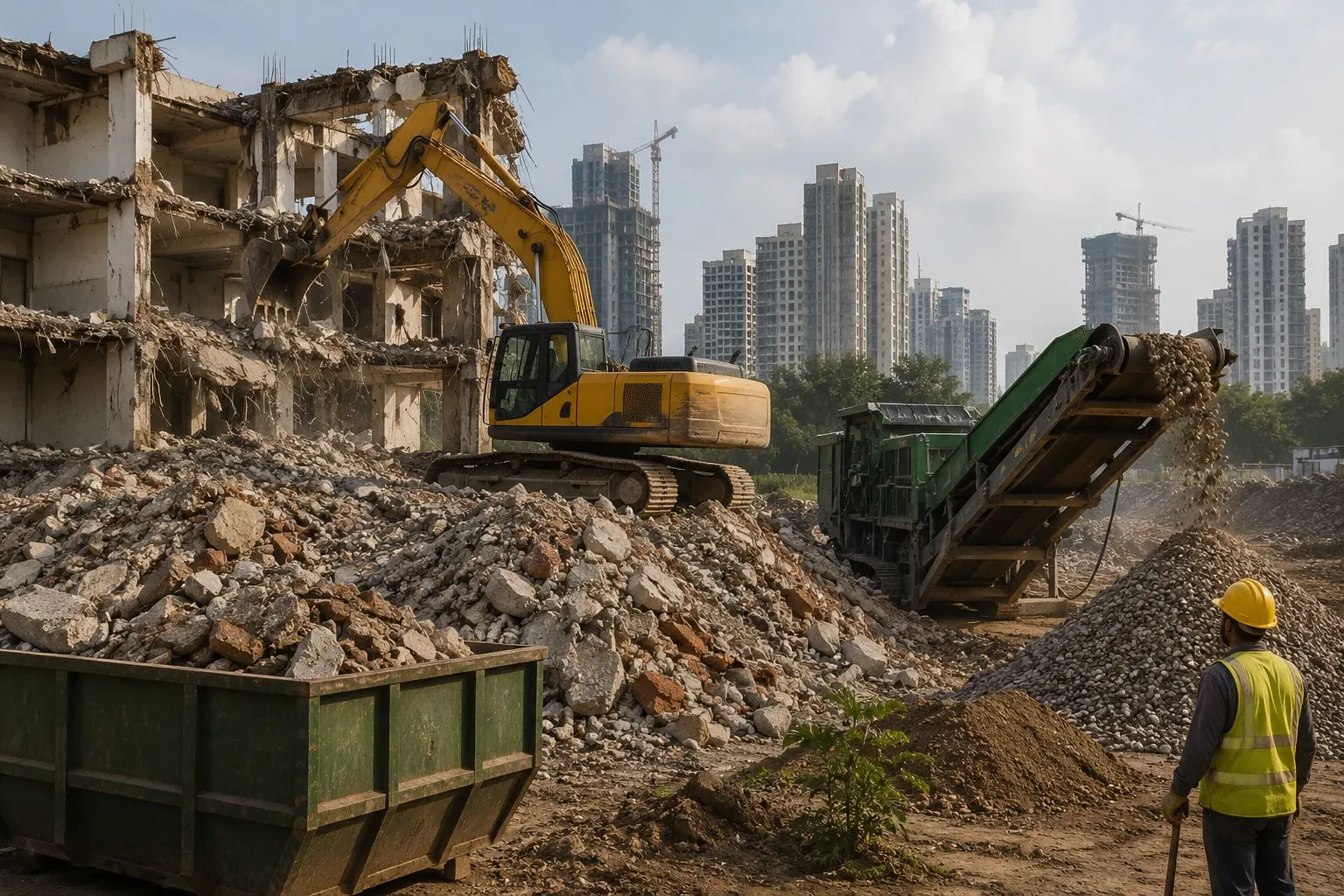
Construction and Demolition (C&D) waste has emerged as one of the major environmental challenges in rapidly urbanizing countries like India. Large-scale infrastructure development, urban redevelopment projects, road construction, and demolition activities generate enormous quantities of waste materials every year. Traditionally, most of this waste has been dumped in open spaces, landfills, roadsides, and water bodies, causing pollution and environmental degradation.
To address this issue, the Ministry of Environment, Forest and Climate Change notified the Construction and Demolition Waste Management Rules, 2016 for the first time in India. These rules aim to promote scientific waste management, recycling, and resource recovery. According to the Press Information Bureau, India generates nearly 530 million tonnes of construction and demolition waste annually.
What is Construction and Demolition Waste?
Construction and demolition waste refers to waste generated during:
- Construction of buildings and infrastructure
- Renovation and remodeling activities
- Repair work
- Demolition of structures
Major Components of C&D Waste
The waste mainly includes:
- Concrete
- Bricks and mortar
- Soil and sand
- Metals
- Wood
- Plastics
- Glass
- Tiles and ceramics
- Asphalt and road debris
Construction and Demolition Waste Management Rules, 2016
The Construction and Demolition Waste Management Rules, 2016 were introduced by the Ministry of Environment, Forest and Climate Change to ensure proper collection, segregation, processing, recycling, and disposal of C&D waste.
Key Objectives of the Rules
Resource Recovery
The rules focus on recovering valuable materials from waste for reuse and recycling.
Pollution Control
The rules aim to reduce air, water, and land pollution caused by illegal dumping.
Circular Economy Promotion
The rules encourage reuse of recycled materials in construction activities.
Duties of Waste Generators
Segregation of Waste
Every waste generator must:
- Segregate construction and demolition waste at source
- Deposit waste at designated collection centers
- Hand over waste to authorized recycling facilities
Prevention of Illegal Dumping
Waste generators must ensure:
- No littering on roads
- No blockage of drains
- No obstruction to traffic or public movement
Responsibilities of Large Waste Generators
Large generators producing:
- More than 20 tonnes per day, or
- More than 300 tonnes per month
must:
- Submit a waste management plan
- Obtain approval from local authorities
- Prepare an environmental management plan
Waste Stream Segregation
Large generators must separate waste into:
- Concrete
- Soil
- Steel
- Wood and plastics
- Bricks and mortar
Role of Local Authorities
Local authorities play a crucial role in implementation of the rules.
Major Responsibilities
Collection and Transportation
Local bodies must:
- Place collection containers
- Arrange transportation of waste
- Ensure regular removal of debris
Recycling Infrastructure
Cities must establish processing and recycling facilities within specified timelines:
- Million-plus cities: within 18 months
- Cities with population 0.5–1 million: within 2 years
- Smaller cities: within 3 years
Use of Recycled Products
Government departments and municipal bodies are encouraged to use 10–20% recycled materials in public construction projects.
Role of CPCB and SPCBs
The Central Pollution Control Board and State Pollution Control Boards are responsible for monitoring and implementation.
Functions of CPCB
- Preparation of operational guidelines
- Monitoring implementation of rules
- Supporting pollution control measures
- Issuing dust mitigation guidelines
Functions of SPCBs
- Grant authorization to recycling facilities
- Conduct inspections and compliance monitoring
- Submit annual implementation reports
Benefits of C&D Waste Recycling
Conservation of Natural Resources
Recycling reduces dependence on:
- Natural sand
- Stone aggregates
- Virgin construction materials
Reduction in Pollution
Proper recycling helps reduce:
- Dust pollution
- Land pollution
- Illegal dumping
- Greenhouse gas emissions
Reduction in Landfill Burden
Recycling diverts bulky waste away from already overloaded landfills.
Employment Generation
According to studies by the Council on Energy, Environment and Water, the recycling sector can create significant employment opportunities in waste collection, processing, manufacturing, and transportation.
Successful Example: Delhi C&D Recycling Plant
The Burari recycling plant in Delhi is one of India’s largest C&D waste recycling facilities.
Features of the Plant
- Processing capacity of nearly 2,000 tonnes per day
- Public-private partnership model
- Production of recycled products such as:
- Paver blocks
- Kerbstones
- Concrete bricks
- Manufactured sand
The plant has supplied recycled materials for several government infrastructure projects.
Challenges in C&D Waste Management
Despite progress, several challenges still exist.
Major Challenges
Illegal Dumping
Many generators dump waste in unauthorized locations to avoid costs.
Lack of Awareness
Public awareness regarding proper waste disposal remains limited.
Poor Recycling Infrastructure
Many cities still lack adequate recycling facilities.
Low Market Acceptance
Recycled products are often perceived as inferior quality materials.
Way Forward
1. Strengthening Implementation
Authorities must ensure:
- Strict enforcement of rules
- Monitoring of waste transportation
- Penalties for illegal dumping
2. Promoting Recycled Products
Government projects should increase mandatory use of recycled materials.
3. Awareness Campaigns
Public awareness and stakeholder training programs should be conducted regularly.
4. Technological Advancement
Advanced recycling technologies and digital monitoring systems can improve efficiency and transparency.
Construction and demolition waste should no longer be considered useless debris but a valuable resource for sustainable development. Effective implementation of the Construction and Demolition Waste Management Rules, 2016 can help India reduce pollution, conserve natural resources, promote recycling industries, and strengthen circular economy practices. Organizations can also benefit from working with an EPR consultant to navigate environmental compliance requirements, improve waste management practices, and align their operations with sustainability goals.
With coordinated efforts from government authorities, recycling industries, construction companies, and citizens, C&D waste management can become an important pillar of sustainable urban development in India.
FAQs
What is C&D waste?
C&D waste is debris generated from construction, renovation, and demolition activities.
What materials are included in C&D waste?
Concrete, bricks, soil, metals, wood, plastics, and glass.
Which ministry introduced the C&D Waste Rules in India?
The Ministry of Environment, Forest and Climate Change introduced the rules in 2016.
Why is C&D waste management important?
It helps reduce pollution, conserve resources, and promote recycling.
What is the role of the Central Pollution Control Board?
CPCB monitors implementation and provides operational guidelines.
Who are large waste generators?
Generators producing more than 20 tonnes per day or 300 tonnes per month.
How much C&D waste is generated in India annually?
India generates around 530 million tonnes of C&D waste annually.
What is the role of BIS in C&D waste management?
The Bureau of Indian Standards develops standards for recycled products.
How can public awareness improve waste management?
Awareness encourages proper segregation and reduces illegal dumping.
What is the future of C&D waste recycling in India?
It is expected to grow with increasing focus on sustainability and circular economy practices.


