
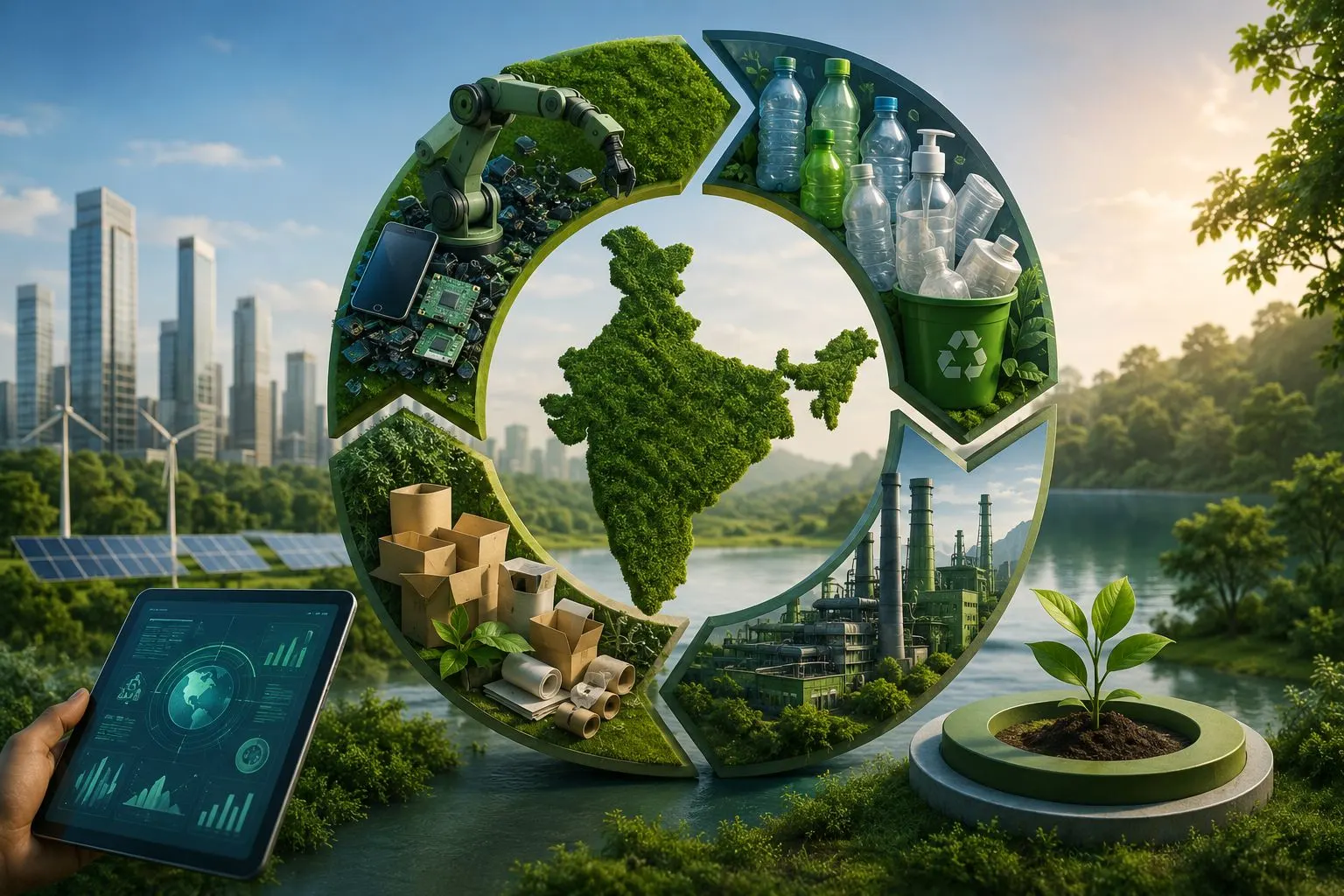
India is rapidly transitioning towards a Circular Economy through a comprehensive framework of waste management regulations, Extended Producer Responsibility (EPR) mechanisms, digital compliance platforms, and recycling incentives. Over the last four years, the Government has introduced sector-specific regulations covering plastic waste, e-waste, battery waste, waste tyres, used oil, end-of-life vehicles (ELVs), construction and demolition (C&D) waste, non-ferrous metal scrap, and most recently, solid waste management.
The regulatory approach has shifted from traditional waste disposal towards resource recovery, recycling, reuse, and circularity. Through market-based EPR frameworks, Producers, Importers, Brand Owners (PIBOs), and Original Equipment Manufacturers (OEMs) are now responsible for managing products throughout their lifecycle, including collection, recycling, and environmentally sound disposal after use.
Key Regulatory Developments
Expansion of EPR Frameworks
India’s Circular Economy framework now covers multiple priority waste streams through dedicated EPR regulations:
| Waste Stream | Regulatory Framework |
| Plastic Packaging Waste | Plastic Waste Management Rules 2016 |
| E-Waste | E-Waste (Management) Rules, 2022 |
| Battery Waste | Battery Waste Management Rules, 2022 |
| Waste Tyres | EPR for Waste Tyre, 2022 |
| Used Oil | EPR for Used Oil, 2023 |
| End-of-Life Vehicles | Environment Protection (ELV) Rules, 2025 |
| Non-Ferrous Metal Scrap | EPR Framework, 2025 |
| Construction & Demolition Waste | C&D Waste Management Rules, 2025 |
| Municipal Solid Waste | Solid Waste Management Rules, 2026 |
These regulations collectively create obligations for collection, recycling, material recovery, reuse, reporting, and traceability across the waste value chain.
Solid Waste Management Rules, 2026
The newly notified Solid Waste Management Rules, 2026 represent a major step toward strengthening municipal waste management and circular resource utilization.
The Rules place greater responsibility on:
- Urban Local Bodies (ULBs)
- Bulk Waste Generators (BWGs)
- Commercial Establishments
- Residential Complexes
- Institutions and Government Facilities
- Waste Processing Facilities
A significant focus has been placed on mandatory source segregation, decentralized waste processing, recycling, composting, and diversion of waste from landfills.
The Rules also introduce stronger compliance obligations for Bulk Waste Generators, encouraging scientific waste management and accountability at the source.
Digital Transformation of Environmental Compliance
Single Sign-On (SSO) Platform
To improve ease of doing business and reduce compliance burden, CPCB is moving towards a Single Sign-On (SSO) system that will allow stakeholders to access multiple waste management portals through a unified login.
The SSO framework is expected to integrate:
- Plastic Waste EPR Portal
- E-Waste EPR Portal
- Battery Waste EPR Portal
- Waste Tyre EPR Portal
- Used Oil EPR Portal
This integration will improve data consistency, reporting efficiency, and regulatory oversight.
EPR Trading Platform (ETP)
India is also strengthening its market-based EPR ecosystem through the development of an EPR Trading Platform (ETP).
The platform is expected to:
- Improve transparency in EPR certificate transactions.
- Enhance traceability of recycling activities.
- Facilitate efficient certificate procurement by obligated entities.
- Strengthen compliance monitoring by regulators.
- Encourage investment in recycling infrastructure.
The ETP is likely to become a critical component of India’s environmental compliance market by creating a transparent and structured mechanism for EPR certificate trading.
Status of EPR Implementation
As of March 2026, India’s EPR ecosystem has witnessed substantial growth.
| Waste Category | Registered Recyclers | Waste Recycled (Lakh MT) | EPR Certificates Generated (Lakh MT) |
| Plastic Waste | 2,986 | 196.97 | 196.97 |
| Battery Waste | 520 | 69.37 | 16.14 |
| Waste Tyres | 579 | 122.29 | 116.94 |
| E-Waste | 386 | 28.75 | 11.86 |
| Used Oil | 103 | 0.19 | 0.02 |
| Total | 4,574 | 417.57 | 341.93 |
Key Insights
- Plastic waste remains the most mature EPR sector.
- Tyre recycling has shown strong compliance and certificate generation.
- Battery recycling capacity is expanding rapidly due to growth in electric mobility.
- E-waste continues to offer significant opportunities for formalization and technological innovation.
- Used oil EPR remains in an early growth phase but is expected to expand significantly.
National Circular Economy Initiatives
Several national initiatives are supporting the transition toward a circular economy:
National Critical Mineral Mission (NCMM)
A ₹1,500 crore incentive scheme has been approved to promote recycling of critical minerals such as lithium, cobalt, and nickel from batteries and electronic waste, reducing dependence on imports and strengthening domestic resource security.
NITI Aayog Circular Economy Reports
In January 2026, NITI Aayog released sectoral reports on:
- End-of-Life Vehicles (ELVs)
- Waste Tyres
- E-Waste and Lithium-Ion Batteries
The reports emphasize infrastructure development, strengthening of EPR mechanisms, formalization of recycling sectors, and creation of secondary raw material markets.
Mission LiFE
Mission LiFE continues to promote citizen participation in sustainable consumption, waste segregation, reduction of single-use plastics, resource conservation, and responsible waste management practices.
Vehicle Scrappage Ecosystem
The Voluntary Vehicle Fleet Modernization Programme (V-VMP) and financial support under the SASCI Scheme are accelerating the development of Registered Vehicle Scrapping Facilities (RVSFs) and supporting scientific recycling of end-of-life vehicles.
Business Impact Assessment
The evolving regulatory landscape presents both compliance obligations and business opportunities.
Key Compliance Priorities
Businesses should:
- Register on applicable EPR and waste management portals.
- Assess obligations under relevant waste management rules.
- Track EPR targets and certificate requirements.
- Verify recycler registrations and credentials.
- Maintain accurate compliance records and reporting systems.
- Prepare for migration to integrated SSO-based compliance systems.
Emerging Opportunities
The circular economy transition is creating opportunities in:
- Recycling and resource recovery.
- EPR compliance services.
- Environmental auditing and consulting.
- Waste collection and logistics.
- Material traceability solutions.
- Digital compliance technologies.
- Green investments and circular business models.
Outlook
India’s waste management framework is evolving into an integrated Circular Economy ecosystem supported by EPR regulations, digital compliance platforms, recycling incentives and resource-efficiency policies. The introduction of the Solid Waste Management Rules, 2026, the upcoming EPR Trading Platform (ETP) and the Single Sign-On (SSO) compliance architecture signal a move toward greater transparency, accountability, and ease of compliance.
Organizations that proactively adapt to these developments will not only mitigate regulatory risks but also gain strategic advantages in the emerging circular economy marketplace.
Kar Parivartan Insights
India is moving beyond waste management towards a resource management economy. The convergence of EPR regulations, digital compliance platforms, recycling incentives, and Circular Economy policies will significantly reshape compliance expectations over the next few years.
Businesses should view these developments not merely as regulatory requirements but as strategic opportunities to strengthen sustainability performance, improve operational efficiency, and build long-term resilience.
Kar Parivartan continues to monitor policy developments, regulatory notifications, CPCB/SPCB updates, EPR frameworks, and Circular Economy initiatives to help organizations stay compliant, informed and future-ready.


