Understanding the Future of Plastic Packaging -What Businesses Need to Know ?
A practical regulatory guide for producers, importers, brand owners, packaging manufacturers and compliance teams.
- Introduction
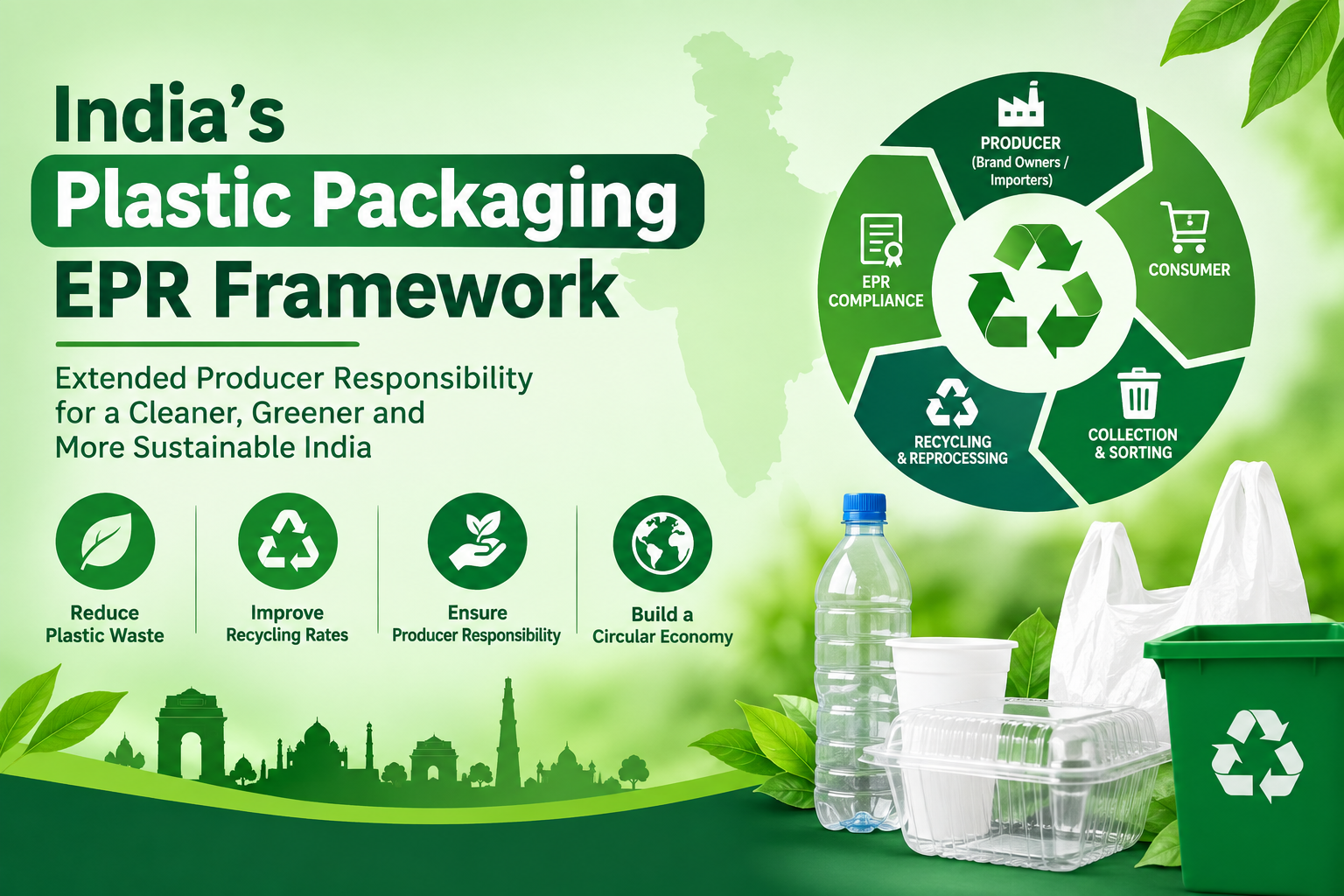
EPR Is No Longer Just a Compliance Exercise. Understanding India’s plastic packaging EPR framework is only one part of the story. The bigger transformation is happening behind the compliance numbers. As recycling, recycled-content, reuse and verification requirements become increasingly embedded into the regulatory framework, businesses are being pushed to rethink decisions that were traditionally handled by packaging, procurement, manufacturing and sustainability teams separately.
A packaging format can influence its EPR category. Its material composition can influence its recycling pathway. The availability of suitable recycled material can affect procurement. The information maintained by the business can determine whether its reported compliance can be substantiated. In other words, EPR is beginning to connect decisions that were previously treated as separate.
This is where EPR’s wider impact on India’s plastic packaging industry becomes visible.
The previous blog titled- “Understanding India’s Plastic Packaging EPR Framework and What Businesses Need to Know” focused on what businesses need to comply with. This blog focuses on how those requirements are changing the way businesses think about packaging itself.
- Data Is Becoming the Backbone of EPR
The most underestimated part of EPR compliance may not be recycling. It may be data.
A business needs to connect several datasets:
CPCB’s EPR system was designed to improve accountability, traceability and transparency and includes mechanisms for registration, certificate generation and transfer, transaction monitoring and annual returns. This is why spreadsheets maintained independently by procurement, production, finance and sustainability teams can become a compliance risk. The numbers need to be reconciled.
- The EPR Portal Is Becoming a Common Digital Compliance Infrastructure
India’s plastic EPR compliance system is also undergoing a digital transition. The earlier Plastic EPR Portal was discontinued from 28 June 2026. CPCB states that registered-user data was migrated to the newly developed Common EPR Portal, and users were asked to verify their migrated data. The Common EPR Portal is now accessible through CPCB’s EPR system(CEPR). This matters because the direction of travel is toward more integrated digital compliance. For businesses, that means EPR should increasingly be treated as an ongoing data-management process, rather than a portal login performed once a year. EPR Registration Certificate in India.
- Packaging Traceability Is Also Increasing
The 2025 amendment introduced an additional digital route for providing information required under the marking/labelling provisions.
From 1 July 2025, Producers, Importers and Brand Owners may provide specified information through:
- A barcode or QR code printed on the plastic packaging
- A product-information brochure
- A unique number issued under applicable law, where the relevant information requirements are fulfilled before issuance of that number
The entity must inform CPCB about the chosen mechanism, and CPCB is required to publish and periodically update the relevant list. This represents another step towards packaging-level information and traceability. The packaging itself is increasingly becoming a data carrier.
- What Happens When a Business Does Not Meet Its Obligations?
EPR compliance is not merely voluntary reporting. CPCB’s environmental-compensation framework provides for compensation based on the polluter-pays principle for specified violations, including shortfalls in EPR targets.
The CPCB’s revised environmental-compensation guidance provides, among other things, an EC rate of:
- ₹5,000 per tonne for the first instance
- ₹10,000 per tonne for the second instance
- ₹20,000 per tonne for the third instance
for specified EPR-target shortfalls. The framework also provides mechanisms for carrying forward unfulfilled obligations for a limited period and for treatment of environmental compensation under specified conditions. The regulatory lesson is straightforward: EPR compliance should be managed throughout the financial year-not reconstructed when the annual return is due.
- Year 2026: The Next Phase of EPR Is More Verifiable
The Plastic Waste Management (Amendment) Rules, 2026, notified through G.S.R. 237(E) on 31 March 2026, introduced several changes relevant to the next phase of the EPR framework.
Among the important changes are:
- Registered Environment Auditors : The 2026 amendment introduces the concept of a Registered Environment Auditor and allows specified verification functions under the PWM framework to be carried out through a Registered Environment Auditor in addition to a designated agency.
- Broader definition of Plastic Waste Processors : The amendment clarifies that Plastic Waste Processors include entities involved in recycling as well as entities engaged in end-of-life disposal.
- Recycled-content verification : The 2026 rules require CPCB to prescribe guidelines for the audit and verification of recycled-content claims.
- Recycled-plastic labelling : Recycled plastic packaging or commodities must conform to IS 14534:2023, carry the applicable marking indicating recycled plastic content and comply with applicable FSSAI marking and labelling requirements for food-contact applications.
Together, these changes point towards a more important principle: EPR compliance is moving from declaration towards verification.
- What Will EPR Change Across the Packaging Industry?
The impact will not be the same for every sector.
| S.No. | Industry/Business Type | Likely Strategic Impact |
| 1) | FMCG | Large packaging volumes make category classification, recycled content and certificate management critical |
| 2) | Food & Beverage | EPR requirements must be considered alongside food-contact safety requirements |
| 3) | E-commerce | Packaging material choices and large volumes of secondary packaging increase compliance complexity |
| 4) | Consumer Goods | Packaging redesign and material selection become increasingly important |
| 5) | Pharmaceuticals | EPR must be managed alongside sector-specific packaging and safety requirements |
| 6) | Packaging manufacturers | Demand for recyclable structures, recycled-content-compatible materials and documented material inputs is likely to become increasingly important |
| 7) | Importers | Imported packaging and packaging materials need to be assessed within the applicable EPR framework |
The common denominator is simple: Packaging decisions and compliance decisions are moving closer together.
- The New Packaging Decision-Making Model
The traditional packaging decision often looked like this:
But, The EPR-era model is broader:
That is the real transformation. EPR is not simply adding another compliance form. It is changing the variables that businesses must consider before packaging enters the market.
- A Practical EPR Readiness Checklist
Businesses can use the following six-step framework to prepare.
- Step 1 – Map the packaging
Identify every plastic packaging format used by the business.
- Step 2 – Classify it
Determine whether each format falls under Category I, II, III, IV or V.
- Step 3 – Quantify it
Build reliable category-wise packaging quantities using production, procurement, import and sales records as applicable.
- Step 4 – Calculate the obligation
Determine applicable EPR, recycling, recycled-content and reuse requirements.
- Step 5 – Build the evidence trail
Verify registered PWPs, certificates, processing records, invoices and supporting documentation.
- Step 6 – Reconcile before filing
Match packaging quantities, obligations, certificates and supporting records before submitting the annual return.
The objective is not merely to file an annual return. The objective is to ensure that the data behind the annual return is defensible.
- The Future: From EPR Compliance to Circular Packaging
The direction of India’s plastic-packaging framework suggests five major shifts.
1. From virgin material to circular material
Recycled-content obligations will increasingly push businesses to incorporate recycled resin into eligible applications.
2. From disposable to reusable
Specified rigid packaging faces increasing reuse obligations, making return and reuse models more relevant.
3. From generic packaging to category-specific packaging
Packaging classification directly affects the applicable compliance pathway.
4. From certificates to traceable transactions
CPCB’s verification mechanisms increasingly connect certificates with processing capacity, invoices and actual operations.
5. From annual compliance to continuous compliance
As portal systems, recycled-content verification and digital traceability become more sophisticated, businesses will need stronger internal data controls.
- What Businesses Should Do Now
The most effective response to EPR is not to wait for the next regulatory amendment. Businesses should start with their packaging itself.
Ask five questions:
1. What plastic packaging are we placing on the Indian market?
2. Which EPR category does each format fall into?
3. How much recycled content will we need over the next three financial years?
4. Can our current packaging designs support recycling, reuse and recycled-content requirements?
5. Can we prove every number reported on the EPR portal?
If the answer to the fifth question is no, the company does not yet have a fully mature EPR system.
- Conclusion: EPR Is Becoming a Business Decision
India’s plastic EPR framework has moved considerably beyond the idea of simply managing waste after consumption.
The regulatory architecture now connects:
Packaging → Materials → Recycling → Reuse → Recycled Content → Processors → Certificates → Data → Verification
The numbers tell the story.
- Recycling obligations are increasing.
- Recycled-content requirements are becoming more demanding.
- Reuse obligations are expanding.
- Digital traceability is increasing.
- Verification mechanisms are becoming more important.
- And the regulatory framework continues to evolve.
For businesses, the strategic implication is clear:> The future of plastic packaging compliance will be designed before the package reaches the market.
Companies that treat EPR as a year-end filing exercise may increasingly find themselves reacting to compliance requirements.
Companies that integrate EPR into packaging design, procurement, supplier management, recycling strategy and data systems will be better positioned to manage the transition towards a more circular packaging economy.
- How Kar Parivartan LLP Can Support Your EPR Journey
For businesses navigating India’s evolving plastic EPR framework, compliance often requires more than portal registration.
Kar Parivartan LLP can support businesses with areas such as:
- EPR registration and category classification
- Packaging-data assessment and quantification
- EPR obligation calculation
- Recycled-content and reuse compliance review
- Plastic Waste Processor and EPR certificate verification
- Annual-return preparation and documentation review
- Ongoing monitoring of regulatory amendments and CPCB requirements
The goal is simple: turn EPR from a regulatory burden into a structured compliance system.
- Frequently Asked Questions
- What is EPR for plastic packaging in India?
EPR for plastic packaging is the regulatory framework under the Plastic Waste Management Rules that places defined responsibilities on Producers, Importers and Brand Owners for managing plastic packaging through prescribed recycling, reuse, recycled-content and end-of-life mechanisms. EPR Registration For Plastic Waste Management.
- What are the five categories of plastic packaging?
The current framework recognises Category I rigid plastic packaging, Category II flexible plastic packaging, Category III multilayered plastic packaging containing plastic and non-plastic layers, Category IV compostable-plastic packaging and Category V biodegradable-plastic packaging. Category V was added through the 14 March 2024 amendment.
- What is the recycling target for plastic packaging?
The minimum recycling obligation varies by category and financial year. From 2027–28 onwards, it reaches 80% for Categories I and IV and 60% for Categories II and III.
- What is the recycled-content requirement?
For 2028–29 onwards, the mandatory recycled-content requirement is 60% for Category I, 20% for Category II and 10% for Category III, subject to the applicable statutory provisions and exemptions.
- Does recycled content automatically mean that the packaging can be used for food contact?
No. Food-contact applications are subject to applicable FSSAI requirements. FSSAI’s 2025 framework specifically addressed recycled PET and subsequently notified guidelines for acceptance of recycled PET as a food-contact material.
- What is the Common EPR Portal?
The Common EPR Portal is CPCB’s current common digital platform for EPR-related systems. CPCB discontinued the earlier standalone Plastic EPR Portal from 28 June 2026 and migrated registered-user data to the Common EPR Portal.
- Why is EPR data reconciliation important?
Because EPR compliance increasingly depends on traceable records linking packaging quantities, processing transactions, certificates and supporting documents. CPCB’s verification directions demonstrate that PWP capacity, plant and machinery, GST invoices and actual processing can be examined during compliance verification.
- What happens if EPR obligations are not fulfilled?
Specified EPR shortfalls and other violations can attract Environmental Compensation under CPCB’s environmental-compensation framework, in addition to the underlying compliance obligations.
Contact Us
Corporate Office: 431, 3rd Floor, Phase III, Udyog Vihar, Sector 20, Gurugram, Haryana 122016
Dedicated Helplines:
EPR Compliance Advisory: +91-7428728855
Email: info@karparivartan.com