BIS Puts Event and Public Gathering Waste Under the Spotlight: Deadline Until 9 October,2026 for Public Comments on New Draft Standard
A new draft standard proposes turning event clean-up into a planned, traceable process i.e. from pre-event waste estimates to post-event reports.
- Introduction
A large wedding, exhibition, sports event, festival or public gathering can generate a substantial volume of waste within just a few hours. Food waste, packaging, plastic and glass containers, promotional material, decorations and sanitary waste can quickly overwhelm temporary waste-management arrangements if they are not planned in advance. BIS ISI Mark Certification Apply Online.
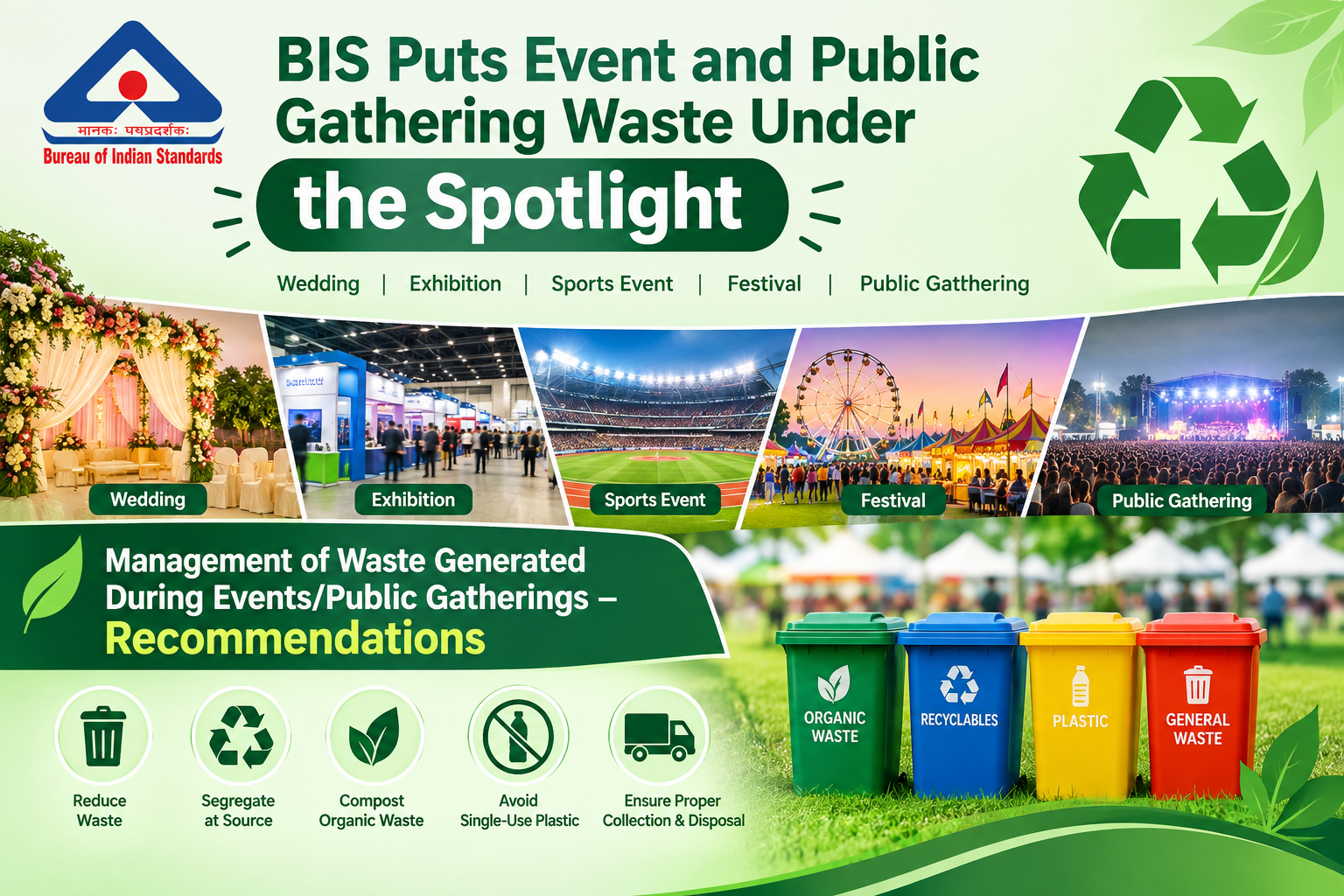
Recognising this challenge, the Bureau of Indian Standards (BIS) has prepared a Draft Indian Standard titled “Management of Waste Generated During Events/Public Gatherings – Recommendations” under the Waste Management Sectional Committee (BIS).
- What does the Draft provide?
The draft provides recommendations for the systematic planning, segregation, collection, storage, transportation, processing, and disposal of waste generated during events and public gatherings, with the objective of promoting efficient waste management and maintaining clean and hygienic surroundings. BIS Certification Registration License Apply Online.
The draft proposes a structured approach covering the entire waste-management cycle – from estimating waste before an event begins to segregation, collection, transportation, processing, recovery, disposal and post-event reporting.
- Who are the relevant Stakeholders and what is the deadline for Public Comments ?
Relevant stakeholders, including central and state government departments, urban local bodies, event organizers, venue owners and managers, waste management agencies, sanitation service providers, waste collection and transportation contractors, recyclers, waste-processing and disposal facility operators, manufacturers and suppliers of waste bins and related equipment, environmental consultants, non-governmental organizations, resident welfare associations, industry associations, academic and research institutions, and members of the public, are invited to review the draft and submit their inputs, comments, and suggestions to help strengthen and further improve the proposed standard.
The deadline for submitting comments is 9 October 2026 (BIS).
In a nutshell, Organisations and professionals working in event management, hospitality, exhibitions, waste management, urban services and related sectors should consider reviewing the proposed framework and submitting practical inputs before the deadline.
- What Is BIS Proposing?
- The proposed framework moves event waste management away from a purely post-event cleaning exercise towards a planned and documented management system.
- The draft covers:
- Waste estimation before the event
- Planning and placement of waste bins
- Source segregation
- Collection and transportation
- Vendor coordination
- Treatment and resource recovery
- Authorised disposal
- Public awareness
- Worker health and safety
- Monitoring and documentation
- Post-event waste reporting
- The underlying approach follows the waste hierarchy, giving priority to prevention and minimisation, followed by reuse, recycling, recovery and environmentally sound disposal.
- Which Events Fall Within the Proposed Framework?
- The draft states that its provisions should apply to places or venues where more than 100 people are involved and where solid waste is generated, collected, transported or disposed of.
- It categorises events according to average daily attendance:
| S.No. | Event Category | Average Attendance per day |
| 1) | Small | 100–1,000 |
| 2) | Medium | 1,001–10,000 |
| 3) | Large | 10,001–100,000 |
| 4) | Mega | Above 100,000 |
- The draft also specifically notes that mega events extending over multiple days are excluded from its stated scope.
This classification is important for organisations because the scale of an event directly influences the manpower, collection infrastructure, transportation capacity and treatment arrangements that may be required.
For businesses, this is significant because waste management is increasingly being treated as an operational responsibility that needs to be planned before an event, rather than an activity handled only after the venue becomes waste-laden.
- Four Waste Streams Organisers Need to Plan For
The draft identifies different categories of waste generated during events and public gatherings.
- Wet Waste
This includes food waste from catering areas and food stalls, discarded flowers, garden trimmings and other organic residues.
- Dry Waste
This includes paper-based promotional material, bottles, cans, packaging, single-use items, plastic bags, banners, flags, thermocol decorations and other non-biodegradable material.
- Sanitary Waste
Used sanitary napkins, diapers, soiled tissues and waste generated from first-aid or designated facilities fall within this category.
- Special-Care Waste
This includes waste requiring additional attention, such as used batteries, cleaning-chemical containers, fuel containers and discarded electrical or electronic equipment used during temporary event arrangements.
For event organisers and service providers, identifying these streams before the event is critical because each may require different collection, handling, transportation and treatment arrangements.
- Waste Planning Starts Before the Event
One of the most practical features of the draft is its emphasis on estimating waste generation before an event begins.
The draft provides indicative waste-generation factors for different types of events:
| S.No. | Event Type | Indicative Waste Generation |
| 1) | Festive/community gatherings | 0.15–0.40 kg/person/day |
| 2) | Wedding ceremony/function | 0.30–0.75 kg/person |
| 3) | Rallies | 0.10–0.25 kg/person |
| 4) | Exhibition/fair | 0.20–0.50 kg/person/day |
| 5) | Sports event | 0.25–0.60 kg/person |
These figures mentioned in the above table are intended to assist with planning infrastructure, manpower, transportation and treatment capacity.
The draft also provides a simple planning formula:
Number of Bin Stations = (Expected Attendance × Waste Generation Factor)Bin Capacity
For businesses managing large gatherings, such an approach can help shift waste management from reactive cleaning to planned resource allocation.
- Segregation at Source Is Central to the Framework
The proposed system places strong emphasis on segregation at the point where waste is generated.
The draft suggests colour-coded bins:
- Green: Biodegradable waste
- Blue: Recyclables
- Red: Hazardous waste
- Black: Residual waste
Bins are to be strategically positioned according to footfall and waste-generation hotspots, including food courts, entrances and exits, seating areas, restrooms and vendor areas.
The draft also recommends clear pictorial signage and communication in English, Hindi and the local language, along with trained personnel to assist visitors and minimise cross-contamination.
For event-management companies and venues, the implication is straightforward: segregation infrastructure needs to be designed into the event layout rather than added after waste starts accumulating.
- BIS Proposes Measurable Collection Benchmarks
The draft goes beyond general instructions and provides indicative service-level requirements for collection operations.
| S.No. | Parameter | Indicative Requirement |
| 1) | Bin fill level | Empty at 75–80% |
| 2) | Overflow tolerance | Zero |
| 3) | Litter response time | Less than 30 minutes |
| 4) | Waste transportation | Every 4–6 hours |
| 5) | End-of-event clean-up | Within 12 hours |
These figures given in the above table can provide organisations and waste-management service providers with clear operational benchmarks when planning manpower, collection schedules and contractor responsibilities.
Importantly, these should be understood as provisions proposed in the draft, rather than automatically treating them as existing statutory limits.
- Vendors Are Part of the Waste-Management Chain
Event waste does not originate only from visitors.
Food stalls, exhibitors, caterers and other vendors can generate significant quantities of packaging and organic waste. The draft therefore places emphasis on vendor coordination, communication and segregation.
It proposes that vendors use compostable or recyclable packaging and that waste generated at individual stalls be pre-segregated before being handed over for collection. The draft also envisages inspections and provisions for addressing non-compliance within the event’s management framework.
For organisations, this means waste-management requirements may need to become part of vendor onboarding, event contracts and operating procedures, rather than being communicated only on the day of the event.
- The Responsibility Does Not End at the Bin
The proposed framework also addresses what happens after waste is collected.
The draft recommends:
Separate vehicles or sealed compartments for different waste streams.
Covered, leak-proof and appropriately labelled transportation.
Daily transportation of biodegradable waste, preferably to authorised composting or biodigestion facilities.
Transfer of recyclable material to registered MRFs or authorised recycling units.
Appropriate transportation and documentation for hazardous waste.
Disposal of residual waste at sanitary landfills only after recovery, recycling and treatment options have been exhausted.
Records covering the type and quantity of waste, collection time, transportation route and treatment/disposal location.
This introduces an important principle for organisations: a venue being visibly clean is not the complete measure of successful waste management.
The movement and final destination of the waste also need to be considered.
- From Waste Disposal to Resource Recovery
The draft promotes a hierarchy that prioritises:
Prevention & Minimisation → Reuse → Recycling → Recovery → Disposal
For food waste, the proposed options include redistribution of surplus edible food through authorised agencies, permitted use as animal feed, biomethanation and composting.
Where feasible, the draft also recommends in-house composting with appropriate controls for aeration, moisture, odour, leachate and contamination.
This approach can help organisations look beyond the cost of removing waste and instead consider how much material can be diverted from final disposal through reuse, recycling and recovery.
- Worker Safety Is Also Part of the Proposed Framework
The draft recognises that event waste management involves a workforce that handles waste directly.
It recommends appropriate PPE, including safety footwear, caps, masks and gloves, along with first-aid and firefighting arrangements. It also addresses basic welfare provisions such as drinking water, sanitation facilities, food and rest arrangements for waste-management personnel.
For organisations outsourcing event waste management, this reinforces the importance of evaluating not only what a service provider collects, but also how collection and handling operations are carried out.
- The Draft Also Introduces a Documentation Framework
A particularly useful part of the proposal is its set of annexures.
Annex A – Event Waste-Management Checklist
- The checklist covers planning and approvals, waste estimation, budgeting, waste prevention, segregation, transportation, authorised facilities, manpower, safety, awareness and post-event management.
Annex B – Alternatives to Banned Single-Use Plastic Items
- The draft provides examples of alternatives to prohibited single-use plastic items, including paper, cloth, steel, wooden, bagasse and leaf-based alternatives, depending on the application.
Annex C – Post-Event Waste Report
- The reporting template captures estimated and actual quantities of different waste streams, collection methods, transportation details, treatment/disposal facilities and quantities diverted through recycling, reuse or composting.
Together, these provisions indicate a move towards a more measurable and documented approach to event waste management.
- What Does This Mean for Organisations?
- For organisations involved in events, exhibitions, hospitality and waste-management services, the draft offers several practical signals.
- Event organisers may need to strengthen pre-event waste planning, budgeting, vendor coordination and documentation.
- Event venues and exhibition companies may need to integrate waste infrastructure into site planning and visitor movement.
- Vendors and exhibitors should be prepared for stronger expectations around packaging and source segregation.
- Waste-management service providers may need clearly defined collection schedules, transportation arrangements, authorised downstream facilities and documentation systems.
- Urban Local Bodies and other authorities remain important to the proposed framework through coordination, approvals and identification of appropriate waste-management facilities.
- The draft therefore has implications well beyond the final clean-up operation. It touches the planning, contracting, operational and reporting stages of an event.
- What Should Businesses Do Before the Comment Deadline?
- The document is currently a draft, and stakeholders have an opportunity to contribute before it progresses further.
- Businesses and organisations working in event management, exhibitions, hospitality, waste management, municipal services and related sectors should consider reviewing the proposed provisions against their existing practices.
- Stakeholders may particularly examine:
- Whether the proposed waste-generation factors are practical across different event formats.
- Whether the proposed bin-placement and collection benchmarks are operationally achievable.
- How vendor responsibilities can be implemented effectively.
- Whether existing waste-management contracts provide adequate traceability.
- How authorised downstream facilities can be integrated into event planning.
- Whether the proposed reporting framework captures sufficient operational information.
The public-comment deadline is 9 October 2026.
Stakeholders wishing to contribute technical, operational or practical inputs should submit their comments through the BIS Standards Portal and the prescribed commenting mechanism before the deadline.
- A Move Towards Planned, Accountable Event Waste Management
- The significance of the proposed BIS framework lies not simply in adding more bins at events.
- It proposes a broader system in which waste is estimated before the event, segregated at source, collected according to defined requirements, transported through appropriate channels, directed towards recovery or treatment, and documented after the event.
- For businesses, this is an opportunity to examine whether their existing event-waste practices are prepared for a more structured approach.
- The draft is still open to stakeholder input. With 9 October 2026 approaching, organisations with relevant operational experience have a limited window to review the proposed framework and share practical suggestions that could help make the eventual standard more effective and implementable.
- What Organisations Should Do Before the Deadline ?
- Review: Examine the proposed BIS framework and identify provisions relevant to your operations.
- Assess: Compare the proposed recommendations with your existing event-waste practices.
- Identify gaps: Look at segregation, vendor management, collection, transportation, recovery and documentation.
- Prepare comments: Where provisions create practical, technical or operational concerns, prepare specific stakeholder feedback.
- Plan ahead: Even though this is a draft, the proposed framework provides an indication of how structured event-waste management may evolve.
- How Can Kar Parivartan Help?
- For businesses, interpreting a regulatory draft is only the first step. The more important question is how its provisions could affect actual operations, contracts and compliance processes.
- Kar Parivartan LLP can support organisations in understanding and preparing for evolving regulatory requirements, including:
- Regulatory interpretation: Breaking down technical and regulatory provisions into clear business implications.
- Applicability assessment: Identifying which proposed requirements may be relevant to a particular event, organisation or operational model.
- Compliance gap assessment: Comparing existing waste-management practices with proposed requirements and identifying areas requiring attention.
- Documentation and process support: Helping organisations structure compliance-related records, checklists and operational processes.
- Regulatory monitoring: Keeping businesses informed about relevant developments as draft provisions progress towards finalisation.
- Stakeholder preparedness: Supporting businesses in understanding proposed requirements before they translate into operational expectations.
- For event organisers and businesses operating at scale, early preparation can make the difference between reacting to a regulatory change and being ready for it.
- Conclusion: The Deadline Is 9 October -Review the Draft Before It Moves Forward
- BIS’s proposed framework signals a more structured approach to event waste management -one that begins before the event, continues through segregation and collection, tracks the movement of waste and ends with documented reporting.
- It is still a draft, and stakeholders have an opportunity to influence its development.
- If your business organises, hosts, manages or services large events and public gatherings, 9 October 2026 should be treated as a date for action -not a date to start paying attention.
- Review the draft. Assess its relevance to your operations. Identify practical concerns. And, where appropriate, submit your comments before the deadline.
Kar Parivartan remains committed to helping businesses navigate evolving regulatory requirements and prepare for the compliance expectations ahead.
Frequently Asked Questions (FAQs)
1. What is the BIS draft on waste management during events and public gatherings?
The Bureau of Indian Standards (BIS) has developed a Draft Indian Standard titled “Management of Waste Generated During Events/Public Gatherings – Recommendations” (Doc. EED08 (32876) WC). It provides recommendations for planning, segregation, collection, storage, transportation, processing and disposal of waste generated during events and public gatherings.
2. Who should pay attention to this draft?
The draft is relevant to event organisers, venue owners and managers, waste management agencies, sanitation service providers, waste collection and transportation contractors, exhibitors, vendors and other stakeholders involved in organising or managing events and public gatherings.
3. Does the draft apply to every event?
The draft covers events and public gatherings involving more than 100 people, where solid waste is generated, collected, transported and disposed of. Mega multi-day events are excluded from the stated scope of the draft.
4. What types of waste are addressed?
The draft identifies four broad waste streams: wet waste, dry waste, sanitary waste and special-care waste. It also provides recommendations for appropriate segregation, collection, transportation, processing and disposal.
5. What are the proposed requirements for waste segregation?
The draft recommends a four-colour bin system:
- Green: Biodegradable waste
- Blue: Recyclable waste
- Red: Hazardous waste
- Black: Residual waste
It also recommends appropriate signage, strategic placement of bins and trained personnel to support segregation and collection.
6. What should event organisers do before an event?
Organisers should plan waste-management requirements in advance, including waste estimation, bin capacity and placement, collection arrangements, transportation, processing/disposal facilities, vendor responsibilities and post-event reporting.
7. What is the deadline for submitting comments on the draft?
Stakeholders have been invited to submit their comments, inputs and suggestions by 9 October 2026. Organisations that may be affected by the proposed recommendations should review the draft before the deadline.
8. Is this draft currently a mandatory BIS standard?
No. This is currently a Draft Indian Standard. The document sets out recommendations and has been circulated for stakeholder comments. Businesses and organisations should monitor BIS updates for any subsequent development or finalisation.
9. How can organisations prepare for the proposed framework?
Organisations can begin by assessing their existing event waste-management practices against the draft recommendations, reviewing vendor and contractor responsibilities, evaluating segregation and collection arrangements, and establishing appropriate documentation and reporting mechanisms.
10. How can Kar Parivartan assist businesses with this development?
Kar Parivartan can support organisations in understanding the regulatory implications of the proposed standard, assessing its applicability, identifying potential compliance gaps, developing appropriate action plans and monitoring subsequent regulatory developments. Organisations can also seek support in reviewing the proposed requirements and preparing stakeholder comments where relevant.
Stay informed. Stay prepared. Stay compliant.
Contact Kar Parivartan
Our experts are ready to help you achieve BIS compliance and all BIS related works with a smooth and efficient certification process.
Mobile: 7428718855
Email: bis.sales@karparivartan.com
Kar Parivartan – Your Trusted Partner for BIS Certification & Regulatory Compliance.