

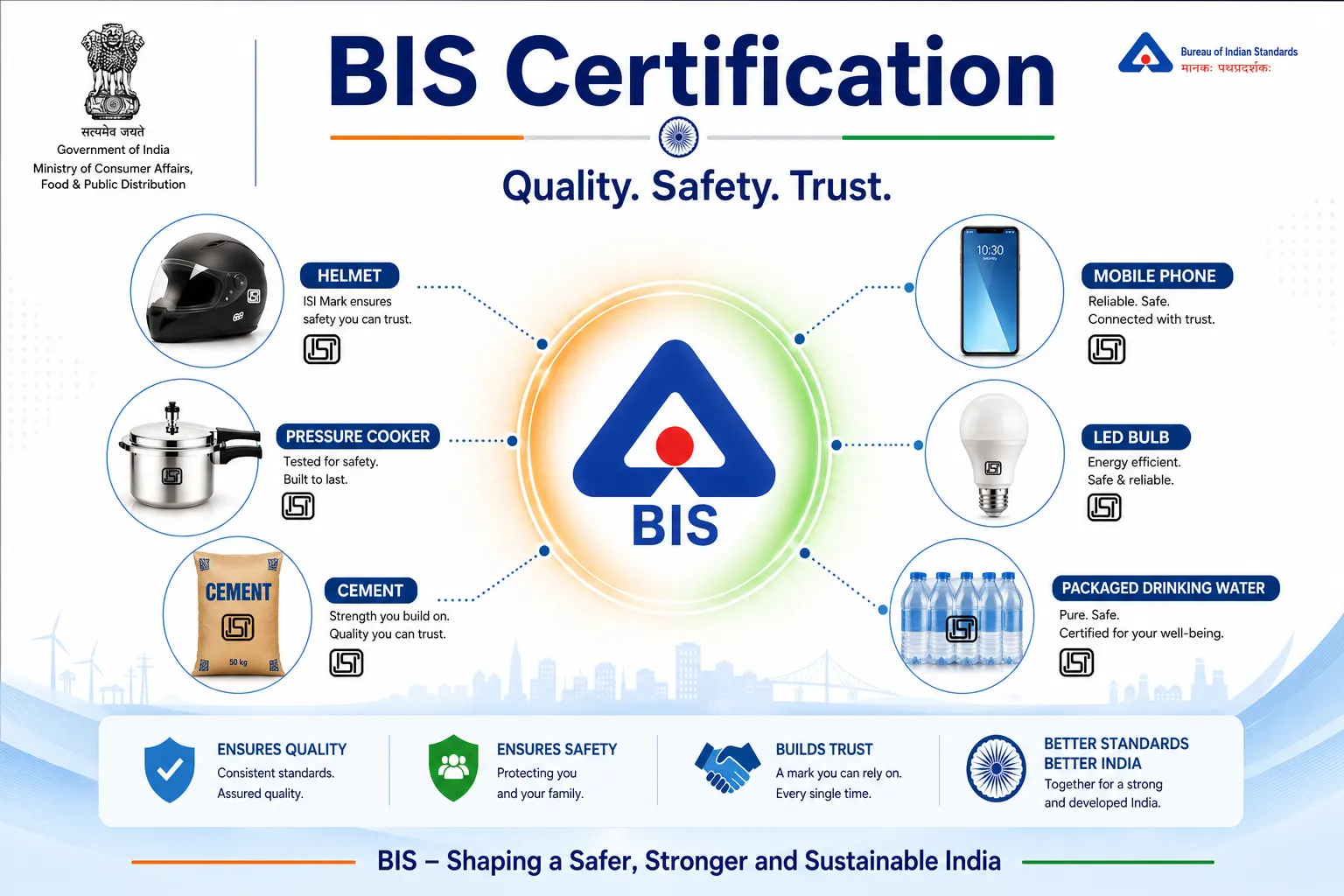
A simple guide to understand BIS certification in India, its process, and who needs it, along with key benefits for businesses and manufacturers. Product safety has become an important concern in India. Consumers expect safe and reliable products, and the government also ensures that only standard-quality goods are sold in the market. As a result, certain products in India cannot be manufactured, sold, or imported without meeting specific quality standards. These rules are checked through a system known as BIS. This is where the BIS certification becomes important for businesses to understand. BIS certification confirms that a product meets the required Indian standards for safety, quality, and performance. It is not just a formality for some products. It is a legal requirement. Many businesses, especially importers and manufacturers, often try to understand why BIS certification is mandatory and which products fall under it. In this blog, we will understand BIS certification in India, who needs it, and why it is required for certain products in a simple and clear way. What Is BIS Certification? BIS certification is a quality approval issued by the Bureau of Indian Standards, India’s national standards body. It confirms that a product meets the required safety, quality, and performance standards set by the government before it is sold in the Indian market. In simple terms, BIS certification means the product has been tested and approved as safe and reliable for use. The Bureau of Indian Standards (BIS) is the authority that sets these standards and checks whether products comply with them. If a product meets all requirements, it may bear the BIS mark. This mark helps customers identify that the product is genuine and complies with Indian quality standards. In many cases, a BIS certification is not optional. It is required by law for specific product categories before they can be sold or imported in India. Why BIS Certification Is Mandatory for Certain Products BIS certification is mandatory for certain products to ensure safety, quality, and reliability before they reach consumers. The government has made it compulsory for certain categories to mitigate risks associated with poor-quality or unsafe goods. Many products can directly affect health and safety. BIS rules ensure such products are tested properly before sale. BIS certification ensures that products follow fixed Indian quality standards. This prevents low-grade or substandard products from entering the market. Imported products must meet Indian safety rules. This is why BIS certification for importers becomes important before selling goods in India. Not all products require BIS approval, but some categories are subject to mandatory rules. These are referred to as mandatory bis products. Products with BIS certification are seen as more reliable. It helps build trust between manufacturers and consumers. Mandatory BIS Products List In India, BIS certification is not required for all products. It is mandatory only for specific product categories where safety, quality, and standardisation are very important. These products fall under government regulation because they can directly impact health, infrastructure, or the safety of daily use. Many electronic products, such as mobile chargers, LED lights, home appliances, and electrical equipment, require BIS certification before they can be sold in India. This is to ensure that they are safe to use and do not cause electrical hazards or performance issues. Products like cement, steel, wires, and other building materials also come under mandatory BIS products. These materials are used in construction, so their quality directly affects the safety and durability of buildings and infrastructure. Certain automobile parts, such as tyres, helmets, batteries, and safety-related components, require BIS approval. This ensures that vehicles meet safety standards and reduce risks during usage. Products such as LPG cylinders, pressure cookers, and similar equipment must comply with strict BIS standards. These items are sensitive, and any quality issue can pose serious safety risks. Some metal products, industrial machinery parts, and engineering goods are also subject to mandatory BIS certification rules, depending on their use and category. Not every product needs BIS approval, but any product that can affect safety, health, or infrastructure is usually included in the list of mandatory BIS products. This ensures that only tested and approved goods enter the Indian market. BIS Certification Schemes in India In India, BIS certification schemes in India are designed based on different product categories and industry needs. Each scheme has a specific purpose depending on the type of product, manufacturing location, and safety requirements. These schemes ensure that all products meet Indian standards before they are sold or imported. This is one of the most widely used BIS certification schemes in India. It applies mainly to products manufactured in India, such as cement, steel products, household electrical goods, and other safety-related items. Under this scheme, products undergo factory inspection and testing before they are allowed to carry the ISI mark. This mark confirms that the product meets Indian safety and quality standards. The CRS scheme is mainly used for electronic and IT-related products. It is jointly regulated with the Ministry of Electronics and Information Technology (MeitY) Products such as mobile phones, laptops, LED lights, batteries, and other electronic goods must be registered under this scheme before they can be sold in India. Testing is done in BIS-approved laboratories to ensure compliance with safety standards. This scheme is designed for manufacturers located outside India who want to sell their products in the Indian market. Under FMCS, foreign companies must obtain a BIS licence before exporting products to India. This ensures that imported goods follow the same quality and safety standards as Indian-made products. The CoC scheme applies to specific product categories where conformity certification is required rather than regular BIS marking. It is used for selected goods for which compliance is verified against defined standards before approval. Scheme-X applies to certain machinery, industrial equipment, and safety-critical electrical products. These products require strict evaluation because they are used in industrial or high-risk environments where safety is important. The Hallmarking Scheme applies to precious metal products, such as gold and silver jewellery. It certifies the purity of the metal and ensures that consumers receive genuine quality products. This scheme is mandatory for specific categories of jewellery items in India. Each BIS certification scheme in India is designed for a specific product type. Whether it is electronics, machinery, metals, or jewellery, the goal remains the same: ensuring safety, quality,
Mandatory BIS Certification for Furniture in India from February 2026
The Government of India has introduced mandatory BIS certification for furniture products under the Furniture (Quality Control) Order, 2025. This regulation will come into effect on 13 February 2026 and will significantly impact manufacturers, importers, MSMEs, and international suppliers operating in the Indian furniture market. The notification S.O. 801(E) was issued on 13 February 2025 by the Department for Promotion of Industry and Internal Trade (DPIIT) under the authority of the Bureau of Indian Standards Act, 2016. The order mandates that specified furniture products must comply with relevant Indian Standards and obtain certification from the Bureau of Indian Standards (BIS) before they can be manufactured, sold, or imported in India. A 12-month transition period has been provided for businesses to align with the new regulatory requirements. Furniture Products Covered Under the Furniture Quality Control Order, 2025 Under the new Quality Control Order (QCO), various categories of furniture will be required to meet specific Indian Standards (IS). Manufacturers and importers must ensure that the listed products are certified under BIS Scheme-I and carry the BIS Standard Mark before entering the Indian market. Failure to comply with the applicable standards may restrict the manufacturing, distribution, or import of such furniture products in India. Exemptions Under the Furniture Quality Control Order To support businesses during the transition phase, the government has introduced certain exemptions and relaxation provisions. Export-Oriented Manufacturing Furniture products that are manufactured in India exclusively for export purposes are exempt from BIS certification requirements. This allows exporters to continue serving international markets without additional compliance obligations under this order. Transitional Relief for MSMEs Micro and Small Enterprises registered under the Micro, Small and Medium Enterprises Development Act, 2006 have been granted an additional 18-month transition period. This means MSME manufacturers will be required to comply with BIS certification requirements only after August 2026. The extended timeline will allow smaller manufacturers to gradually upgrade their production systems and quality standards. Exemption for Small Udyam-Registered Enterprises Businesses registered on the Udyam Registration Portal may qualify for exemption if they meet the following conditions: ● Investment in plant and machinery not exceeding ₹25 lakh ● Annual turnover not exceeding ₹2 crore in the previous financial year These financial limits must be certified by a Chartered Accountant. Penalties for Non-Compliance Non-compliance with the Furniture Quality Control Order may lead to strict enforcement actions under the Bureau of Indian Standards Act, 2016. Possible penalties include: ● Financial penalties ● Seizure of non-compliant products ● Cancellation of manufacturing or import licenses ● Legal action and prosecution Authorities may also prohibit the sale or distribution of furniture products that do not carry BIS certification. Impact of Mandatory BIS Certification on the Furniture Industry The introduction of mandatory certification is expected to significantly influence the Indian furniture ecosystem, including domestic manufacturers, MSMEs, importers, and international suppliers. Impact on Domestic Furniture Manufacturers Indian furniture manufacturers will need to align their production processes with Indian Standards and BIS certification requirements. Key Compliance Requirements Manufacturers will need to ensure: ● Product testing as per applicable Indian Standards ● Obtaining a BIS license under Scheme-I ● Implementing quality control systems in manufacturing ● Proper marking of products with the BIS Standard Mark Expected Benefits Despite initial compliance costs, the regulation is expected to deliver long-term benefits such as: ● Improved product quality and durability ● Increased consumer trust ● Greater competitiveness in domestic and international markets However, manufacturers may initially face higher testing costs and regulatory procedures during the transition phase. Impact on MSME Furniture Manufacturers The Indian furniture industry relies heavily on small and medium enterprises, including local carpentry units, modular furniture manufacturers, and small workshops. The 18-month compliance window gives MSMEs time to: ● Upgrade production processes ● Improve product quality standards ● Understand BIS certification procedures However, MSMEs may still face certain challenges such as: ● Certification costs ● Limited technical knowledge of standards ● Documentation and compliance requirements Industry awareness programs and professional compliance support will play an important role in ensuring smooth adoption. Impact on Furniture Importers Importers will also be required to ensure that furniture products imported into India meet the applicable BIS certification requirements. Key Compliance Steps for Importers Importers must: ● Ensure products comply with applicable Indian Standards ● Obtain BIS certification before importing products ● Facilitate factory inspections of overseas manufacturers ● Submit necessary compliance documentation during customs clearance Importers sourcing low-cost furniture from international markets may experience longer certification timelines and additional compliance costs. Impact on International Furniture Manufacturers Foreign manufacturers exporting furniture products to India must obtain certification under the BIS Foreign Manufacturers Certification Scheme (FMCS). The process generally includes: ● Factory inspection by BIS officials ● Product testing in BIS-approved laboratories ● Ongoing compliance with Indian Standards Although this introduces additional regulatory requirements, it will also help ensure consistent product quality and safety across the Indian furniture market. Key Takeaways The Furniture (Quality Control) Order, 2025 represents a significant step toward strengthening product quality, safety, and regulatory compliance in India’s furniture sector. By mandating BIS certification, the government aims to: ● Protect consumers from substandard furniture products ● Improve product durability and safety ● Encourage quality manufacturing in India ● Strengthen regulatory oversight of imported products While the new regulation introduces additional compliance requirements for businesses, it is expected to enhance overall quality standards and strengthen the Indian furniture industry in the long run. Need Assistance with BIS Certification? If your business is involved in manufacturing, importing, or selling furniture products in India, it is important to begin the BIS certification process well before the February 2026 deadline. The experts at Kar Parivartan can assist you with end-to-end BIS certification,