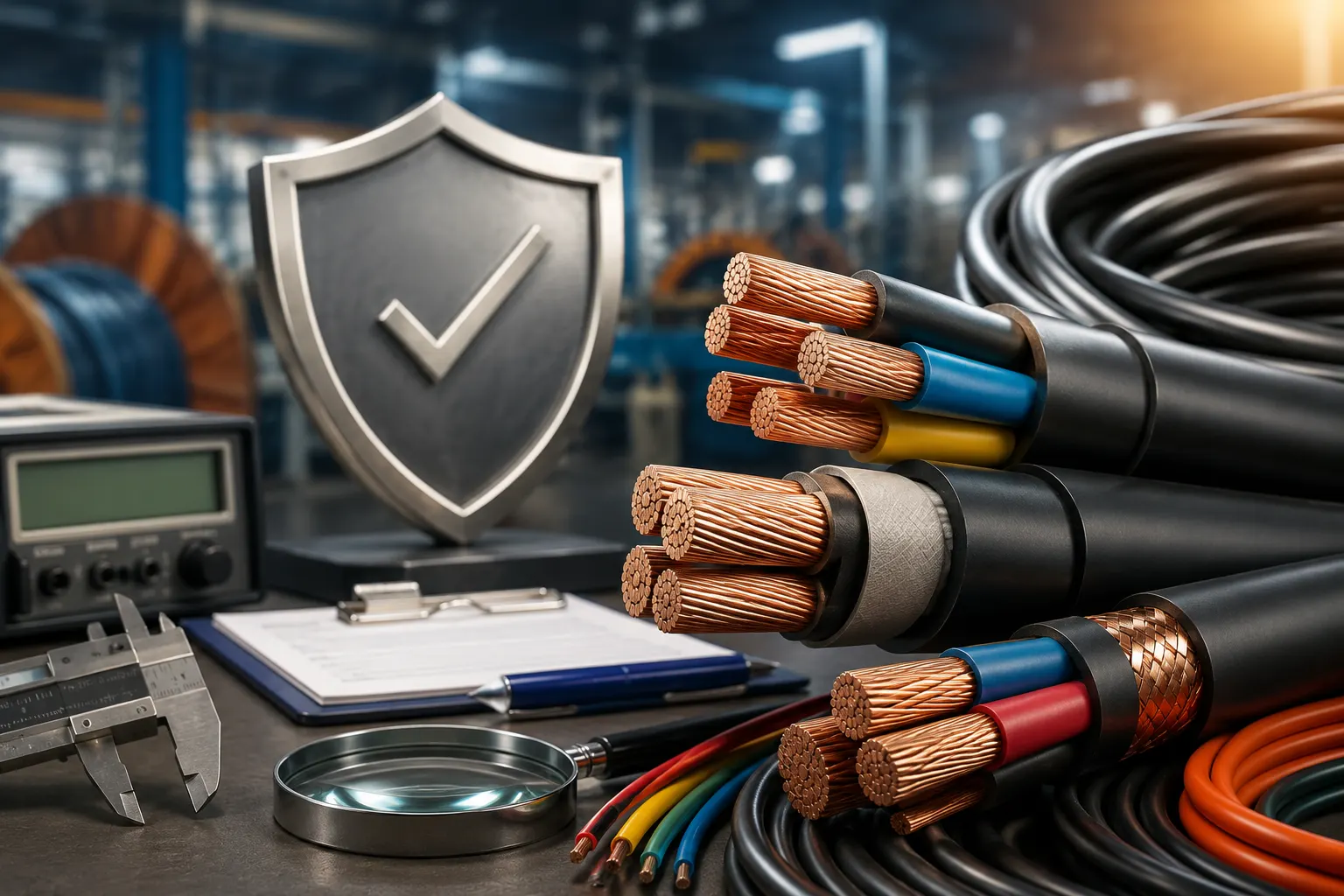
The Government of India has made BIS Certification mandatory for various categories of electrical cables under the Cables (Quality Control) Order, 2020 issued by the Ministry of Commerce & Industry (Department for Promotion of Industry and Internal Trade – DPIIT). The Order requires specified cable products to conform to the applicable Indian Standards and bear the BIS Standard Mark under Scheme-I of the BIS Conformity Assessment Regulations.
Manufacturers intending to manufacture, sell, distribute, import, or store these products in India must obtain a valid BIS license before placing them on the Indian market.
What is the Cables (Quality Control) Order, 2020?
The Cables (Quality Control) Order, 2020 was notified by the Government of India on 21 January 2020 to ensure the safety, quality, and reliability of electrical cables used across residential, commercial, industrial, and infrastructure applications.
The Order mandates that notified cable products shall:
- Conform to the applicable Indian Standard (IS)
- Bear the Standard Mark (ISI Mark)
- Be manufactured under a valid BIS License issued under Scheme-I
- Not be manufactured or sold without BIS Certification in India
Export products are exempt from the applicability of this Order.
Implementation Date
Notification Date: 21 January 2020
Implementation Date: 01 August 2020
Who All Are Affected?
The Order applies to:
- Indian manufacturers of electrical cables
- Foreign manufacturers exporting cables to India
- Importers dealing in notified cable products
- Brand owners
- OEM manufacturers
- Government procurement suppliers
- Electrical equipment manufacturers using covered cables
Any manufacturer producing the notified products must obtain BIS registration before supplying them in India — a BIS registration consultant in India can help confirm which cable category applies to your business.
Products Covered Under the Order
The following cable categories are covered:
| Product | Applicable Indian Standard |
| Heavy Duty Electric Cables | IS 1554 (Part 1):1988 & IS 1554 (Part 2):1988 |
| Cross-linked Polyethylene (XLPE) Insulated Sheathed Cables | IS 7098 (Part 1):1988, Part 2:2011 & Part 3:1993 |
| Aerial Bunched Cables | IS 14255:1995 |
| Elastomer Insulated Cables | IS 9968 (Part 2):2002 |
| Thermocouple Compensating Cables | IS 8784:1987 |
| Welding Cables | IS 9857:1990 |
| Elastomer Insulated Flexible Cables for Mines | IS 14494:2019 |
| Flexible Cables for Miner’s Cap Lamps | IS 2593:1984 |
| Shot Firing Cables | IS 5950:1984 |
| Halogen Free Flame Retardant (HFFR) Cables | IS 17048:2018 |
Why is BIS Certification Mandatory?
BIS Certification helps to:
- Ensure electrical safety
- Maintain consistent product quality
- Protect consumers from substandard products
- Reduce electrical hazards and fire risks
- Promote compliance with Indian regulations
- Enhance trust among buyers and government agencies
Process for Obtaining BIS License
Step 1 – Product Identification
Identify the applicable Indian Standard (IS) based on the cable category.
Step 2 – Documentation
Prepare all required documents, including:
- Factory registration documents
- Manufacturing process details
- Quality control plan
- Machinery list
- Test equipment details
- Raw material details
- Authorized signatory documents
Step 3 – Product Testing
Samples are tested in a BIS-recognized laboratory to verify compliance with the relevant Indian Standard.
Step 4 – Online BIS Application
Submit the BIS application along with:
- Test reports
- Technical documents
- Factory information
- Required declarations
Step 5 – Factory Inspection
A BIS officer visits the manufacturing facility to verify:
- Manufacturing capability
- Quality management system
- Testing facilities
- Production process
- Sample verification (where applicable)
Step 6 – Grant of BIS License
Upon satisfactory evaluation, BIS grants the license authorizing the manufacturer to use the ISI Mark on compliant products.
Timeline for BIS Certification
Indian Manufacturers
Approximately 30–45 working days, depending on document readiness, testing, and BIS processing.
Foreign Manufacturers (FMCS)
Typically 4–6 months, including application review, factory inspection, and license issuance.
Consequences of Non-Compliance
Manufacturing, importing, or selling notified cable products without a valid BIS license may result in:
- Product seizure
- Market restrictions
- Regulatory action under the BIS Act
- Monetary penalties
- Cancellation of tenders or supply contracts
- Damage to business reputation
How Kar Parivartan Can Help
Kar Parivartan offers complete BIS certification support, including:
- Product applicability assessment
- Identification of applicable IS standards
- Documentation preparation
- Laboratory testing coordination
- BIS application filing
- Factory audit preparation
- Query handling with BIS
- Support until grant of license
- Renewal and compliance assistance
Our experienced team assists both Indian manufacturers and foreign manufacturers with end-to-end BIS certification services.
Why Choose Kar Parivartan?
- Experienced BIS compliance consultants
- End-to-end project management
- Support for Indian and foreign manufacturers
- Documentation expertise
- Fast application processing
- Audit preparation assistance
- Dedicated compliance support
FAQs
Is BIS Certification mandatory for electrical cables?
Yes. The specified cable products covered under the Cables (Quality Control) Order, 2020 require mandatory BIS certification.
When did the Order become effective?
The Order came into force on 01 August 2020.
Which BIS Scheme is applicable?
Scheme-I of the BIS (Conformity Assessment) Regulations, 2018.
Can importers apply for BIS Certification?
No. BIS licenses are issued to manufacturers. Importers can import only products manufactured under a valid BIS license.
Are foreign manufacturers eligible?
Yes. Foreign manufacturers can obtain BIS certification under the Foreign Manufacturers Certification Scheme (FMCS).
Are exports covered under this Order?
No. Products manufactured exclusively for export are exempt.
Can one license cover multiple cable types?
It depends on the applicable Indian Standards, manufacturing process, and BIS requirements.
Is factory inspection mandatory?
Yes, as required under the applicable BIS certification procedure.
Can Kar Parivartan manage the entire certification process?
Yes. We provide complete end-to-end BIS certification support from documentation through license grant.