

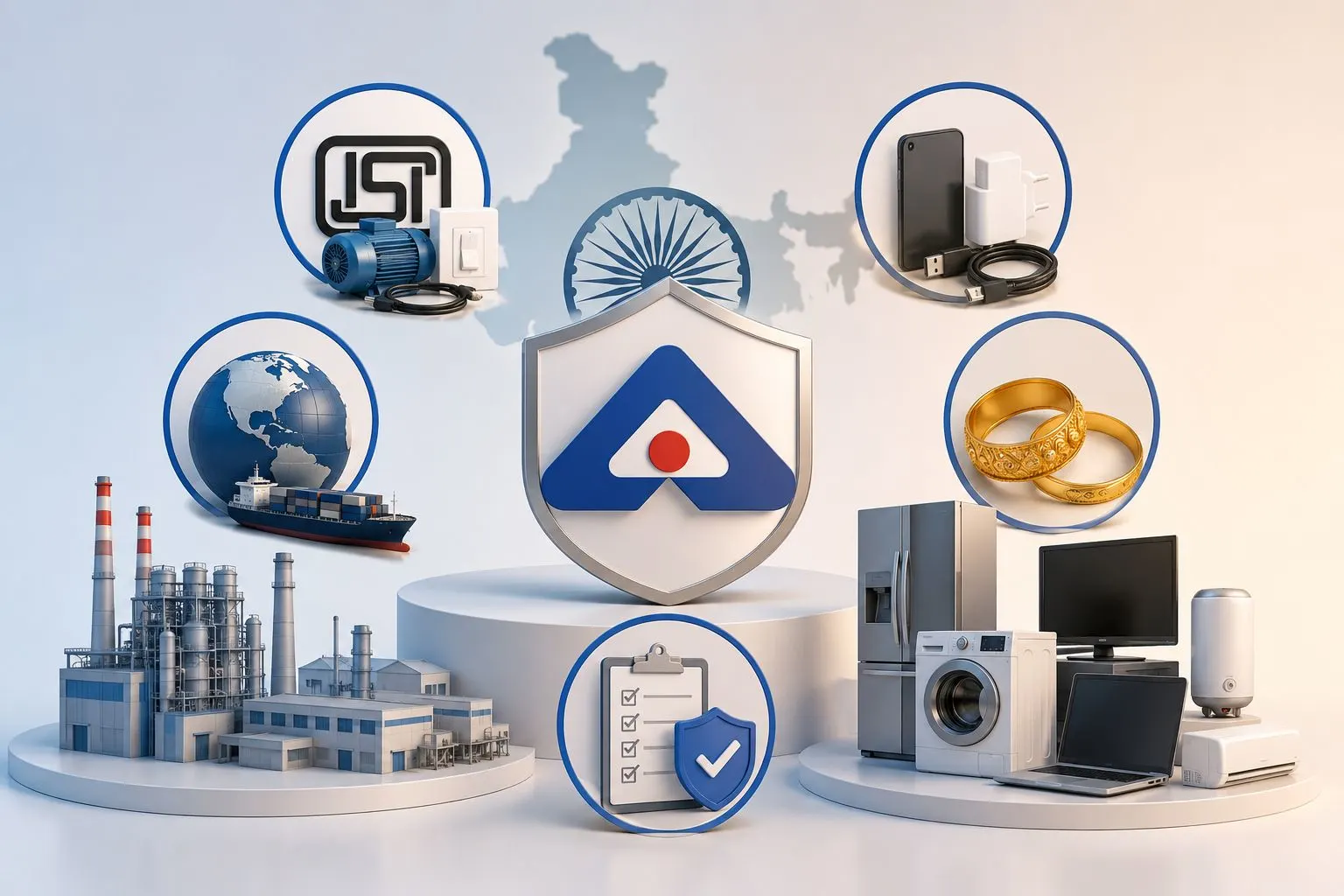
The Bureau of Indian Standards (BIS) is India’s national standards body responsible for ensuring product quality, safety, and reliability across multiple industries. BIS certification is mandatory for various products before they can be manufactured, imported, sold, or distributed in the Indian market. BIS operates under the BIS Act, 2016 and functions under the Ministry of Consumer Affairs, Food & Public Distribution.
With increasing Quality Control Orders (QCOs) issued by the Government of India, BIS compliance has become essential for manufacturers, importers, foreign brands, and e-commerce sellers operating in India.
This guide explains:
- Different BIS certification schemes
- Products covered under BIS
- Certification procedure
- Timelines
- Applicability
- Compliance requirements
What is BIS Certification?
BIS Certification is a conformity assessment process through which products are verified against applicable Indian Standards (IS). Once approved, manufacturers are allowed to use:
- ISI Mark
- CRS Registration Number
- Hallmark
- BIS Standard Mark
depending on the applicable certification scheme.
Why is BIS Certification Important?
BIS certification helps ensure:
- Product quality & safety
- Consumer protection
- Legal market access
- Product standardization
- Import compliance
- Brand credibility
Businesses often rely on professional BIS services to navigate certification requirements, ensure regulatory compliance, and streamline the approval process for their products.
Non-compliance with mandatory BIS regulations may lead to:
- Product seizure
- Import rejection
- Penalties
- Legal action
- Imprisonment under applicable provisions of the BIS Act
Different Types of BIS Certification Schemes in India
1. ISI Mark Certification (Scheme-I)
The ISI Mark is India’s most recognized product quality certification mark. It is applicable to products covered under mandatory Indian Standards and QCOs. Products are tested and manufacturing facilities are inspected before grant of license.
Applicable For:
- Indian manufacturers
- Certain notified products
Products Commonly Covered:
- Cement
- Steel products
- Electrical appliances
- Pressure cookers
- LPG cylinders
- Cables & wires
- Packaged drinking water
- Footwear
- Helmets
- Automotive components
Procedure:
- Product identification
- Product testing
- Application filing
- Factory inspection
- Query handling
- Grant of ISI license
Timeline:
✅ Approx. 30–45 Days
2. CRS Registration (Compulsory Registration Scheme)
The BIS CRS Scheme was introduced by MeitY for electronic and IT products. Under CRS, products are tested in BIS-recognized laboratories and registered with BIS.
Products Covered Under CRS:
- Mobile Phones
- Laptops
- LED Lights
- Power Banks
- Smart Watches
- CCTV Cameras
- Smart TVs
- Microwave Ovens
- UPS/Inverters
- Bluetooth Speakers
- EV Chargers
- Lithium-ion Batteries
Procedure:
- Product testing in BIS lab
- Online application
- Documentation review
- Registration approval
Timeline:
✅ Approx. 15–45 Days
3. FMCS – Foreign Manufacturers Certification Scheme
FMCS is applicable to foreign manufacturers exporting products to India. Under FMCS, foreign factories are audited by BIS officials before certification. (Bureau of Indian Standards)
Key Features:
- Mandatory for foreign manufacturers
- BIS factory audit required
- Authorized Indian Representative (AIR) required
Products Covered:
Almost all products covered under Indian Standards except certain CRS products. (Bureau of Indian Standards)
Procedure:
- Appointment of AIR
- Documentation preparation
- Application filing
- BIS factory audit
- Sample testing
- Grant of BIS license
Timeline:
✅ Approx. 4–6 Months
4. BIS Hallmarking Scheme
Hallmarking certifies the purity of precious metal articles. BIS hallmarking is mandatory for certain gold and silver jewelry categories in India. (Bureau of Indian Standards)
Applicable Products:
- Gold jewelry
- Silver jewelry
- Precious metal articles
Procedure:
- Jeweller registration
- Assaying & hallmarking
- Hallmark approval
Timeline:
✅ Approx. 15–30 Days
5. BIS Scheme X Certification
Scheme X is a newer BIS conformity assessment framework applicable to certain regulated machinery and industrial products notified under QCOs.
Key Features:
- Product testing
- Technical evaluation
- Factory assessment
- QCO-based compliance
Applicable Products:
- Low Voltage Switchgear
- Industrial Machinery
- Electrical Equipment
- Certain HS Code 84 & 85 products
Timeline:
✅ Approx. 60–120 Days
Major Product Categories Covered Under BIS
Electrical & Electronics
- LED Lights
- Fans
- Air Conditioners
- Power Banks
- Cables
- Switches
- Mobile Phones
Construction Materials
- Cement
- Steel
- Pipes
- Paints
Consumer Products
- Helmets
- Footwear
- Toys
- Kitchen Appliances
Food & Packaging
- Food Containers
- Beverage Cans
Industrial Products
- Chemicals
- Machinery
- Fasteners
- Pressure Equipment
Healthcare Products
- Medical Devices
- Protective Equipment
Common Documents Required for BIS Certification
- Business License
- Factory License
- ISO Certificate
- Product Specifications
- Test Reports
- Trademark Certificate
- Manufacturing Process
- Authorized Signatory Documents
- Quality Control Documents
- AIR Documents (for FMCS)
General BIS Certification Procedure
Step 1 – Identify Applicable Standard
Determine the relevant Indian Standard (IS) and certification scheme.
Step 2 – Product Testing
Testing is conducted in BIS-recognized laboratories.
Step 3 – Documentation Preparation
Technical and legal documents are prepared.
Step 4 – Application Filing
Application is submitted through the BIS portal.
Step 5 – Factory Inspection (If Applicable)
BIS may conduct factory audits.
Step 6 – Query Resolution
Any technical or compliance queries are addressed.
Step 7 – Grant of License/Registration
BIS issues certification approval.
Approximate BIS Certification Timeline
| Scheme | Approx Timeline |
| ISI Mark | 30–45 Days |
| CRS Registration | 15–45 Days |
| FMCS | 4–6 Months |
| Hallmark Registration | 15–30 Days |
| Scheme X | 60–120 Days |
Challenges Faced by Manufacturers
Businesses commonly face:
- Product classification confusion
- Testing delays
- Incorrect documentation
- BIS query handling
- Factory audit non-compliance
- Import clearance issues
Professional compliance support helps reduce approval delays and rejection risks.
How Kar Parivartan Can Help
At Kar Parivartan, we provide complete assistance for:
- ISI Mark Certification
- CRS Registration
- FMCS Certification
- BIS Scheme X Compliance
- Hallmark Registration
- Product Testing Coordination
- Factory Audit Assistance
- Documentation Support
- Query Handling
- End-to-End BIS Compliance Consulting
Our expert team helps Indian and foreign manufacturers achieve smooth BIS approvals with complete regulatory guidance.
FAQs
Is BIS certification mandatory in India?
Yes, for products covered under mandatory QCOs and notified Indian Standards.
Can foreign manufacturers apply for BIS certification?
Yes, through FMCS or CRS depending on the product category.
Is factory inspection mandatory?
It depends on the applicable BIS scheme.
What happens if products are sold without BIS certification?
Products may face:
- Seizure
- Penalties
- Import rejection
- Legal prosecution
Which products require CRS registration?
Electronic and IT products notified by MeitY.
What is the validity of BIS certification?
Validity depends on the scheme and license type.


