

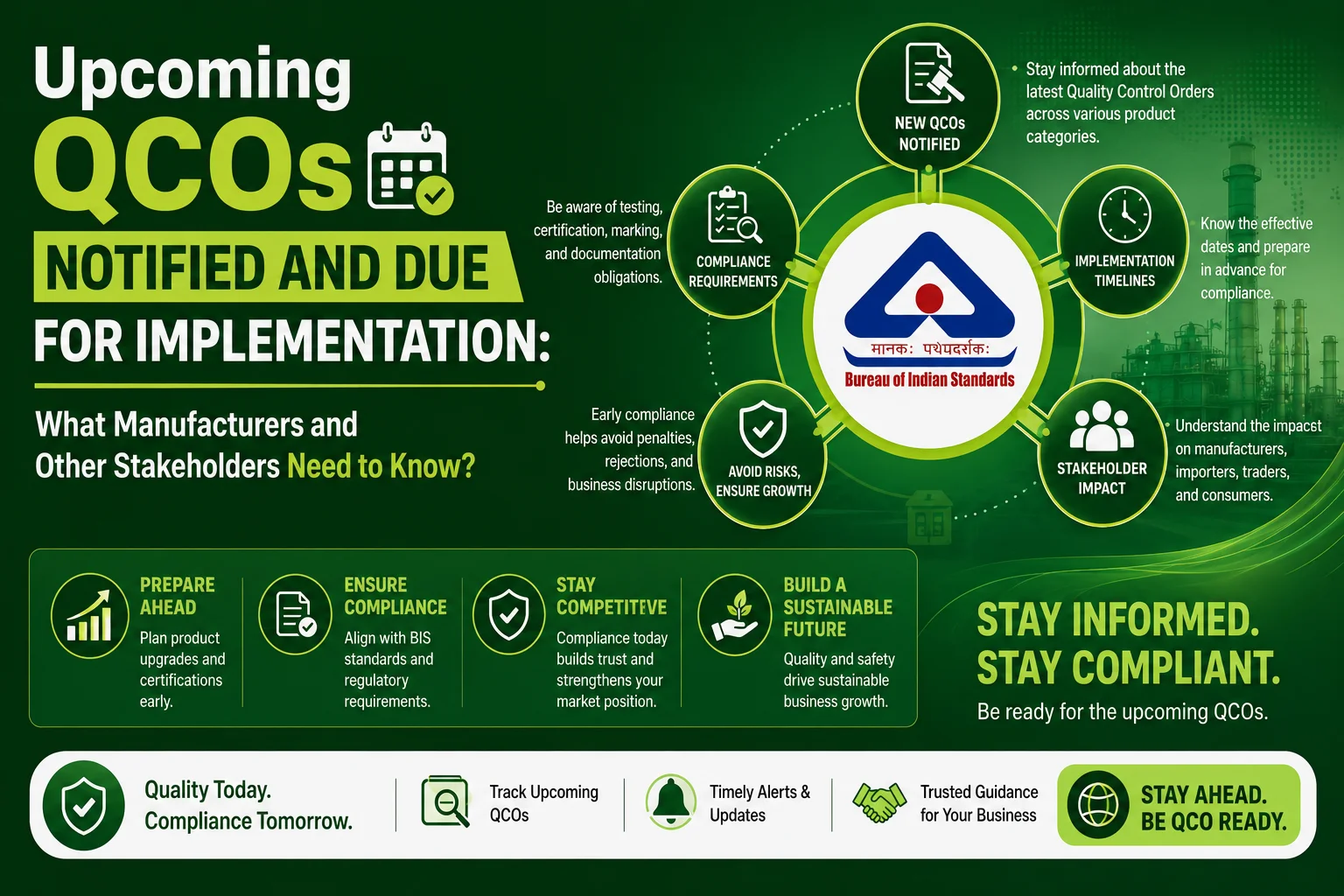
India’s quality and regulatory framework continues to evolve, with the Government bringing more products under mandatory compliance with applicable Indian Standards through Quality Control Orders (QCOs). For manufacturers, importers, sellers and other stakeholders, keeping track of these regulatory developments is important because a QCO can make compliance with a specified Indian Standard mandatory from a notified enforcement date.
The Bureau of Indian Standards (BIS) maintains an official list titled “Upcoming QCOs – Notified and Due for Implementation” to provide stakeholders with advance information about Quality Control Orders that have been notified and the dates from which they are scheduled to come into force. The BIS webpage currently available was last updated on 4 August 2026.
What is a Quality Control Order (QCO)?
A Quality Control Order is a regulatory order through which the Central Government makes compliance with specified Indian Standards compulsory for particular products.
Under the BIS certification framework is generally voluntary. However, the Central Government may make compliance mandatory for specific products in areas such as public interest, protection of human, animal or plant health, environmental safety, prevention of unfair trade practices and national security. This is done through the issuance of QCOs. Importantly, QCOs are issued by the concerned Ministry or Department of the Government of India, depending on the product or product category being regulated. BIS is involved in the applicable conformity-assessment process and the implementation of the relevant Indian Standard requirements.
Once a QCO comes into force, products covered by the order are required to comply with the applicable requirements specified in the QCO. Depending on the applicable BIS conformity-assessment scheme, the product may require a BIS Licence, Certificate of Conformity (CoC), or other specified approval before it can be legally manufactured, imported, distributed or sold.
Why the Upcoming QCO List Matters ?
The transition from voluntary to mandatory compliance can have significant implications for businesses. A manufacturer whose product is newly brought under a QCO may need to review its product specifications, testing arrangements, manufacturing processes, quality-control systems and documentation well before the enforcement date. Importers and distributors may also need to assess whether the products they source will fall within the scope of the upcoming requirement.
BIS’s QCO guidance states that the commencement date is specified in the QCO so that stakeholders have sufficient awareness of the implementation timeline and can make the necessary arrangements relating to manufacturing, testing infrastructure and compliance with the applicable Indian Standard.
Therefore, the Upcoming QCOs list should be viewed as an early compliance-alert mechanism, rather than simply as an information list.
Upcoming QCOs and Scheduled Enforcement Dates
Stakeholders should be aware that the Quality Control Orders (QCOs) issued by the concerned Ministry/Department of the Government of India will become effective from the dates specified for each product. This advance information is intended to help manufacturers, importers, and other stakeholders understand the upcoming requirements and prepare for their implementation in a timely manner.
A significant development for electrical appliances
One of the broader entries on the current list relates to electrical appliances intended for household, commercial or similar applications. The listed requirement refers to IS 302 (Part 1): 2024 / IEC 60335-1:2020 and covers appliances within the specified voltage limits.
The BIS list includes an extensive illustrative range of products, including vacuum cleaners, cooking appliances, electric heating tools, dishwashers, food-processing appliances, electric water boilers, massage appliances, humidifiers, air-cleaning appliances, certain battery-operated appliances and several commercial appliances. Because this entry covers a wide range of products, businesses dealing with electrical appliances should review the scope carefully rather than assuming that every appliance is automatically covered or excluded.
What About HDPE/PP Woven Sacks?
The current BIS list also includes several textile and packaging-related products that may be particularly relevant to manufacturers and importers.
Three entries are scheduled for enforcement from 6 October 2026:
- HDPE/PP woven sacks for packaging of 50 kg cement – IS 11652:2017
- PP/HDPE laminated woven sacks for mail sorting, storage, transport and distribution – IS 17399:2020
- PP woven, laminated, block-bottom valve sacks for packaging of 50 kg cement – IS 16709:2017.
Stakeholders dealing with these products should examine the applicable QCO and Indian Standard in detail, including the product scope, testing requirements, conformity-assessment provisions and any exemptions or transitional provisions specified in the relevant order.
What Should Manufacturers Do Before the Enforcement Date?
A QCO’s enforcement date should not be treated as the date on which compliance preparation begins. Businesses affected by an upcoming QCO should ideally start their assessment well in advance.
1. Identify whether the product falls within the QCO
The first step is to determine whether the product manufactured, imported or marketed by the business actually falls within the scope of the notified QCO. Product names can sometimes be misleading. The applicable scope, definitions, specifications and exclusions in the QCO and referenced Indian Standard should therefore be reviewed carefully.
2. Identify the applicable Indian Standard
The QCO specifies the relevant Indian Standard against which compliance is required. Businesses should verify the exact edition and requirements referenced in the applicable order.
3. Review testing requirements
Manufacturers should assess whether their existing testing facilities and quality-control arrangements are adequate for the applicable standard. Where external testing is required, the availability of appropriate BIS-recognised or otherwise applicable laboratories should be considered as part of the compliance planning process.
4. Determine the applicable BIS conformity-assessment route
A QCO does not mean that every product follows exactly the same certification procedure. The applicable conformity-assessment requirements depend on the relevant QCO and BIS scheme.
The BIS compulsory-certification framework includes different schemes, including Scheme I (Mark Scheme), Scheme II (Registration Scheme), Scheme IV (Certificate of Conformity) and Scheme X (Certification). Therefore, stakeholders should identify the specific conformity-assessment route applicable to their product instead of assuming that one BIS process applies universally.
5. Review supply chains and imported products
QCO compliance is not limited to domestic manufacturing. BIS’s guidance states that domestic laws, rules, orders and regulations applicable to domestically produced goods generally apply correspondingly to imported goods unless a specific exemption is provided. Importers should therefore review their sourcing arrangements and ensure that products entering the Indian market meet the applicable mandatory requirements from the relevant enforcement date.
6. Check the actual QCO for exemptions and transitional provisions
The BIS “Upcoming QCOs” page provides advance information, but stakeholders should not rely on the summary table alone. The actual QCO and its subsequent amendments should be checked for the precise scope, commencement date, exemptions, transitional arrangements and other conditions applicable to the product. This is particularly important because regulatory requirements can be amended after an order is initially issued.
What Happens After a QCO Comes Into Force?
The consequences of non-compliance can be significant. According to the BIS Guidance Document on QCOs, after the commencement date of a QCO, a person cannot manufacture, import, distribute, sell, hire, lease, store or exhibit for sale products covered by the QCO without the required Standard Mark under a valid BIS Licence or Certificate of Conformity, subject to the provisions and exemptions of the applicable order.
This makes the enforcement date a critical regulatory milestone for affected businesses.
Stay Ahead of QCO Compliance
The BIS “Upcoming QCOs – Notified and Due for Implementation” page is an important resource for manufacturers, importers and other stakeholders monitoring India’s evolving product-compliance landscape. As the list is updated periodically, businesses should monitor the official BIS portal and the concerned Ministry/Department for subsequent notifications, amendments or changes to implementation dates. The current BIS page was last updated on 4 August 2026.
At Kar Parivartan, we help businesses understand applicable BIS requirements, assess product-specific compliance obligations and plan their certification journey in line with the relevant regulatory framework. If your product appears on the upcoming QCO list, the right time to assess your compliance requirements is before the enforcement date-not after it.
How Kar Parivartan Can Help You ?
Kar Parivartan provides complete end-to-end BIS certification support, including:
- Product applicability assessment
- Identification of applicable Indian Standards
- Documentation preparation
- Coordination with BIS-recognized laboratories
- BIS application filing
- Factory inspection support
- BIS query management
- Licence grant assistance.
- Renewal and post-certification compliance.
Our experienced compliance professionals help both Indian and foreign manufacturers obtain BIS Certification efficiently and smoothly.
Why Choose Kar Parivartan?
- Expert BIS consultants.
- End-to-end certification support
- Dedicated documentation assistance
- Support for Indian and foreign manufacturers
- Timely project management
- Transparent compliance process
- Ongoing post-licensing guidance
Contact Kar Parivartan
Need BIS Certification for HDPE/PP Woven Sacks?
Our experts are ready to help you achieve BIS compliance with a smooth and efficient certification process.
Mobile: 7428718855
Email: bis.sales@karparivartan.com
Kar Parivartan – Your Trusted Partner for BIS Certification & Regulatory Compliance


