A practical regulatory guide for producers, importers, brand owners, packaging manufacturers and compliance teams.
- Introduction
Plastic packaging in India is no longer governed only by questions of cost, performance, shelf life and branding. A new question is becoming equally important: What happens to the packaging after the product has been sold? This question sits at the centre of India’s Extended Producer Responsibility (EPR) framework.
The Ministry of Environment, Forest and Climate Change (MoEFCC) introduced the Guidelines on Extended Producer Responsibility for Plastic Packaging through the Plastic Waste Management (Amendment) Rules, 2022. The framework places defined responsibilities on Producers, Importers and Brand Owners (PIBOs) and establishes obligations relating to recycling, reuse, recycled plastic content and end-of-life disposal. Since then, the framework has continued to evolve through amendments in 2023, 2024, 2025 and 2026.
The result is significant: EPR is moving plastic-packaging compliance away from being an end-of-year waste-management exercise and towards becoming an issue of packaging design, procurement, material selection, recycling infrastructure, supplier management and data governance.
As of July 2026, the Government reported that approximately 232 lakh tonnes of plastic packaging waste had been processed under the EPR framework since its introduction in 2022. The direction is clear: The future of packaging compliance will be determined long before the packaging becomes waste. (PIB)
- What Is EPR for Plastic Packaging?
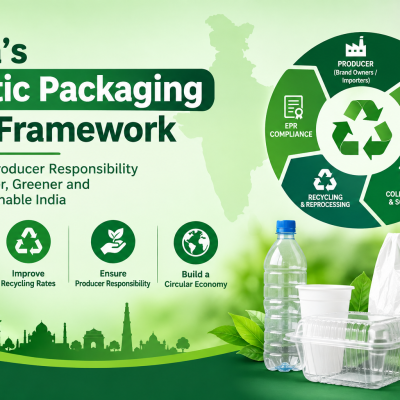
Extended Producer Responsibility essentially extends a business’s responsibility beyond the point of sale. Under India’s Plastic Waste Management Rules, Producers, Importers and Brand Owners have obligations relating to the plastic packaging that they place on the Indian market. The EPR framework was formally incorporated into Schedule II of the Plastic Waste Management Rules through the 16 February 2022 amendment. The framework operates through the CPCB’s digital EPR system.
At a simplified level:
The important shift is that packaging is no longer viewed only as a product component. It is also a regulated material flow.
- The EPR Framework Has Four Major Compliance Levers
The EPR framework does not impose one single obligation. It combines multiple requirements.
| S.No. | EPR Components | What does it mean for businesses? |
| 1) | Recycling | A defined minimum proportion of the EPR-targeted plastic packaging waste must be recycled |
| 2) | Reuse | Applicable to specified Category I rigid plastic packaging used by Brand Owners |
| 3) | Recycled Plastic Content | Specified proportions of recycled plastic must be incorporated into Categories I-III |
| 4) | End-of-Life Disposal | Non-recyclable plastic can be directed to prescribed end-of-life routes |
As specified in the above table, the recycling obligation is category-specific, while recycled-content obligations apply to Categories I, II and III. Reuse obligations apply to specified Category I rigid packaging. This is why simply saying “we are compliant with plastic EPR” is no longer enough.
A company needs to know:
- What is its EPR target ?
- How much needs to be recycled ?
- Whether recycled-content obligations apply ?
- Whether reuse obligations apply ?
- What certificates are required ?
- Whether the underlying transactions can be substantiated ?
- Understanding your Plastic Packaging Category
One of the most important compliance decisions is also one of the simplest: Classify the packaging correctly.
The current framework recognises five categories.
| S.No. | Category | Packaging Type | Regulations associated |
| 1) | Category I | Rigid Plastic Packaging | Recycling, recycled-content and specified reuse obligations |
| 2) | Category II | Flexible plastic packaging, including single- or multilayer plastic structures. | Recycling and recycled-content obligations |
| 3) | Category III | Multilayered packaging containing plastic and at least one non-plastic layer. | Recycling and recycled-content obligations |
| 4) | Category IV | Packaging made from compostable plastics. | Specific recycling/industrial-composting framework |
| 5) | Category V | Packaging made from biodegradable plastics. | Separate category under the amended framework |
The distinction between Category II and Category III is particularly important. A flexible structure made entirely from different types of plastic can fall under Category II. Packaging combining plastic with a non-plastic material, such as a plastic-paper or plastic-aluminium structure, falls under Category III.
- The Numbers Are Becoming More Important
The EPR framework has progressively moved from establishing responsibility to establishing measurable obligations. For Recycling, the minimum level of Recycling of plastic packaging waste collected under the EPR target rises progressively.
Minimum recycling obligation
| S.No. | Financial Year | Category I | Category II | Category III | Category IV |
| 1) | 2024-25 | 50% | 30% | 30% | 50% |
| 2) | 2025-26 | 60% | 40% | 40% | 60% |
| 3) | 2026-27 | 70% | 50% | 50% | 70% |
| 4) | 2027-28 onwards | 80% | 60% | 60% | 80% |
These percentages represent the minimum level of recycling of plastic packaging waste collected under the EPR target, excluding end-of-life disposal.
What does this mean?
Suppose a business has a Category II EPR target of 100 tonnes.
From 2027–28 onwards, the minimum recycling requirement would be 60 tonnes of the plastic packaging waste collected under that EPR target.
The balance cannot simply be treated as recycled material. Where applicable, non-recyclable material moves into the prescribed end-of-life disposal routes.
The direction is unmistakable: The compliance floor keeps rising.
- Recycled Content Is Changing Packaging Procurement
Perhaps the biggest change for packaging procurement is the transition from simply buying plastic packaging to managing the virgin-versus-recycled material mix. The current framework prescribes mandatory recycled plastic content for Categories I, II and III.
Mandatory recycled-content requirements
| S.No. | Plastic Packaging Category | 2025-26 | 2026-27 | 2027-28 | 2028-29 onwards |
| 1) | Category I | 30% | 40% | 50% | 60% |
| 2) | Category II | 10% | 10% | 20% | 20% |
| 3) | Category III | 5% | 5% | 10% | 10% |
These requirements apply to Producers, Importers and Brand Owners according to their respective obligations. The 2026 amendment retained these targets and clarified related provisions concerning statutory exemptions, verification and certificate mechanisms. For Category III, the target is limited to the weight of the plastic layers present in the multilayered packaging. This has a direct business consequence.
Packaging procurement teams increasingly need to ask:
- What polymer is being purchased?
- How much recycled content is incorporated?
- Can the supplier substantiate that recycled content?
- Is the material suitable for the intended application?
- Does the packaging meet applicable standards?
- Can the recycled-content claim be documented for EPR reporting?
In other words: Recycled content is becoming a procurement specification, not merely a sustainability statement.
- Food Packaging Has Another Layer of Compliance
There is an important distinction between EPR compliance and food-contact safety compliance. Meeting a recycled-content target does not automatically mean that recycled plastic is permissible for every food-contact application.
In March 2025, FSSAI amended the Food Safety and Standards (Packaging) Regulations to provide for the use of products made from recycled PET in food packaging, storage, carrying and dispensing applications when the applicable standards and guidelines are notified and complied with.
FSSAI subsequently notified its Guidelines for Acceptance of Recycled Polyethylene Terephthalate (PET) as Food Contact Material (FCM-rPET) on 23 May 2025. The guidelines establish acceptance criteria and require the recycling technology to meet specified safety requirements.
Therefore, businesses should not interpret the EPR recycled-content obligation as: “Use recycled plastic anywhere.”
The correct approach is: Use recycled plastic where legally permitted, technically suitable and compliant with the applicable sectoral requirements.
The 2026 PWM amendment itself recognises exemptions where recycled plastic use is not permitted under applicable laws, regulations, mandatory standards or statutory requirements.
- Reuse Is Becoming a Major Packaging Strategy
Recycling is not the only route being strengthened. The EPR framework also creates reuse obligations for specified Category I rigid plastic packaging used by Brand Owners. The current reuse framework contains different targets based on packaging size and application.
Minimum reuse obligation from 2028–29 onwards
| S.No. | Category I Rigid Packaging | Minimum Reuse Obligation |
| 1) | 0.9 litre/kg or more but below 4.9 litres/kg | 25% |
| 2) | 4.9 litres/kg or more – drinking water | 85% |
| 3) | 4.9 litres/kg or more – products other than drinking water | 15% |
The 2026 amendment revised the reuse provision and retained the phased structure leading to these 2028–29-and-onwards targets.
This changes the commercial question. Instead of asking: “Can we recycle this package?” businesses may increasingly need to ask: “Can this package be used again?”
That can influence:
- Container durability
- Return systems
- Reverse logistics
- Cleaning and refilling infrastructure
- Distribution models
- Packaging specifications
- Customer collection systems
Reuse therefore has the potential to influence the business model itself, not merely the packaging material.
- Packaging Design Is Becoming a Compliance Decision
There is an important distinction here. The EPR framework does not mean that every packaging designer is currently required to follow one universal government-prescribed “design rulebook”. However, the regulatory direction creates a strong commercial incentive to design packaging differently.
The original EPR framework itself identifies sustainable packaging considerations including package design promoting reuse, design amenable to recycling, recycled plastic content and design for the environment.
This means that packaging teams should increasingly evaluate:
1. Material simplicity : Can unnecessary material combinations be avoided?
2. Recyclability : Can the packaging realistically enter an established recycling stream?
3. Layer structure : Does the design move the packaging into Category II or Category III?
4. Recycled-content compatibility : Can the required recycled content be safely and technically incorporated?
5. Reuse potential : Can the package withstand multiple cycles where reuse obligations apply?
6. Documentation : Can the material composition and recycled content be demonstrated?
The result is a new principle: The cheapest package to manufacture is not necessarily the cheapest package to keep compliant.
- EPR Certificates: The Digital Link Between Packaging and Recycling
EPR certificates are a critical part of the compliance architecture. The CPCB portal framework provides for registration of Plastic Waste Processors and generation and transfer of EPR certificates. CPCB has also stated that only registered PWPs can issue certificates that are considered for fulfilment of PIBO obligations.
The basic chain is: PIBO → EPR obligation → Plastic Waste Processor → Processing → EPR certificate → PIBO compliance
But an EPR registration certificate should not be treated as an isolated purchase. CPCB’s implementation and audit directions demonstrate the reason for the same .
CPCB has required verification of matters such as:
- Processing capacity
- Plant and machinery
- GST e-invoices
- Finished-product sales
- Power consumption
- Actual processing activity
Non-compliance identified during PWP audits can result in environmental compensation and regulatory action. So the future of EPR compliance is not simply: “Do I have enough certificates?”
It is: “Can I substantiate the complete compliance trail behind those certificates?”
- Category-wise Surplus Cannot Simply Be Mixed
Another important point for compliance teams is that EPR credits are not an unrestricted pool. The EPR framework provides that surplus in one category can be used for offsetting, carry-forward or sale within the same category. It also specifies different rules for surplus generated from reuse, recycling and end-of-life disposal.
Therefore: Category I surplus is not equal to Category II compliance, and Recycling credit is not equal to unrestricted substitute for every other obligation. This makes correct packaging classification even more important. A classification error at the beginning can flow through to the EPR calculation, certificate procurement and annual return. EPR Registration for Plastic Waste Management.
- Conclusion: Understanding the Rules Is Only the First Step
India’s plastic packaging EPR framework has moved from a broad principle of producer responsibility to a system built around defined packaging categories, measurable targets, recycled-content requirements, reuse obligations and documented compliance.
For businesses, the first challenge is therefore not simply to obtain an EPR registration. It is to understand exactly what packaging they place on the market, where it falls within the EPR framework, what obligations apply to it and how those obligations can be demonstrated through valid records and certificates.
But understanding the obligation is only the beginning. The bigger question is what these requirements mean for the way businesses design, source, manufacture, track and manage packaging. That is where the transformation of India’s plastic packaging industry becomes even more significant.
The next question is no longer simply how to comply with EPR – but how EPR will change the way packaging businesses operate.
- How Kar Parivartan LLP Can Support Your EPR Journey
For businesses navigating India’s evolving plastic EPR framework, compliance often requires more than portal registration.
Kar Parivartan LLP can support businesses with areas such as:
- EPR registration and category classification
- Packaging-data assessment and quantification
- EPR obligation calculation
- Recycled-content and reuse compliance review
- Plastic Waste Processor and EPR certificate verification
- Annual-return preparation and documentation review
- Ongoing monitoring of regulatory amendments and CPCB requirements
The goal is simple: turn EPR from a regulatory burden into a structured compliance system.
- Frequently Asked Questions (FAQs)
- What is EPR for plastic packaging in India?
EPR for plastic packaging is the regulatory framework under the Plastic Waste Management Rules that places defined responsibilities on Producers, Importers and Brand Owners for managing plastic packaging through prescribed recycling, reuse, recycled-content and end-of-life mechanisms.
- What are the five categories of plastic packaging?
The current framework recognises Category I rigid plastic packaging, Category II flexible plastic packaging, Category III multilayered plastic packaging containing plastic and non-plastic layers, Category IV compostable-plastic packaging and Category V biodegradable-plastic packaging.
- What is the recycling target for plastic packaging?
The minimum recycling obligation varies by category and financial year. From 2027–28 onwards, it reaches 80% for Categories I and IV and 60% for Categories II and III.
- What is the recycled-content requirement?
For 2028–29 onwards, the mandatory recycled-content requirement is 60% for Category I, 20% for Category II and 10% for Category III, subject to applicable statutory provisions and exemptions.
- Does recycled content automatically mean that the packaging can be used for food contact?
No. Food-contact applications are subject to applicable FSSAI requirements. FSSAI’s 2025 framework specifically addressed recycled PET and subsequently notified guidelines for acceptance of recycled PET as a food-contact material.
- What is the Common EPR Portal?
The Common EPR Portal is CPCB’s current common digital platform for EPR-related systems. CPCB discontinued the earlier standalone Plastic EPR Portal from 28 June 2026 and migrated registered-user data to the Common EPR Portal.
- Why is EPR data reconciliation important?
Because EPR compliance increasingly depends on traceable records linking packaging quantities, processing transactions, certificates and supporting documents. CPCB’s verification directions demonstrate that PWP capacity, plant and machinery, GST invoices and actual processing can be examined during compliance verification.
- What happens if EPR obligations are not fulfilled?
Specified EPR shortfalls and other violations can attract Environmental Compensation under CPCB’s environmental-compensation framework, in addition to the underlying compliance obligations.
Contact Us
Corporate Office: 431, 3rd Floor, Phase III, Udyog Vihar, Sector 20, Gurugram, Haryana 122016
Dedicated Helplines:
EPR Compliance Advisory: +91-7428728855
Email: info@karparivartan.com