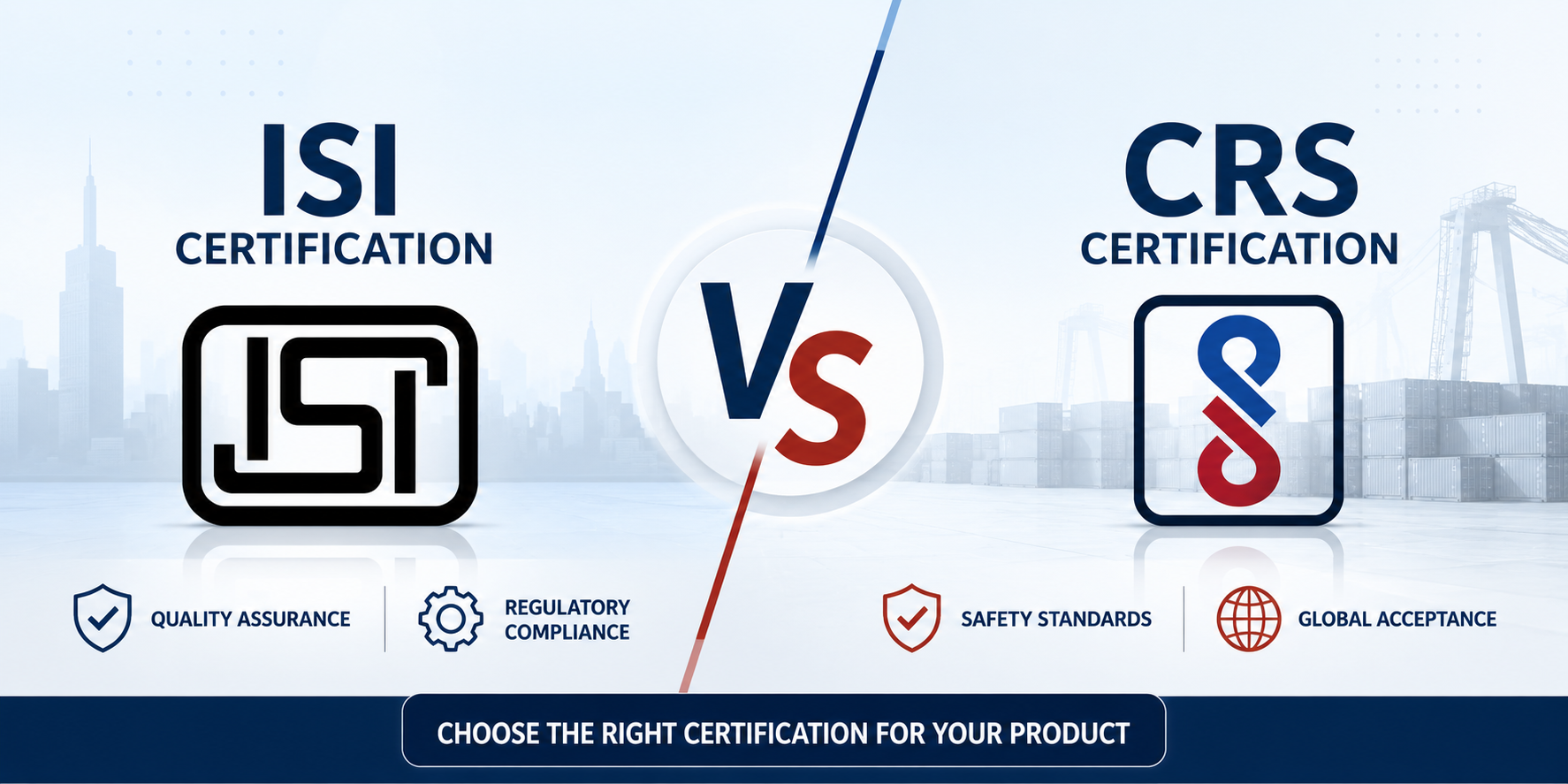
In India, the Bureau of Indian Standards (BIS) regulates product quality and safety through different certification schemes. Two of the most common schemes are the ISI Mark Scheme and the CRS (Compulsory Registration Scheme). Many manufacturers, importers, and brand owners often get confused between these two certifications because both are managed by BIS, but they apply to different product categories and follow different compliance processes. Businesses seeking india bis certification must clearly understand which scheme applies to their products to avoid compliance issues and delays.
This blog explains the major differences between ISI and CRS certification in a simple and practical way.
What is ISI Certification?
The ISI Mark is one of the oldest and most recognized quality certification marks in India. ISI stands for Indian Standards Institute, which was later replaced by BIS. Products certified under this scheme carry the ISI mark, indicating that they comply with the relevant Indian Standard (IS).
ISI certification is mainly applicable to products that impact consumer safety, health, and quality. Many businesses work with bis certification consultants in India to streamline the certification process and ensure proper compliance documentation.
Examples of Products Under ISI Scheme
- Cement
- Electrical appliances
- LPG cylinders
- Packaged drinking water
- Steel products
- Kitchen appliances
- Helmets
- Footwear
- Toys
Under the ISI scheme, BIS conducts:
- Factory inspection
- Product testing in BIS-recognized labs
- Verification of manufacturing infrastructure
- Ongoing surveillance after grant of license
This process is an important part of bis product certification for manufacturers operating in regulated sectors.
What is CRS Certification?
The Compulsory Registration Scheme (CRS) was introduced by BIS in collaboration with the Ministry of Electronics and Information Technology (MeitY). This scheme mainly covers electronics and IT products.
Under CRS, manufacturers are required to get their products tested from BIS-recognized laboratories and register the products with BIS before selling them in the Indian market. Many companies rely on a bis registration consultant in India to manage product testing, documentation, and registration procedures efficiently.
Examples of Products Under CRS Scheme
- Mobile phones
- LED lights
- Power banks
- Laptops
- Smart watches
- CCTV cameras
- UPS/Inverters
- Bluetooth speakers
- LED televisions
Unlike ISI certification, CRS generally does not involve a factory inspection before grant of registration.
Major Differences Between ISI and CRS Scheme
| Basis | ISI Certification | CRS Certification |
| Governing Authority | BIS | BIS |
| Full Form | Indian Standards Institute Mark | Compulsory Registration Scheme |
| Applicable Products | General consumer and industrial products | Electronics & IT products |
| Certification Type | License-based certification | Registration-based certification |
| Factory Inspection | Mandatory | Usually not required before registration |
| Product Testing | Mandatory | Mandatory |
| Mark Used on Product | ISI Mark | Standard Mark with R-number |
| Applicable Standards | Indian Standards (IS) | Indian Standards for Electronics/IT |
| Manufacturer Eligibility | Indian & Foreign Manufacturers | Indian & Foreign Manufacturers |
| Surveillance by BIS | Regular surveillance inspections | Market surveillance/testing |
| Processing Timeline | Usually longer | Comparatively faster |
ISI Mark Structure
Products approved under ISI certification carry:
- ISI logo
- IS standard number
- CM/L license number
This mark indicates that the product continuously complies with BIS quality requirements and applicable regulatory standards.
CRS Marking Requirements
Products under CRS carry:
- BIS Standard Mark
- Registration number (R-number)
- Relevant Indian Standard
Example format:
R-XXXXXXXX
This marking is mandatory before products are sold in India.
Which Scheme Requires Factory Inspection?
This is one of the biggest differences between the two schemes.
ISI Scheme
- BIS officer visits the manufacturing unit
- Manufacturing process and quality controls are verified
- Samples may be drawn during inspection
CRS Scheme
- No routine factory inspection before registration
- Product testing report is the primary requirement
- BIS may conduct surveillance later if required
Companies often use professional bis services to prepare for inspections, testing, and documentation under both schemes.
Testing Requirements in Both Schemes
Both ISI and CRS require product testing from BIS-recognized laboratories.
However:
ISI Scheme
- Testing is often more extensive
- Includes factory sample verification
- Ongoing testing may be required after license grant
CRS Scheme
- Based mainly on laboratory test reports
- Simpler documentation compared to ISI
Validity of Certification
ISI License
- Generally granted for 1–2 years initially
- Requires renewal and surveillance compliance
CRS Registration
- Usually valid for 2 years
- Can be renewed as per BIS guidelines
Importance of BIS Certification
Both ISI and CRS certifications are mandatory for products covered under respective Quality Control Orders (QCOs). Selling non-compliant products in India may lead to:
- Product seizure
- Penalties
- Customs clearance issues
- Legal action
For manufacturers and importers, BIS certification helps in:
- Building customer trust
- Ensuring product quality
- Smooth market entry in India
- Compliance with Indian regulations
Many companies dealing with electronics, batteries, and packaging compliance also consult an epr consultant alongside BIS experts to ensure complete regulatory compliance in India.
Although both ISI and CRS are BIS certification schemes, they differ significantly in terms of product categories, approval process, inspection requirements, and marking systems.
ISI Certification focuses more on product quality and manufacturing control through inspections and surveillance.
CRS Certification mainly applies to electronics and IT products with a simpler registration process based on product testing.
Understanding the correct BIS scheme for your product is essential to avoid delays and compliance issues in the Indian market. Businesses looking for india bis certification often seek support from experienced bis certification consultants in India or a reliable bis registration consultant in India to simplify the approval process and ensure smooth compliance.
If your product falls under mandatory BIS compliance, it is always advisable to consult experts offering bis product certification, bis services, and regulatory guidance to ensure smooth approval and timely certification.