

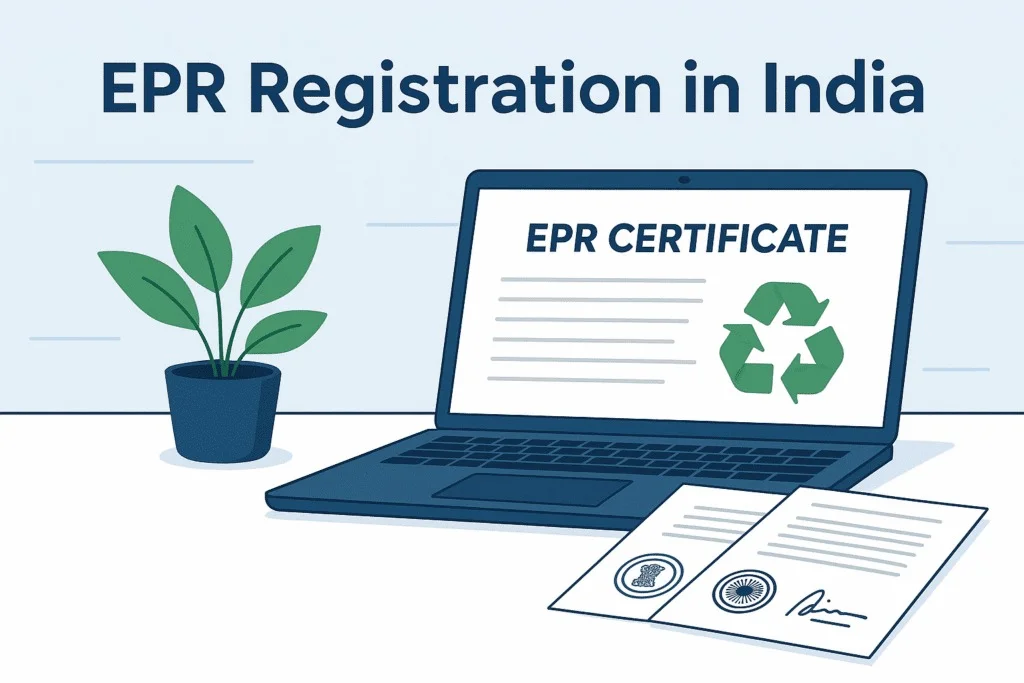
If you’re a manufacturer, importer, brand owner, or producer dealing with electronics, batteries, plastic, tyres, or packaged goods, you’ve probably heard this phrase repeatedly in boardrooms and logistics meetings:
“You need an EPR certificate before you go to market.”
But what exactly does that mean? Why do businesses struggle to obtain it? And most importantly—how can you get your EPR registration certificate easily, without the delays, confusion, and documentation chaos?
Navigating government portals and environmental regulations can feel like walking through a maze blindfolded. In this guide, we break it down step-by-step to turn a complicated compliance requirement into a simple business advantage.
What Is an EPR Certificate and Why Do You Need It?
Before jumping into the “how,” let’s answer the “why.”
An EPR certificate (Extended Producer Responsibility certificate) is an official authorization issued by the CPCB (Central Pollution Control Board) or SPCB (State Pollution Control Board). It authorizes your business to manufacture, import, or sell products that generate specific types of waste—such as e-waste, plastic waste, batteries, tyres, and used oil.
It serves as a confirmation that:
- You are successfully registered on the centralized CPCB EPR portal.
- You are legally compliant with India’s waste management rules.
- You accept responsibility for the waste generated by your products at the end of their life cycle.
- You have a plan in place for proper recycling, collection, and reporting.
In simple terms: EPR registration = Your business license to operate compliantly in the Indian market.
The Cost of Non-Compliance
Without a valid EPR registration certificate, businesses face severe roadblocks, including:
- Customs Blocks: Imported shipments being held at ports.
- Marketplace Bans: Rejection from listing products on Amazon, Flipkart, or Government e-Marketplace (GeM).
- Financial Penalties: Heavy Environmental Compensation (EC) charges.
- Legal Scrutiny: Risk of closure notices or legal action.
- Business Trust: Difficulty in securing vendors, distributors, or environmentally conscious investors.
So the big question is: How do you get your EPR certificate smoothly and quickly?
Common Challenges Businesses Face While Getting an EPR Registration Certificate
If you are reading this, you might already be facing some of these hurdles. The process is designed to be digital, but it is rarely straightforward for first-time applicants.
1. Portal Confusion
The CPCB centralized portal is detailed and highly technical. Navigating the interface, understanding the specific forms, and ensuring data accuracy is often confusing for businesses without a dedicated compliance team.
2. Incorrect Documentation
This is the #1 reason for rejection. Most applications get sent back because documents are uploaded in the wrong format, are missing signatures, or do not align strictly with CPCB guidelines.
3. Matching Product Categories
Do yo know if your product falls under ITEW1 or ITEW6? Many businesses struggle to map their inventory to the correct government codes, leading to misclassification and subsequent delays.
4. Complexity of EPR Targets
Once registered, producers must meet annual recycling targets. Many applicants don’t understand:
- How these targets are calculated based on sales data.
- How recycling credits work.
- How to manage recycling partners legally.
5. Lack of Expert Support
With guidelines evolving constantly (like the recent amendments to the E-Waste and Battery Waste rules), staying updated is a full-time job. Lack of expert support makes the process prone to errors.
Step-by-Step Guide to Getting Your EPR Certificate Easily
Let’s simplify the EPR registration process into a clear, actionable roadmap.
Step 1: Identify Your EPR Category
Every business generating waste needs an EPR certificate under one (or more) distinct categories. You must determine which rules apply to you:
- E-waste EPR: For electronics and electrical equipment.
- Battery Waste EPR: For lead-acid, lithium-ion, and other portable batteries.
- Plastic Waste EPR: For packaging, rigid plastics, and compostable plastics.
- Tyre Waste EPR: For tire manufacturers and importers.
- Used Oil EPR: For importers and producers of lubricating oils.
Interactive Check: Do you know exactly which category your business falls into? If not, that’s your first step—identifying the correct category ensures smooth processing.
Step 2: Prepare Documentation Properly
Documentation is the backbone of your application. Depending on the waste type, you generally need:
- GST certificate & PAN Card.
- Certificate of Incorporation.
- Product technical details (datasheets).
- BIS certificates (if applicable).
- IEC (Import Export Code) for importers.
- Past sales data (to calculate targets).
- Authorized signatory Aadhaar and details.
The Solution: Prepare all documents in a clear, compliant format (usually PDF/JPG within specific size limits). At Kar Parivartan, we create your entire EPR documentation file as per CPCB guidelines to prevent rejection.
Step 3: Register on the CPCB Portal
Once the paperwork is ready, the digital work begins:
- Create an account on the specific CPCB portal.
- Authenticate your business details.
- Fill out the EPR application section-wise.
- Upload the prepared documents.
- Submit the application fee and file for verification.
Have you tried registering on the CPCB portal and found it confusing? You’re not alone. Thousands of businesses face the same challenge every month.
Step 4: Verification by CPCB
After submission, CPCB officials review your application. They check:
- Legitimacy of documents.
- Accuracy of product category mapping.
- Waste responsibility commitments.
If everything is correct, the CPCB grants your EPR registration certificate. If not, they raise “Shortcomings” (queries)—leading to delays of weeks or months.
Our Approach: We ensure that your file is cross-checked by experts before submission to avoid objections entirely.
Step 5: Receive Your EPR Certificate
Once approved, your EPR certificate becomes active on the dashboard. You will receive:
- The official certificate PDF.
- A unique Producer Registration Number.
- Access to the compliance dashboard.
- Your yearly recycling target allocation.
Congratulations—you are now legally compliant!
But Getting the Certificate Is Just the Beginning…
This is the part many businesses misunderstand. The EPR registration certificate is not the final step—it’s the first.
Obtaining the certificate is just the entry pass. To keep it valid, businesses must:
- Track and fulfill annual EPR targets.
- Acquire recycling credits from authorized recyclers.
- Submit quarterly & annual returns.
- Maintain proof of recycling (Audit trail).
- Stay audit-ready for CPCB inspections.
This is where many companies struggle and risk non-compliance penalties even after being registered. That’s exactly why Kar Parivartan exists.
How Kar Parivartan Makes EPR Registration and Certification Easy
Kar Parivartan provides end-to-end EPR management, ensuring zero hassle for companies. We don’t just get you the paper; we manage the process.
Here’s how we simplify it:
1. Expert Category Guidance
We analyze your business model and inventory to identify the correct EPR category instantly, preventing future legal issues.
2. Documentation File Creation
We prepare all required documents in CPCB-approved formats, ensuring your application sails through the first time.
3. CPCB Portal Registration
Our team handles the complete portal signup, data entry, application filling, and submission. You don’t need to learn a new software interface.
4. Objection Handling
If CPCB raises any technical queries or objections, we resolve them promptly so your approval never gets stuck in bureaucratic limbo.
5. Post-Certificate Support
We provide a comprehensive ecosystem:
- Target planning & Strategy.
- Recycling Credit acquisition.
- Recycler onboarding.
- Reporting & Return filing.
- Advisory & Audits.
Our Source-to-Pay EPR model gives businesses a 360° view of their compliance journey—from EPR registration to recycling credits.
Wouldn’t it be easier if your EPR obligations were handled entirely by experts—while you focused on growing your business? That’s the Kar Parivartan advantage.
Getting Your EPR Certificate Doesn’t Have to Be Complicated
With rising environmental laws and increasing CPCB scrutiny, compliance isn’t optional—it’s essential. But the good news? With the right guidance, you can get your EPR registration certificate smoothly, quickly, and without stress.
Whether you’re an MSME, importer, manufacturer, OEM, or brand owner—Kar Parivartan ensures:
- Zero confusion
- Zero rejection
- Zero last-minute panic
Just clear, compliant, end-to-end EPR management.
Ready to Get Your EPR Certificate Easily?
Don’t let compliance delays hold back your business growth.
Drop us a message on WhatsApp today. Our experts will guide you through the entire process from registration to compliance success.


