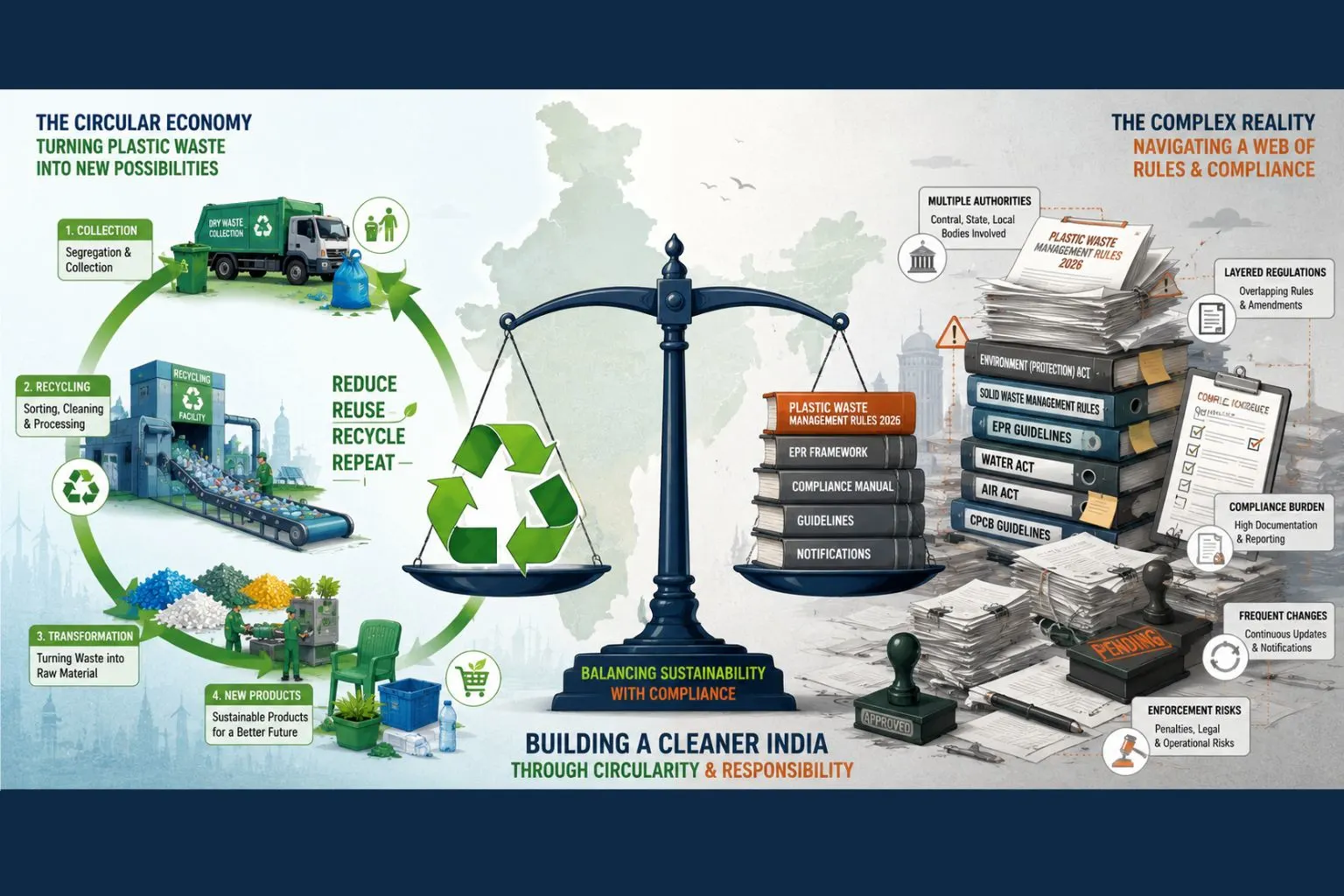
India’s plastic waste management regime is undergoing an important transition. With the 2026 amendment to the Plastic Waste Management Rules, 2016, the regulatory focus has shifted toward flexibility in compliance while retaining ambitious recycling and reuse targets under Extended Producer Responsibility (EPR).
This dual approach, easing penalties while maintaining targets, raises an important question:
Is India strengthening compliance, or delaying accountability?
1. Flexibility in Compliance: Relief or Risk?
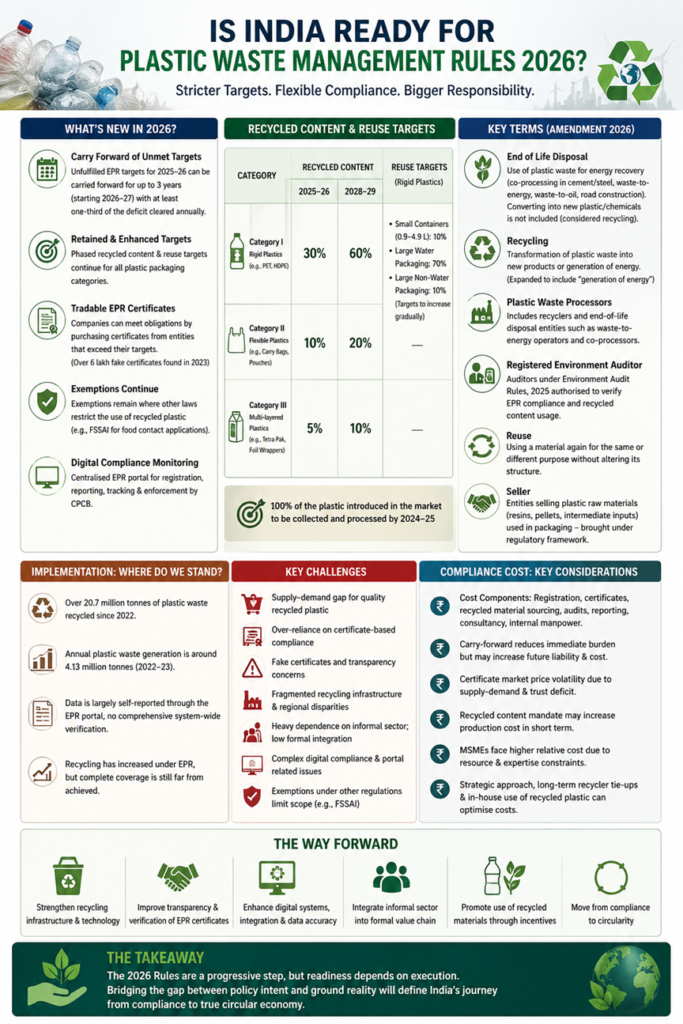
The 2026 amendment allows companies to carry forward unmet EPR targets for up to three years, provided one-third of the deficit is cleared annually.
While this reduces immediate compliance pressure, it may also:
- Delay environmental outcomes
- Encourage short-term non-compliance
- Shift burden to future years
2. Rising Targets for Recycled Content
The rules retain a phased increase in recycled material usage:
- Rigid plastics (Category I): 30% → 60% by 2028–29
- Flexible plastics (Category II): 10% → 20%
- Multi-layered plastics (Category III): 5% → 10%
Additionally, reuse targets for rigid packaging have been introduced, particularly stringent for large water packaging.
This reflects a strong push toward circularity—but supply constraints remain a concern.
3. Certificate-Based Compliance and Credibility Issues
The formalization of tradable EPR certificates offers flexibility. However:
- It enables companies to meet targets without direct recycling
- Over 6 lakh fake certificates were identified in 2023, raising serious concerns about system integrity
This highlights a critical gap between reported compliance and actual material recovery.
4. Data Gaps and Self-Reporting Limitations
Despite digital monitoring through CPCB portals:
- Compliance data largely depends on self-reporting
- There is no comprehensive system-wide verification
While over 20.7 million tonnes of plastic waste have reportedly been recycled since 2022, annual generation (~4.13 million tonnes) indicates that complete coverage is still far from achieved.
5. Expanded Definitions and Wider Accountability
The 2026 amendment broadens the regulatory scope:
- Plastic Waste Processors now include recyclers and end-of-life disposal entities
- Recycling definition expanded to include energy recovery
- Sellers of raw materials brought under compliance
- Introduction of Registered Environment Auditors for verification
This expansion improves coverage but also increases complexity in implementation.
6. Persistent Structural Challenges
- Limited availability of high-quality recycled plastic
- Fragmented recycling infrastructure
- Dependence on informal sector
- Regulatory exemptions (e.g., food-grade packaging restrictions by FSSAI)
These factors continue to affect real-world compliance.
India’s Plastic Waste Management Rules 2026 reflect a mature and evolving regulatory framework. The emphasis on flexibility, traceability, and expanded accountability is a step forward.
However, the system still faces a fundamental challenge:
Bridging the gap between compliance on paper and environmental outcomes on the ground.
Without stronger verification, infrastructure scaling, and alignment across stakeholders, there is a risk that compliance may remain transactional rather than transformational.
The success of the 2026 framework will depend not on targets—but on execution.
FAQs
What are the Plastic Waste Management Rules 2026?
They are the latest amendments to the Plastic Waste Management Rules, 2016, introducing flexible compliance provisions, continued recycled content targets, and expanded accountability under Extended Producer Responsibility (EPR).
What is the key change introduced in 2026?
The major change is the carry-forward provision, allowing companies to meet unmet EPR targets over three years instead of immediate penalties.
What are the recycled content targets under the rules?
Targets vary by category:
- Rigid plastics: 30% increasing to 60%
- Flexible plastics: 10% increasing to 20%
- Multi-layered plastics: 5% increasing to 10%
What is Extended Producer Responsibility (EPR)?
EPR makes producers, importers, and brand owners responsible for the collection, recycling, and proper disposal of plastic waste generated from their products.
How does the EPR certificate system work?
Companies can meet obligations by purchasing certificates from entities that have exceeded recycling targets, creating a tradable compliance mechanism.
What are the concerns with the certificate system?
Issues include lack of transparency, misuse, and cases of fake certificates, raising questions about actual recycling versus reported compliance.
Is India achieving 100% plastic waste recycling?
No. Despite improvements, a gap still exists between total plastic waste generation and actual recycling and processing capacity.
How does the 2026 amendment affect compliance costs?
The carry-forward provision reduces immediate financial burden by allowing companies to spread unmet targets over three years, but it may increase cumulative costs if obligations are delayed.
How do these rules impact industries?
Industries face increased compliance responsibilities, higher demand for recycled materials, operational complexity, and cost implications.
What is required for effective implementation of the 2026 rules?
Key requirements include stronger verification systems, improved recycling infrastructure, better integration of the informal sector, and a shift from certificate-based compliance to actual material recovery.