This blog explains BIS certification in India, its different types, process, costs, and how businesses can choose the right compliance support.
In India, many products need official approval before they can be sold or imported. This is where the Indian BIS certification plays an important role.
It is mandatory for several product categories to ensure safety, quality, and compliance with standards. Manufacturers, importers, and foreign brands dealing with regulated products must complete BIS product certification before entering the Indian market.
However, many businesses find the process confusing due to different certification types and requirements, which often leads to delays or errors.
This blog explains BIS certification in simple terms, including its types, process, cost, and how expert support can make it easier.
What is BIS Certification?
BIS certification is an approval given by the Bureau of Indian Standards to ensure that a product meets required safety and quality standards in India.
In simple terms, it confirms that a product is safe to use and follows Indian regulations before it is sold in the market.
This certification is primarily required for manufacturers, importers, and foreign brands that deal with regulated products, such as electronics, appliances, and industrial goods.
Without BIS approval, many products cannot be legally sold or imported in India.
Types of BIS Certification in India
BIS certification is not the same for all products. It is divided into different types based on where the product is made and what category it belongs to.
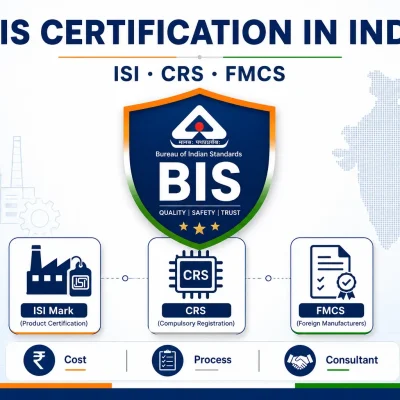
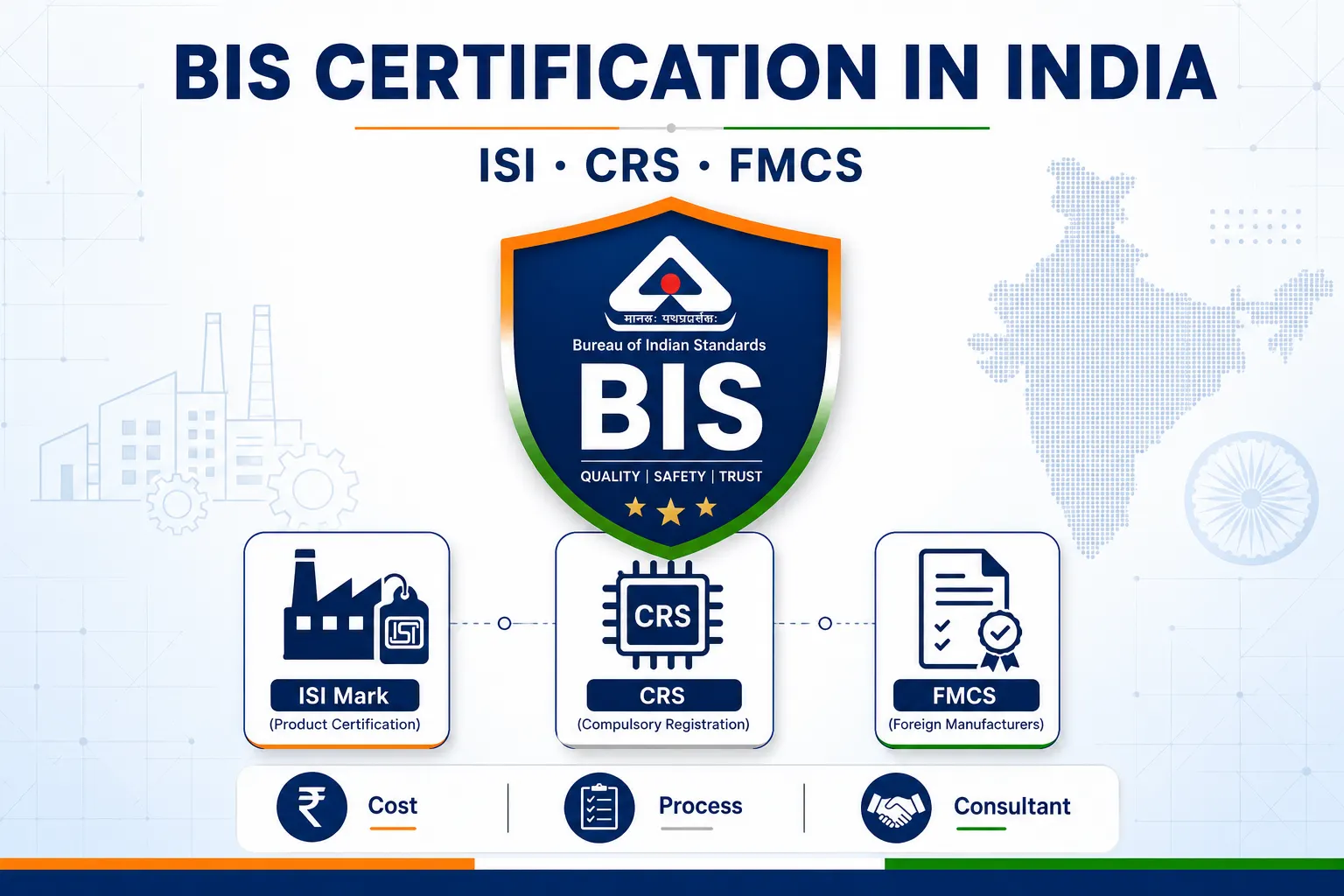
- ISI Certification
ISI certification is mainly for products manufactured within India. It is one of the most common BIS approvals.
Under this scheme, products are tested to ensure they meet Indian safety and quality standards before reaching the market. Manufacturers must follow specific guidelines, and the product is marked with the ISI symbol after approval.
It is commonly used for products like household appliances, cement, steel, and other industrial goods.
- CRS (Compulsory Registration Scheme)
CRS is mainly applicable to electronics and IT products.
Under this scheme, products must be tested in BIS-approved laboratories before being sold in India. Unlike ISI, it is based more on product testing and self-declaration by the manufacturer or importer.
Once approved, the product is listed under BIS registration and can be legally sold in the Indian market.
- FMCS (Foreign Manufacturers Certification Scheme)
FMCS is designed for foreign manufacturers who want to sell their products in India.
During this process, the BIS officers may visit the manufacturing unit in that country to verify whether it conforms to Indian standards. An authorised Indian representative is needed for managing compliance in India.
This certification is required before exporting regulated products into the Indian market.
Each BIS certification type is designed for a different product category, but all ensure one thing: safe, standard-compliant products in India.
Who Needs BIS Certification?
Not every product needs approval, but many regulated categories must have the BIS certification in India before they can be sold or imported.
This applies to a wide range of businesses, especially those working with standard-controlled products.
Here’s who typically needs it:
- Manufacturers in India
Any company producing regulated goods must get BIS approval before selling in the market.
- Importers bringing products into India
Imported goods such as electronics, appliances, and industrial items must comply with BIS rules before entering the country.
- Foreign brands selling in India
Overseas manufacturers must follow FMCS requirements to access the Indian market.
- Businesses dealing with regulated product categories
This includes electronics, electrical goods, construction materials, and more.
BIS Certification Process in India
The process for Indian BIS certification follows a structured approval system designed to check product quality and compliance.
Here are the basic steps:
- Product testing in BIS-approved labs
The product is tested to ensure it meets required safety and quality standards.
- Application submission
Businesses apply through the BIS portal with complete product and company details.
- Document verification
Submitted documents are reviewed for accuracy and compliance.
- Factory inspection (if required)
In some cases, BIS officials may inspect the manufacturing facility.
- Approval and certification issuance
Once everything is verified, BIS grants approval and the product is certified for sale.
The process ensures only tested and approved products enter the Indian market under BIS product certification rules.
Documents Required for BIS Certification
To apply for Indian BIS certification, businesses need to submit specific documents to support their application and product details.
Here are the commonly required documents:
- Company registration details: Basic business documents such as the incorporation certificate, GST, and trade licence.
- Product technical details: Complete information about product design, specifications, and usage.
- Test reports from BIS-approved labs: Proof that the product has passed required safety and quality tests.
- Factory details: Address, setup information, and manufacturing process details.
- Authorised representative documents (for foreign applicants): Required for companies applying under FMCS.
Proper documentation is essential for smooth BIS product certification approval without delays or rejections.
Cost of BIS Certification in India
The cost of an Indian BIS certification varies and depends on several factors. It varies based on product type, certification scheme, and testing requirements.
Here are the main cost components:
- Application fees: Standard fees paid while submitting the BIS application.
- Testing charges: Cost of testing products in BIS-approved laboratories.
- Inspection charges (if applicable): Applicable when BIS conducts factory inspection, mainly under ISI or FMCS.
- Product category variation: Different product types under BIS product certification have different cost structures.
Why BIS Certification Can Be Complex
Getting an Indian BIS certification is not always a smooth process. Many businesses face challenges because the system involves multiple steps, strict checks, and technical requirements.
Here are some common difficulties companies face:
- Multiple Certificate Types:
ISI, CRS, and FMCS each follow different rules, making it difficult for businesses to choose the right path.
- Strict documentation requirements:
Even small errors in paperwork can delay BIS product certification approval.
- Product testing delays:
Testing in BIS-approved labs can take time, especially when demand is high or documentation is incomplete.
- Incorrect product classification:
Choosing the incorrect category often leads to rejection or the need to reapply.
- Frequent updates in compliance rules:
Regulations are updated from time to time, and businesses may miss important changes.
Why BIS Certification Consultants in India Are Important
For a number of firms, managing BIS approval can be cumbersome and complicated. This is the reason why firms resort to engaging with BIS certification consultants in India.
The role of a consultant for firms includes:
- Understand which certification type applies to their product
- Prepare accurate documentation and applications
- Coordinate product testing and compliance steps
- Reduce chances of rejection or delays
- Handle communication with BIS authorities
- Manage approvals for both Indian and foreign manufacturers
Working with a BIS registration consultant in India also helps businesses avoid common compliance mistakes that can slow down approvals.
For companies dealing with multiple products or regulations, expert support makes the entire BIS product certification process more organised and easier to manage.
How to Choose the Right BIS Consultant
Selection of the appropriate consultant is very important for proper and correct BIS approval. The right expert not only assists with proper documentation but also ensures the entire process is handled properly.
Before selecting a consultant, businesses should look for:
- Experience with different BIS schemes like ISI, CRS, and FMCS
- Proper understanding of product categories and compliance requirements
- End-to-end support for documentation, testing, and approvals
- Clear communication and transparent process handling
- Knowledge of updated BIS regulations and standards
Businesses working with experienced BIS certification consultants in India often complete approvals faster and with fewer errors. A trusted BIS registration consultant in India can also help companies manage renewals, compliance updates, and long-term regulatory requirements more efficiently.
Simplifying BIS Certification for Businesses
Understanding Indian BIS Certification will be much simpler if companies understand the distinctions among ISI, CRS, and FMCS certifications. While each form of certification has its own unique process, the objective is essentially the same: to guarantee that products meet quality and safety standards in India.
This process includes steps that must be carried out carefully, such as documentation, testing, approvals, and inspections. This is why so many firms opt for expert BIS certification consultants in India to avoid trouble.
For companies dealing with regulated products, proper BIS product certification is not just a legal requirement but also an important step toward building market trust and smooth business operations.
Kar Parivartan provides structured compliance support for BIS approvals and related regulatory requirements. With support across certification processes, documentation, and compliance management, the focus remains on helping businesses navigate approvals more simply and more organised.