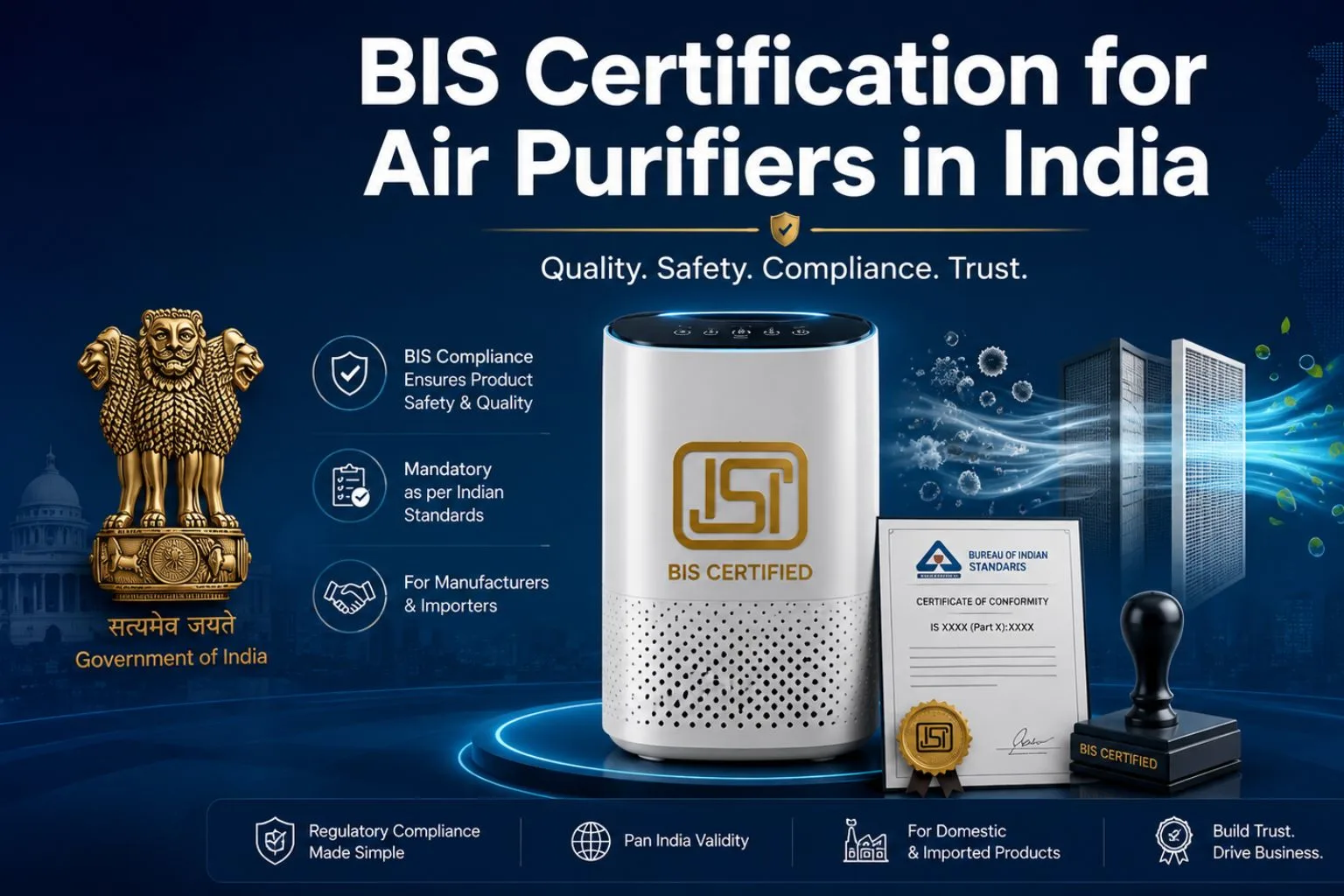
With increasing awareness regarding indoor air quality and health safety, the demand for Air Purifiers in India has increased significantly. To ensure product safety, quality, and performance, manufacturers and importers of Air Purifiers are required to comply with applicable BIS standards and regulatory requirements before selling products in the Indian market.
BIS certification plays an important role in ensuring that air purifiers meet Indian safety standards and electrical performance requirements.
What is an Air Purifier?
An Air Purifier is an electrical appliance designed to improve indoor air quality by removing:
- Dust
- Smoke
- Allergens
- Pollen
- Bacteria
- Odor
- Airborne particles
- PM2.5 pollutants
Air purifiers are widely used in:
- Homes
- Offices
- Hospitals
- Hotels
- Schools
- Commercial Buildings
- Healthcare Facilities
Applicable BIS Standard for Air Purifiers
Air Purifiers generally fall under electrical appliance safety standards and may require BIS certification under applicable Indian Standards depending on product category, design, and functionality.
Commonly applicable standards may include:
- IS 302 (Part 1): Safety of Household and Similar Electrical Appliances
- Relevant product-specific safety standards
- EMI/EMC compliance requirements (where applicable)
Manufacturers must ensure compliance with the latest applicable BIS requirements before market entry.
Is BIS Certification Mandatory for Air Purifiers?
Depending on the notified Quality Control Orders (QCOs) and product category applicability, BIS certification may become mandatory for:
- Indian Manufacturers
- Foreign Manufacturers
- Importers
- Brand Owners
Manufacturers and importers should verify the exact applicability based on:
- Product design
- Voltage rating
- Usage category
- Product functionality
Types of BIS Certification for Air Purifiers
1. ISI Mark Certification
Applicable for products covered under mandatory BIS certification schemes for Indian manufacturers.
2. CRS Registration (Compulsory Registration Scheme)
Applicable for electronic and IT-related products notified under BIS CRS.
3. FMCS Certification
Applicable for foreign manufacturers exporting products to India.
BIS Certification Procedure for Air Purifiers
Step 1 – Product Identification
Identify the applicable Indian Standard and certification scheme.
Step 2 – Documentation Preparation
Common Documents Required
- Business License
- Factory License
- ISO Certificate
- Trademark Authorization (if applicable)
- Product Specifications
- Circuit Diagram
- User Manual
- Test Reports
- PCB Details
- Manufacturing Process
- Authorized Signatory Documents
Step 3 – Product Testing
Samples are tested in BIS-recognized laboratories to verify:
- Electrical safety
- Performance
- Leakage current
- Temperature rise
- Insulation resistance
- Stability & durability
Step 4 – Online Application Filing
Application is submitted through the BIS online portal with supporting documents and test reports.
Step 5 – Factory Inspection (If Applicable)
For certain certification schemes, BIS officials may conduct factory inspection to verify:
- Manufacturing capability
- Quality control system
- Testing infrastructure
- Production process
Step 6 – Grant of BIS License/Registration
After successful evaluation, BIS grants:
- ISI License
or
- CRS Registration Certificate
allowing the manufacturer to use the BIS marking.
Approximate Timeline for BIS Certification
| Activity | Approx Timeline |
| Documentation Preparation | 1–2 Weeks |
| Product Testing | 15–30 Days |
| Application Filing | 2–5 Days |
| Query Handling | 7–20 Days |
| Factory Inspection (if applicable) | 7–15 Days |
| Final Approval | 30–60 Days |
Total Approximate Timeline:
✅ 30–90 Days
(Timeline depends on testing, documentation quality, and BIS queries.)
Important Factors Affecting Approval Timeline
- Product complexity
- Accuracy of technical documents
- Laboratory testing timeline
- Query response time
- Factory preparedness
- Availability of test samples
Benefits of BIS Certification for Air Purifiers
1. Legal Market Access
Allows lawful sale and distribution in India.
2. Consumer Trust
Enhances brand credibility and product reliability.
3. Product Safety Assurance
Ensures compliance with Indian safety standards.
4. Better Business Opportunities
Improves acceptance in retail and institutional procurement.
5. Reduced Regulatory Risk
Helps avoid penalties and market restrictions.
Consequences of Non-Compliance
Selling non-compliant products may lead to:
❌ Product Seizure
❌ Penalties
❌ Import Rejection
❌ Market Restrictions
❌ Legal Action
How Kar Parivartan Can Help
At Kar Parivartan, we provide complete assistance for:
- BIS Certification for Air Purifiers
- CRS Registration
- ISI Mark Certification
- FMCS Certification for Foreign Manufacturers
- Documentation Support
- Product Testing Coordination
- Query Handling
- Factory Audit Assistance
- End-to-End Compliance Support
Our team helps manufacturers and importers achieve smooth and timely BIS approvals with complete regulatory guidance.
📞 +91-7428718855
📧 bis.sales@karparivartan.com
FAQs
Is BIS certification mandatory for Air Purifiers in India?
Applicability depends on the notified standards and product category. Manufacturers should verify the exact compliance requirement before sale or import.
Can foreign manufacturers apply for BIS certification?
Yes. Foreign manufacturers can apply under the BIS Foreign Manufacturers Certification Scheme (FMCS) or CRS, depending on applicability.
Is product testing mandatory?
Yes. Testing in BIS-recognized laboratories is generally required.
What is the approximate BIS certification timeline?
Generally between 30–90 days depending on product category and testing requirements.
What documents are commonly required?
Common documents include:
- Test Reports
- Factory Documents
- Product Specifications
- ISO Certificate
- Trademark Authorization
Technical Documents
Is factory inspection compulsory?
It depends on the certification scheme and product category.
Can importers apply for BIS certification?
Yes. Importers and brand owners may apply depending on the applicable certification model.