

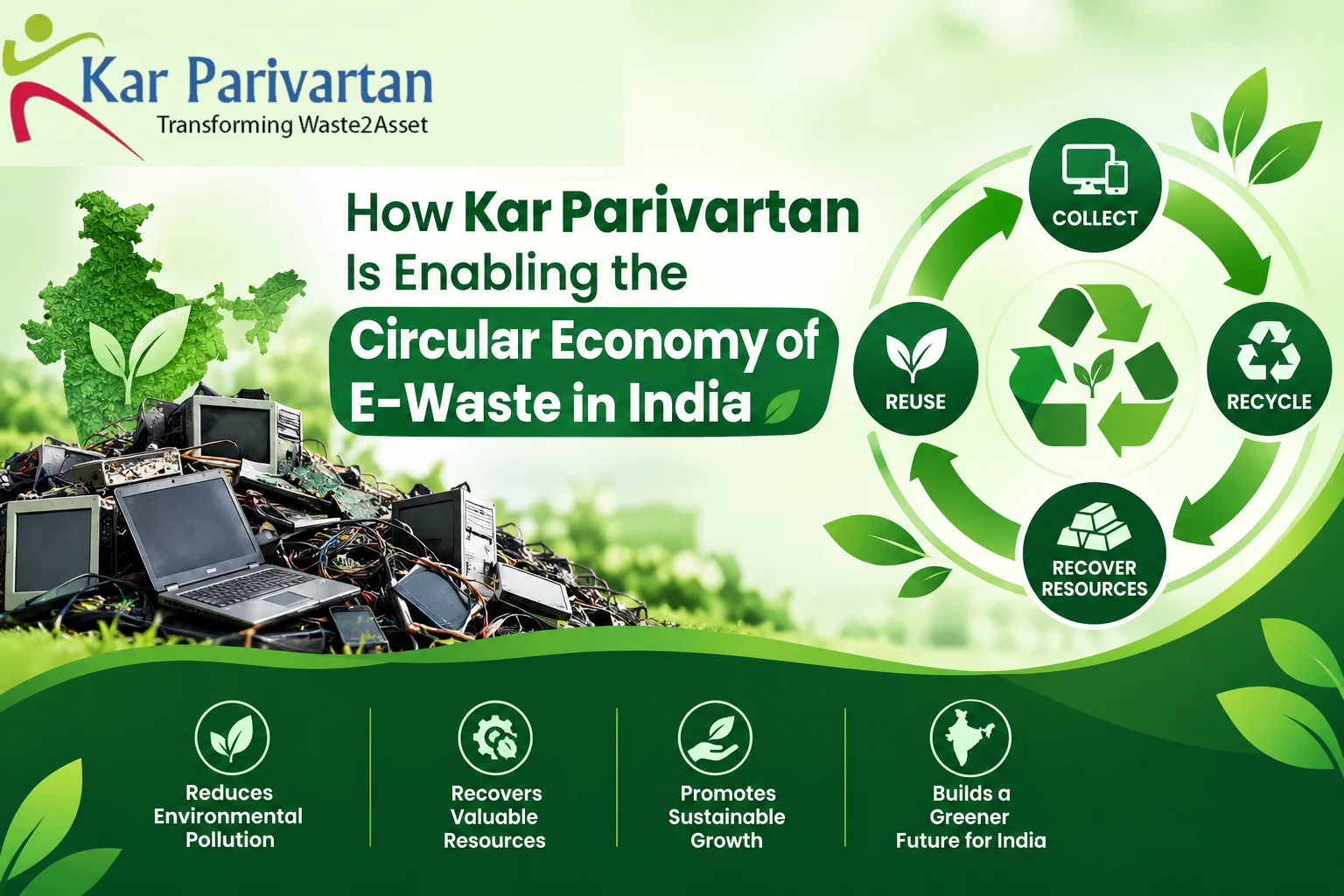
- Introduction: From E-Waste to Economic Value
Electronic products are now an essential part of everyday life. Smartphones, laptops, televisions, IT equipment, appliances and other electrical products are being replaced at an increasing rate.
This creates an important question:
What happens when electronic products reach the end of their useful life?
The answer should not simply be disposal.
It should involve:
– Responsible collection
– Reuse and refurbishment
– Recycling
– Resource recovery
– Reverse logistics
– Traceability
– EPR compliance
– Integration of recovered resources back into the economy
India’s E-Waste Management Rules, 2022 have strengthened this transition by placing Extended Producer Responsibility (EPR) at the centre of e-waste management.
For businesses, this means e-waste is no longer only an environmental issue.
It is becoming a compliance, resource-efficiency and circular-business opportunity.
Kar Parivartan supports businesses through its “E-Waste EPR Compliance services” (https://www.karparivartan.com/e-waste-management/), helping connect regulatory obligations with responsible recycling and resource recovery.
—
- What Is E-Waste?
In simple terms:
E-waste refers to discarded electrical and electronic equipment and its components.
Examples include:
– Computers and laptops
– Mobile phones
– Televisions
– Printers
– Networking equipment
– IT and telecom equipment
– Electrical appliances
– Electronic components
E-waste is different from ordinary waste because it can contain both:
Valuable resources
– Copper
– Aluminium
– Iron
– Gold
– Other recoverable materials
Potentially hazardous substances
Improper dismantling, processing or disposal can create environmental and occupational risks.
Therefore, the objective should be:
Collect → Reuse/Refurbish → Recycle → Recover → Reintroduce resources
—
- Why Is E-Waste a Circular Economy Opportunity?
A traditional linear economy follows:
Take → Make → Use → Dispose
A circular economy aims to create:
Design → Use → Reuse → Repair → Refurbish → Recycle → Recover → Remanufacture
The key difference?
Waste becomes a potential secondary resource.
For electronics, recycling can recover valuable materials that can potentially re-enter industrial supply chains.
This is why e-waste should not be viewed only as a disposal problem.
It should be viewed as a resource recovery opportunity.
For a broader understanding of India’s transition toward EPR and circularity, businesses can also explore Kar Parivartan’s “Circular Economy, EPR & Digital Compliance Ecosystem in India”.
—
- India’s E-Waste EPR Framework: The Basics
The E-Waste Management Rules, 2022 introduced a stronger EPR-based framework for covered electrical and electronic equipment.
The framework focuses on:
– Producer responsibility
– Registered recyclers
– Recycling targets
– EPR certificates
– Refurbishing
– Digital reporting
– Traceability
– Documentation
– Compliance monitoring
For companies trying to understand the practical side of compliance, Kar Parivartan’s “EPR Compliance & Advisory services” cover registration, reporting, target fulfilment and other EPR requirements.
Business perspective
The important shift is:
EPR is not simply a certificate or registration.
It creates a system connecting:
Producer → EPR obligation → Collection → Recycling → Resource recovery → Compliance
—
- Where Does Kar Parivartan Fit Into This Ecosystem?
Kar Parivartan works at the intersection of:
– Regulatory compliance
– Waste management
– Recycling
– Reverse logistics
– Traceability
– EPR credit fulfilment
– Circularity
Its “E-Waste EPR Management” approach includes strategy and budgeting, authorised recycler identification, traceability, audit readiness and documentation.
The simplified ecosystem looks like:
Producer/Importer
↓
EPR Strategy
↓
Waste Collection
↓
Reverse Logistics
↓
Verified/Authorised Recycler
↓
Recycling & Resource Recovery
↓
EPR Credit
↓
Compliance & Reporting
This connects the regulatory side of EPR with the physical movement of waste.
—
- EPR Compliance: Turning Regulation Into Action
The business challenge
For producers and importers, e-waste EPR can involve:
– Understanding applicability
– Product categorisation
– EPR target calculation
– Registration
– Recycler selection
– Credit fulfilment
– Documentation
– Reporting
– Audit preparedness
Kar Parivartan’s “EPR Compliance & Advisory” model helps businesses manage these requirements through an end-to-end approach.
Why does this matter for circularity?
Because compliance creates demand for legitimate recycling.
That helps move the market from:
Unstructured disposal → Formal recycling → Resource recovery
—
- Building a Verified Recycler Ecosystem
A circular economy depends on what happens after collection.
Simply collecting e-waste does not guarantee that it will be recycled responsibly.
Businesses need to consider:
– Recycler authorisation
– Facility capability
– Processing capacity
– Documentation
– Traceability
– Input-output records
– Environmental compliance
Kar Parivartan’s “Recycler Due Diligence & Audit services” focus on verifying recycler partnerships and supporting compliant recycling.
Business value
For producers:
– Lower compliance risk
– Better traceability
– Improved vendor governance
For recyclers:
– Access to organised waste streams
– Corporate partnerships
– Better capacity utilisation
For the ecosystem:
More trust + better documentation + stronger formal recycling
—
- Reverse Logistics: Bringing E-Waste Back Into the System
Circularity cannot happen if discarded electronics never reach the formal recycling system.
The basic flow:
Consumer/Business
↓
Collection
↓
Transportation
↓
Authorised Recycler
↓
Recycling/Refurbishment
↓
Resource Recovery
Kar Parivartan provides “Waste Collection & Logistics Coordination” to support the movement of waste through appropriate channels.
Why is this important?
Recycling infrastructure alone is not enough.
The material has to physically reach the right facility.
—
- Traceability: The Missing Link in Circularity
A circular economy needs to answer:
Where did the waste go?
And:
What happened to it after collection?
A traceable e-waste chain can include:
– Waste source
– Collection records
– Transportation details
– Recycler details
– Processing records
– Recycling quantities
– EPR certificates
– Documentation
– Reporting
Kar Parivartan’s “E-Waste EPR process” includes traceability and audit-readiness as important components.
Business learning
Traceability supports:
– Regulatory compliance
– Audits
– ESG reporting
– Vendor management
– Sustainability claims
– Internal governance
—
- EPR Certificates: Creating a Market Mechanism
EPR creates an economic connection between recycling activity and producer responsibility.
Simplified model:
Producer has EPR obligation
↓
Registered recycler processes eligible e-waste
↓
Eligible recycling activity generates EPR certificate
↓
Producer fulfils applicable EPR obligation
This creates a relationship between:
Recycling + Compliance + Economic value
Kar Parivartan’s “Source-to-Pay (S2P) EPR model” is designed around sourcing, validation and submission of verified EPR credits.
Why does this matter?
It helps move the conversation from:
“How do I meet my target?”
to:
“How can my compliance contribute to a verified recycling ecosystem?”
—
- From Waste Management to Resource Management
This is one of the biggest lessons from the circular economy.
The old question:
How do we dispose of e-waste?
The new question:
How do we recover maximum value from e-waste?
Electronic products contain materials that required:
– Mining
– Energy
– Manufacturing
– Transportation
– Capital investment
Recovering these materials can contribute to:
– Resource conservation
– Secondary raw materials
– Material efficiency
– Reduced resource pressure
– Circular supply chains
Kar Parivartan’s “Corporate Sustainability & Circularity” approach focuses on connecting compliance with resource recovery and circular supply chains.
—
- Refurbishment: Extending Product Life
Recycling should not always be the first option.
If a product can be repaired, upgraded or refurbished safely, its useful life can be extended.
A circular hierarchy can look like:
Reuse
↓
Repair
↓
Refurbish
↓
Recycle
↓
Resource Recovery
Why does refurbishment matter?
It can create:
– Longer product life
– Affordable electronics
– Secondary markets
– Employment
– Reduced demand for new products
– Better resource efficiency
This demonstrates an important circular-economy principle:
The highest-value option is often to keep the product in use for longer.
—
- Moving Businesses From Compliance to Circularity
There is an important difference between EPR compliance and circular business strategy.
Compliance asks:
– Are we registered?
– What is our EPR target?
– Have we fulfilled the target?
– Are our records complete?
– Have we filed our returns?
Circularity asks:
– What happens to our products after use?
– Can we improve collection?
– Can products be refurbished?
– Can components be reused?
– Can recovered materials enter our supply chain?
– Can we reduce material consumption?
Kar Parivartan’s “Circularity as a Service (CaaS)” is designed to help businesses move beyond compliance toward systems that turn waste streams into resources.
—
- Creating Business Value From E-Waste
The circular economy creates opportunities for multiple stakeholders.
For Producers and Importers
– EPR compliance
– Better traceability
– Reduced regulatory risk
– ESG performance
– Take-back systems
For Recyclers
– Organised waste streams
– Corporate partnerships
– Better capacity utilisation
– EPR certificate generation
For Collection & Logistics Companies
– Reverse logistics opportunities
– Organised collection networks
– Corporate contracts
– Tracking systems
For Businesses
– Resource recovery
– Sustainability reporting
– Better vendor governance
– Circular procurement
For the Indian economy
– Secondary raw materials
– Employment
– Recycling infrastructure
– Resource efficiency
– Formalisation of waste management
—
- Why E-Waste Matters for India’s Circular Economy
India is developing EPR frameworks across several waste streams.
These include:
– Plastic waste
– E-waste
– Battery waste
– Waste tyres
– Used oil
– End-of-life vehicles
– Other emerging waste categories
This broader regulatory direction indicates a shift from:
Waste disposal → Recycling → Resource recovery → Circularity
For businesses operating across multiple waste streams, Kar Parivartan’s “Multi-Category EPR Advisory” can help integrate compliance requirements across categories.
—
- Kar Parivartan’s Circular E-Waste Model
The overall approach can be understood through six stages.
1. Assess
Understand the company’s products, operations and EPR applicability.
2. Plan
Map obligations, targets, timelines and compliance requirements.
3. Channelise
Move e-waste through appropriate collection and logistics channels.
4. Recycle/Refurbish
Send materials to appropriate authorised facilities.
5. Verify
Maintain documentation, traceability and audit trails.
6. Comply & Improve
Fulfil EPR obligations while identifying opportunities for greater circularity.
In simple terms:
Compliance + Collection + Traceability + Recycling + Resource Recovery = Circular E-Waste Management
—
- What Businesses Can Learn From the E-Waste Circular Economy
The biggest learning is:
Circularity does not happen only at the recycling plant.
It requires coordination across the entire value chain.
Businesses should focus on:
– Design: Consider product life and recyclability.
– Collection: Develop effective take-back systems.
– Traceability: Know where waste goes.
– Verification: Work with credible recycling partners.
– Data: Maintain accurate EPR records.
– Recovery: Focus on material value.
– Refurbishment: Extend product life wherever possible.
– Compliance: Treat EPR as an ongoing process.
– Circularity: Connect recovered resources with future supply chains.
For businesses looking at sustainability beyond regulatory compliance, Kar Parivartan’s “Corporate Sustainability & Circularity solutions” (https://www.karparivartan.com/corporate-sustainability-circularity/) provide a pathway toward integrating circularity with business strategy.
—
- The Future: From EPR Compliance to Circular Supply Chains
The next phase of India’s e-waste ecosystem will be about more than simply meeting an EPR target.
Businesses will increasingly need to ask:
“How circular is our product lifecycle?”
The future model can be visualised as:
Product
↓
Consumer
↓
Collection
↓
Reverse Logistics
↓
Reuse / Refurbishment / Recycling
↓
Material Recovery
↓
Secondary Resources
↓
New Production
This is where circular economy becomes a business strategy rather than simply a waste-management activity.
—
- Conclusion
India’s e-waste challenge is also a significant circular-economy opportunity.
The objective should not simply be to move e-waste from one location to another.
It should be to:
– Keep products in use longer
– Recover valuable materials
– Improve traceability
– Strengthen formal recycling
– Reduce resource losses
– Create economic value from waste
Kar Parivartan works across these interconnected areas through “EPR Compliance & Advisory”.
The bigger opportunity is to move from:
“EPR as a compliance obligation”
to
“EPR as an enabler of circular business.”
That is how e-waste can move from being a waste-management challenge to becoming a source of resources, resilience and sustainable business value.
—
Frequently Asked Questions
1. What is e-waste EPR in India?
E-waste EPR is a regulatory mechanism that places responsibility on applicable producers and other stakeholders for managing the end-of-life impact of covered electrical and electronic equipment.
2. Is EPR mandatory for e-waste in India?
Businesses covered under the applicable E-Waste Management Rules must comply with the relevant registration, target, recycling, reporting and documentation requirements.
3. What does Kar Parivartan do for e-waste EPR?
Kar Parivartan supports businesses with e-waste EPR registration, target planning, recycler identification, waste channelisation, EPR credit fulfilment, documentation and reporting. Businesses can explore its “E-Waste EPR services”.
4. How does e-waste contribute to the circular economy?
E-waste contains recoverable materials. Responsible recycling allows valuable materials to be recovered and potentially returned to productive economic use.
5. What are EPR certificates?
EPR certificates are compliance instruments associated with eligible recycling activities under the applicable regulatory framework and can be used by obligated entities to meet applicable EPR obligations.
6. Why is recycler verification important?
Recycler verification helps businesses reduce the risk of working with unsuitable facilities and improves the credibility and traceability of their recycling chain.
Businesses can learn more about this through Kar Parivartan’s “Recycler Due Diligence & Audit services” (https://www.karparivartan.com/services-solutions/).
7. What is reverse logistics in e-waste management?
Reverse logistics refers to the organised movement of end-of-life electronic products or waste from consumers or businesses back to appropriate collection, refurbishment or recycling facilities.
8. Can e-waste be refurbished instead of recycled?
Yes. Where an electronic product can safely be used again after repair or refurbishment, extending its useful life can retain more value than immediately recycling it.
9. How can companies improve their e-waste compliance?
Companies should:
– Identify applicable EPR obligations
– Maintain accurate product data
– Complete required registration
– Calculate applicable targets
– Work with appropriate recyclers
– Maintain recycling documentation
– Track EPR certificates
– Complete required reporting
– Maintain audit-ready records
Kar Parivartan’s “EPR Compliance & Advisory” services cover these areas.
10. How does e-waste EPR support India’s circular economy?
EPR creates a connection between producers, collection systems, recyclers and resource recovery. This can strengthen formal recycling, increase material recovery and support India’s transition from a linear to a circular economy.
Key Takeaway
E-waste is not the end of a product’s lifecycle. It can be the beginning of a new resource cycle.
The circular pathway is:
EPR Obligation → Collection → Traceability → Authorised Recycling → Resource Recovery → EPR Compliance → Circular Economy
And the bigger business opportunity is to transform compliance into circular value.


