

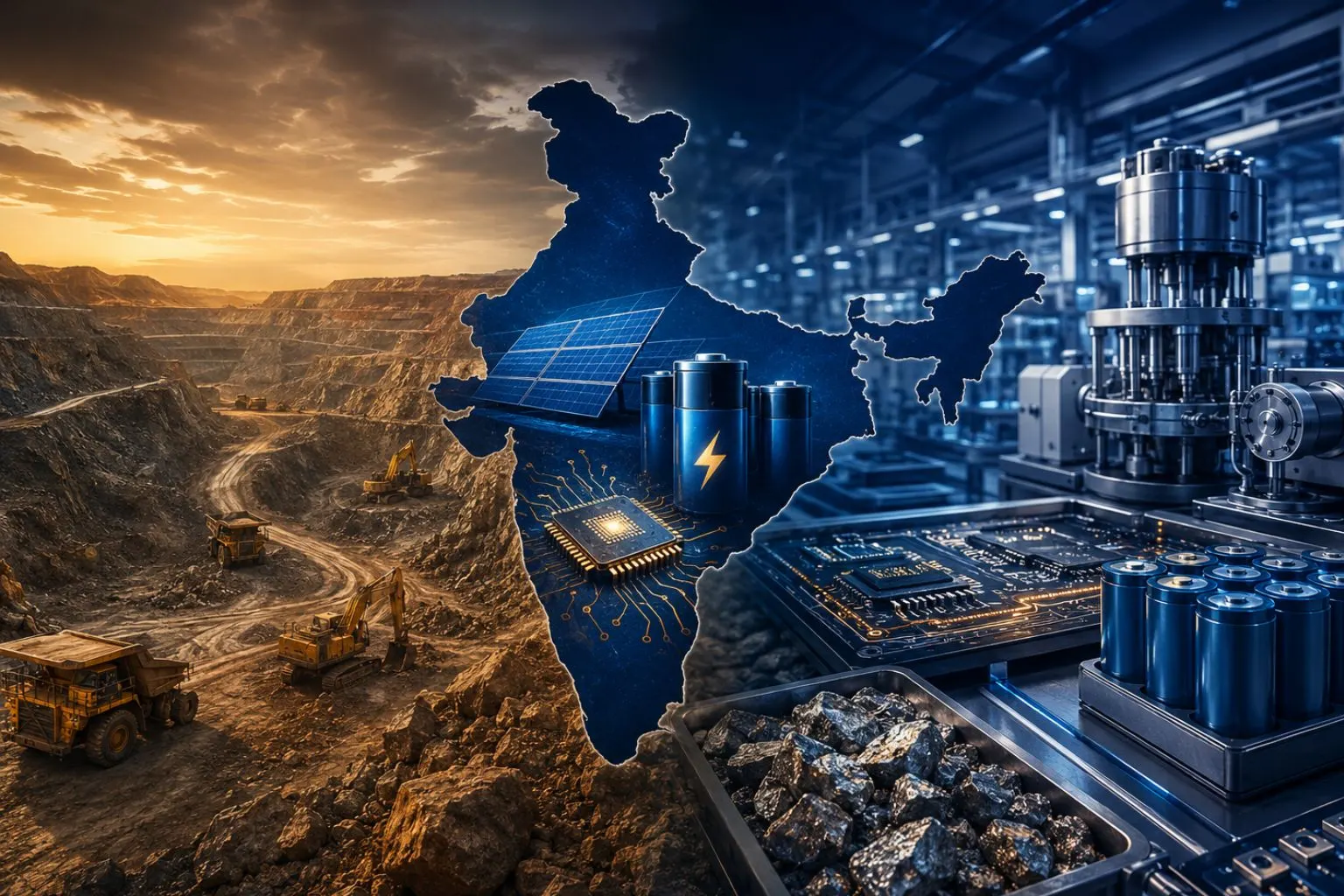
India’s growth, driven by clean energy, electric mobility, and digital expansion, relies heavily on a group of materials known as critical minerals. These include lithium, cobalt, nickel, and rare earth elements, all of which are essential for batteries, electronics, and renewable technologies.
As demand rises sharply, a key concern emerges:
How can India ensure long-term access to these materials in a sustainable and reliable way?
The Real Challenge: Not Just Scarcity, but Dependence
The issue goes beyond simple availability. It is closely linked to control over supply chains and long-term access.
- Geographical concentration of resources:
Critical minerals are largely concentrated in a few countries. This creates dependency risks where supply disruptions, caused by geopolitical tensions or trade restrictions, can directly affect industries.
- Import dependence and price volatility:
Heavy reliance on imports exposes India to fluctuating global prices. This leads to cost instability and uncertainty for industries. As imports of batteries, electronics, and raw materials continue to rise, compliance requirements such as EPR registration for import are also becoming increasingly important for businesses operating in these sectors.
- Environmental cost of mining:
Extraction processes involve intensive land use, water consumption, and emissions. This contradicts sustainability goals associated with clean energy transitions.
The challenge, therefore, is not only about availability but about secure, stable, and responsible access to resources.
A Hidden Opportunity: E-Waste as a Secondary Resource
E-waste represents a highly concentrated and underutilized source of critical materials.
- Material richness of e-waste:
Electronic devices contain valuable elements such as precious metals, battery materials, and rare earth components. In many cases, their concentration is higher than that found in natural ores.
- Untapped resource potential:
With rapid digitalization, e-waste generation is increasing continuously, creating a consistent stream of recoverable materials.
- Shift in perception:
E-waste should not be treated merely as waste. It should be recognized as a strategic secondary resource that can support domestic material security.
This introduces the concept of urban mining, which focuses on recovering value from materials already in circulation.
Why This Shift is Critical
Transitioning from a linear system to a circular approach is essential.
- Reducing import dependency:
Domestic recovery of materials reduces reliance on global supply chains and enhances national resilience.
- Lower environmental impact:
Recycling requires less energy than mining and significantly reduces ecological damage.
- Economic value creation:
A well-developed recycling ecosystem can generate employment, promote innovation, and create new industrial opportunities.
Circularity transforms waste into a valuable economic and strategic asset.
Systemic Barriers Holding Back Progress
1. Informal Recycling Dominance
A significant portion of e-waste is processed informally:
- Unsafe and inefficient recovery practices
- Loss of high-value materials
- Environmental and health risks
2. Weak Collection and Reverse Logistics
Collection remains the weakest link:
- Limited consumer awareness
- Lack of incentives for proper disposal
- Inconsistent supply to recyclers
3. Limited Advanced Recycling Infrastructure
Recovering critical and rare earth elements requires:
- Advanced technologies
- High capital investment
- Skilled technical expertise
Most existing systems focus only on basic metal recovery.
4. Gaps in Traceability and Market Development
- Difficulty in tracking material flow
- Lack of standardized pricing mechanisms
- Limited trust in recycled materials
These gaps restrict the development of a formal and transparent market.
The Way Forward: Building a Circular Resource Ecosystem
1. Strengthening Collection Systems
- Establish structured and accessible collection networks
- Introduce consumer incentives such as buy-back schemes
- Increase awareness about safe disposal practices
2. Integrating the Informal Sector
- Provide training and certification
- Include informal workers in formal systems
- Ensure safe and environmentally compliant practices
3. Investing in Advanced Recycling Technologies
- Develop efficient extraction methods for rare earth elements
- Promote low-impact processes such as hydrometallurgy and bioleaching
- Encourage research and industry collaboration
4. Creating Market Demand for Recycled Materials
- Establish quality and performance standards
- Promote industry adoption of recycled inputs
- Encourage green procurement practices
5. Strengthening Policy and Institutional Frameworks
- Improve enforcement and compliance monitoring
- Enhance digital traceability systems
- Provide incentives for recycling investments
Rethinking Resource Security
The future of critical minerals lies not only in natural reserves but also in materials already present within products and waste streams.
E-waste represents both a current inefficiency and a future opportunity. With the right systems in place, it can become a reliable source of critical materials. In this transition, the role of an EPR consultant becomes increasingly important in helping businesses build compliant and efficient recycling and resource recovery systems.
India’s approach to resource security must evolve from extraction to efficient resource circulation.
By aligning technology, policy, industry participation, and consumer behavior, it is possible to build a system that is resilient, sustainable, and economically viable.
The focus now should not be on whether circularity is needed, but on how quickly it can be implemented at scale.
FAQs
What are critical minerals?
Critical minerals are essential raw materials required for modern technologies but have limited supply and high economic importance, such as lithium, cobalt, and rare earth elements.
What is the difference between rare earth and critical minerals?
Rare earth elements are a specific group of 17 elements, while critical minerals include a broader category of materials essential for industry and energy systems.
Why is India dependent on imports for these minerals?
India has limited domestic reserves and relies on global supply chains, which are concentrated in a few countries.
What is urban mining?
Urban mining refers to the process of recovering valuable metals from waste, especially e-waste, instead of extracting them from natural ores.
Why is e-waste important for critical mineral recovery?
E-waste contains high concentrations of valuable metals, often more than traditional mining sources, making it a key secondary resource.
What are the main challenges in e-waste recycling in India?
- Informal sector dominance
- Poor collection systems
- Lack of advanced recycling technology
- Weak traceability
Can rare earth elements be recovered from e-waste?
Yes, but recovery is technically complex and still developing, requiring advanced processing technologies.
How does recycling help in sustainability?
Recycling reduces:
- Environmental damage from mining
- Energy consumption
- Waste generation
What role do businesses play in this ecosystem?
Businesses are responsible for:
- Managing end-of-life products
- Supporting recycling systems
- Adopting circular economy practices
What is the future of critical mineral management in India?
The future lies in:
- Circular economy models
- Advanced recycling technologies
- Strong policy frameworks
- Reduced dependence on imports


