

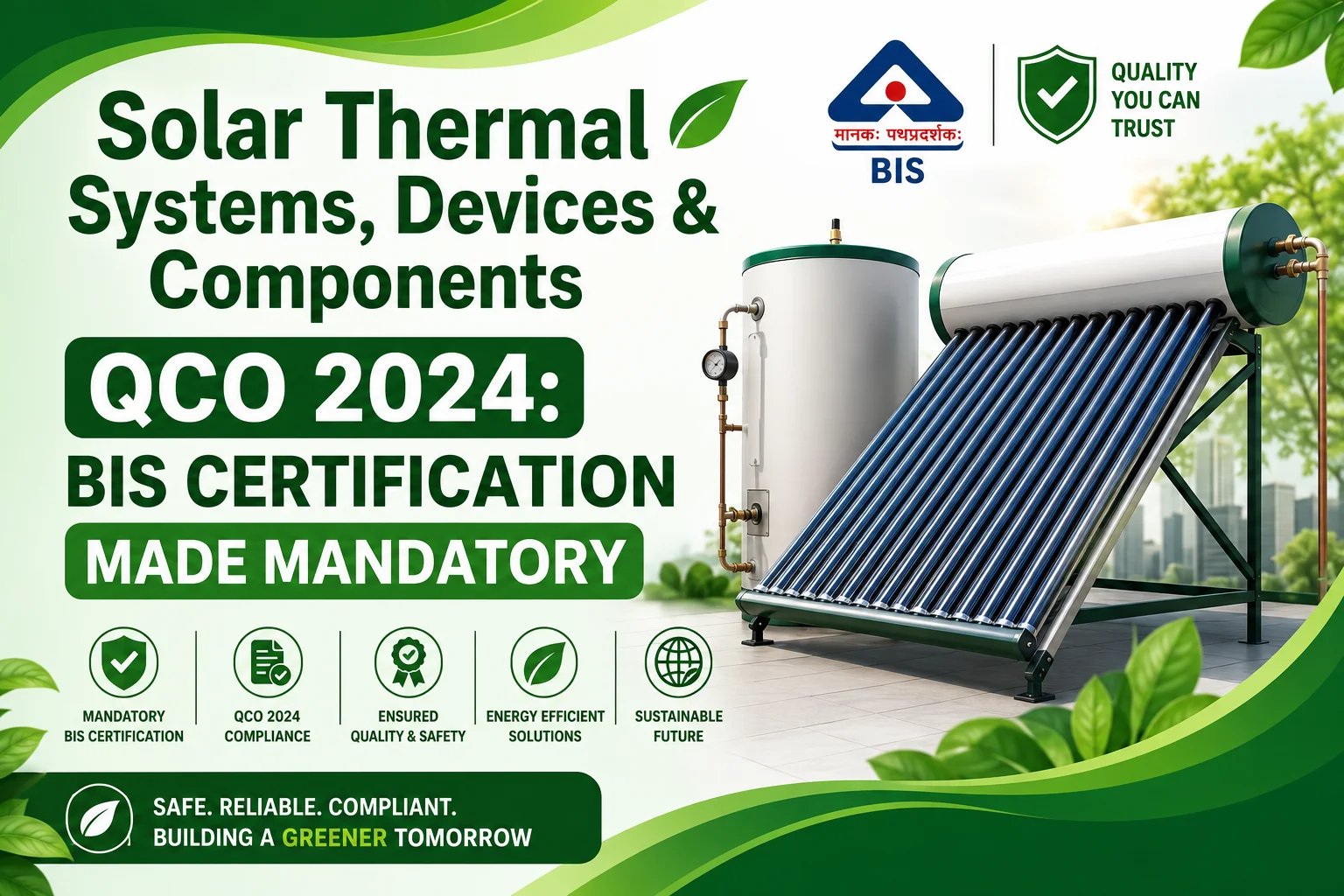
The Government of India has introduced the Solar Thermal Systems, Devices and Components (Quality Control) Order, 2024 to ensure that specified solar thermal products supplied in the Indian market conform to the applicable Indian Standards.
The Order was issued by the Ministry of New and Renewable Energy (MNRE) in consultation with the Bureau of Indian Standards (BIS) and was published in the Official Gazette on 14 October 2024.
Under this QCO, specified solar thermal products are required to conform to the applicable Indian Standards and carry the BIS Standard Mark under a BIS licence under Scheme-I.
Implementation Date
The QCO states that it will come into force 180 days from the date of its publication in the Official Gazette. Since the notification was published on 14 October 2024, the Order became effective on:
12 April 2025
Therefore, manufacturers and other stakeholders dealing with the products covered under this QCO should ensure BIS compliance from the implementation date.
Products Covered Under the QCO
The Order covers the following three categories of products:
| S. No. | Product | Applicable Indian Standard |
| 1 | Solar Flat Plate Collector for Solar Water Heating Systems | IS 12933 (Part 1): 2003 – Requirements |
| IS 12933 (Part 2): 2003 – Components | ||
| 2 | All Glass Evacuated Tubes Solar Water Heating System | IS 16544:2016 |
| 3 | Storage Water Tank for All Glass Evacuated Tubes Solar Water Heating Systems | IS 16542:2016 |
These products and their corresponding standards are specifically listed in the Schedule to the QCO.
What Does the QCO Require?
As per the Order, the specified products must:
- Conform to the applicable Indian Standard.
- Obtain the required BIS certification/licence.
- Bear the BIS Standard Mark under the licence.
- Follow Scheme-I of Schedule-II of the BIS (Conformity Assessment) Regulations, 2018.
This means that manufacturers covered by the QCO cannot simply manufacture or supply the specified products without completing the applicable BIS certification requirements.
Who Is Affected?
The QCO applies to the goods/articles specified in its Schedule.
Accordingly, businesses manufacturing the following products for the Indian market should evaluate their BIS applicability:
- Solar Flat Plate Collectors
- All Glass Evacuated Tube Solar Water Heating Systems
- Storage Water Tanks for All Glass Evacuated Tube Solar Collectors
The Order specifically states that it does not apply to goods or articles meant for export.
Indian Manufacturers
Indian manufacturers producing the covered products for the domestic market need to obtain the applicable BIS licence and comply with the relevant Indian Standard.
Foreign Manufacturers
Foreign manufacturers supplying covered products to India should assess their BIS certification requirements before placing products in the Indian market. The QCO itself establishes mandatory conformity with the applicable Indian Standards and use of the Standard Mark under a BIS licence. Foreign Manufacturers Certification Scheme.
Exporters
Products meant specifically for export are outside the scope of this particular QCO.
BIS Certification Procedure
For manufacturers covered under the QCO, the general BIS certification process can be approached in the following stages:
Step 1 – Product Applicability Assessment
First, identify whether the product falls under any of the three categories specified in the QCO and determine the applicable Indian Standard.
Step 2 – Review of Applicable Standard
The product and manufacturing process should be evaluated against the relevant standard:
- IS 12933 (Part 1): 2003
- IS 12933 (Part 2): 2003
- IS 16544:2016
- IS 16542:2016
Step 3 – Documentation
Prepare the required technical and manufacturing documents, which may include:
- Manufacturing process details
- Product specifications
- Raw material details
- Test reports
- Factory details
- Quality control arrangements
- Testing facilities
- Equipment details
- Calibration records
- Quality control personnel details
- Other documents required by BIS
Step 4 – Product Testing
The product is required to be evaluated/tested against the applicable requirements of the relevant Indian Standard through the applicable BIS-recognised testing mechanism.
Step 5 – BIS Application
The manufacturer submits the BIS application along with the required documents, test reports and prescribed fees.
Step 6 – BIS Scrutiny / Assessment
BIS reviews the application and supporting documents. Depending on the applicable certification route, further assessment and factory verification may be required.
Step 7 – Grant of BIS Licence
After successful completion of the applicable requirements, BIS grants the licence to the manufacturer.
Step 8 – Use of BIS Standard Mark
Once the licence is granted, the manufacturer can use the BIS Standard Mark on the covered product in accordance with the applicable licence conditions.
Expected Timeline
The actual timeline depends on factors such as:
- Product complexity
- Testing requirements
- Availability of testing facilities
- Readiness of manufacturing documentation
- Factory preparedness
- BIS scrutiny and queries
- Inspection/assessment requirements
- Closure of non-conformities, if any
Therefore, manufacturers should not wait until the point of dispatch or import to begin the certification process.
For a properly prepared application, the certification process can be planned in advance based on the applicable BIS route and testing requirements.
Consequences of Non-Compliance
The QCO makes BIS the certifying and enforcing authority for the covered products. BIS, or agencies notified by BIS in consultation with MNRE, may conduct market surveillance to ensure conformity with the applicable Indian Standards.
The Order specifically provides that a person contravening its provisions shall be punishable under Section 29(3) of the Bureau of Indian Standards Act, 2016.
Therefore, non-compliance can expose businesses to regulatory enforcement and penalties under the BIS Act.
Manufacturers should also consider the commercial consequences of non-compliance, including potential disruption to the supply of covered products and difficulties during regulatory or market surveillance activities.
Important: Latest Version of the Standard
The QCO contains an important clarification regarding revisions to Indian Standards.
It states that the latest version of the Indian Standard established and published by BIS from time to time shall apply from the date of its publication.
Manufacturers should therefore continuously monitor updates to the relevant standards rather than relying only on the version mentioned in the original QCO.
Key Takeaways
QCO: Solar Thermal Systems, Devices and Components (Quality Control) Order, 2024
Issuing Ministry: Ministry of New and Renewable Energy (MNRE)
Publication Date: 14 October 2024
Implementation: 180 days from publication
Effective Date: 12 April 2025
Certification Authority: Bureau of Indian Standards (BIS)
Certification Scheme: Scheme-I of Schedule-II under BIS (Conformity Assessment) Regulations, 2018
Products Covered:
- Solar Flat Plate Collector for Solar Water Heating Systems
- All Glass Evacuated Tubes Solar Water Heating System
- Storage Water Tank for All Glass Evacuated Tubes Solar Water Heating Systems
Export Exemption: Products meant for export are excluded from the QCO.
Marking Requirement: BIS Standard Mark under a BIS licence
Penalty: Contravention is punishable under Section 29(3) of the BIS Act, 2016.
Frequently Asked Questions (FAQs)
1. When did the Solar Thermal Systems QCO 2024 come into force?
The Order was published on 14 October 2024 and provides for implementation after 180 days. Accordingly, it came into force on 12 April 2025.
2. Is BIS certification mandatory for the products covered under this QCO?
Yes. The specified products must conform to the applicable Indian Standards and bear the BIS Standard Mark under a BIS licence.
3. Which products are covered?
The QCO covers Solar Flat Plate Collectors, All Glass Evacuated Tubes Solar Water Heating Systems and Storage Water Tanks for All Glass Evacuated Tube Solar Water Heating Systems.
4. Does the QCO apply to products manufactured only for export?
No. The Order specifically states that it does not apply to goods or articles meant for export.
5. Can a manufacturer use the BIS Standard Mark without a BIS licence?
No. The QCO requires the covered products to bear the Standard Mark under a BIS licence.
6. What happens if a company does not comply?
Contravention of the Order is punishable under Section 29(3) of the BIS Act, 2016. BIS is also the certifying and enforcing authority and may conduct market surveillance.
7. Do manufacturers need to monitor future changes in the standard?
Yes. The QCO states that the latest version of the applicable Indian Standard published by BIS will apply from the date of its publication.
How Kar Parivartan Can Help
Kar Parivartan assists manufacturers, importers and businesses in understanding and managing their BIS compliance requirements.
Our support can include:
- Product applicability assessment
- Identification of applicable Indian Standard
- BIS certification strategy
- Documentation support
- Testing coordination
- BIS application support
- Factory assessment preparation
- Query resolution support
- BIS licence assistance
- Compliance and renewal support
If your company manufactures or imports solar thermal systems, solar collectors or related components, it is important to assess the applicability of the QCO before continuing commercial supply in India.
Contact Kar Parivartan today to assess your product’s BIS applicability and certification requirements.


