
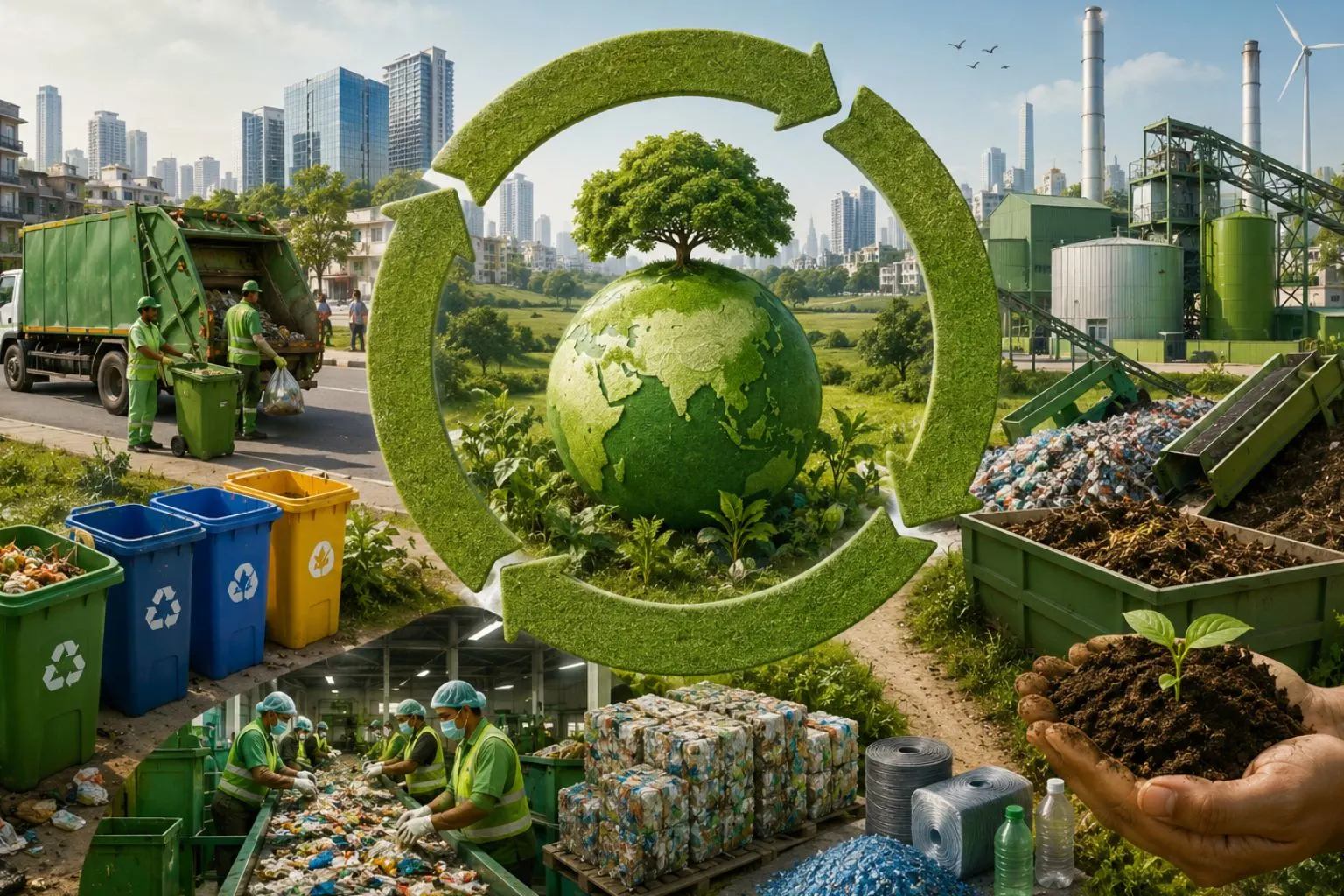
For decades, solid waste management in India was viewed as a municipal service focused on collection and disposal. Today, the sector is undergoing a structural transformation. Regulatory reforms, technological innovation, and increasing private sector participation are creating a rapidly expanding market for waste processing, recycling, compliance services, and resource recovery.
The Solid Waste Management Rules, 2026, which came into force on 1 April 2026, have significantly strengthened India’s waste governance framework. The Rules mandate four-stream source segregation, introduce digital tracking of waste, strengthen the “Polluter Pays” principle, redefine Bulk Waste Generators (BWGs), and integrate circular economy principles into municipal waste management. These changes are not only environmental reforms—they are creating new business opportunities across the waste value chain. (Source: MoEFCC/PIB)
1. Material Recovery Facilities (MRFs): Turning Waste into Revenue
India’s recycling industry depends on efficient segregation. Material Recovery Facilities recover paper, plastics, metals, glass, and other recyclables before they reach landfills.
The new Rules require dry waste to be channelled to MRFs, increasing demand for:
– Automated sorting technologies
– Optical sorting systems
– Conveyor and baling equipment
– Recycling companies
– Plastic aggregators
Cities investing in MRF infrastructure are recovering higher-value recyclables while reducing landfill dependency.
2. Organic Waste Processing Is a Growing Investment Segment
More than half of municipal solid waste in many Indian cities is biodegradable. Instead of landfilling this material, municipalities and private operators are investing in:
– Composting plants
– Biomethanation facilities
– Bio-CNG production
– Organic fertilizer manufacturing
A practical example is Indore Municipal Corporation, which has developed multiple PPP-based waste processing facilities, including Bio-CNG plants and Material Recovery Facilities. The city continues to expand its “Waste to Wealth” model by establishing a textile waste recycling plant that converts discarded clothing into reusable yarn while generating revenue for the municipal corporation.
3. Public-Private Partnerships Are Driving Industry Growth
Waste management is increasingly becoming a Public-Private Partnership (PPP) business rather than a purely municipal function.
Companies such as Re Sustainability manage municipal, industrial, hazardous, and biomedical waste while recovering recyclable materials and generating electricity from waste. The company reports managing approximately 10 million tonnes of waste annually in India.
Similarly, Antony Waste Handling Cell Ltd. has developed integrated municipal waste management projects across multiple Indian cities, providing collection, transportation, processing, and landfill management services under long-term municipal contracts.
These examples demonstrate that waste management has evolved into a mature infrastructure business supported by long-term contracts and recurring revenue.
4. Technology Companies Have Entered the Waste Sector
Modern waste management extends beyond collection vehicles.
New opportunities exist in:
– IoT-enabled smart bins
– GPS-based fleet tracking
– AI-powered waste sorting
– Digital waste tracking platforms
– Environmental data analytics
– Carbon accounting software
The SWM Rules, 2026 require online tracking and monitoring across the waste management chain, accelerating demand for digital solutions.
5. Investors Are Betting on the Circular Economy
According to investment guidance prepared for India’s municipal solid waste sector, opportunities now span collection, transfer stations, processing facilities, recycling infrastructure, biomethanation, RDF production, waste-to-energy, and landfill remediation. Growing regulatory certainty and increasing municipal investment are attracting private capital into the sector.
India’s waste sector is shifting from a public sanitation challenge to a circular economy industry. The combination of stronger regulation, mandatory compliance, digital monitoring, and private investment is creating opportunities for consultants, technology providers, recyclers, equipment manufacturers, infrastructure developers, and financial investors.
For businesses, the question is no longer whether waste management will become a major industry—it already has. The opportunity now lies in identifying where to participate in this rapidly expanding value chain.
About Kar Parivartan
Kar Parivartan is an environmental consulting and sustainability advisory firm committed to helping businesses navigate India’s evolving environmental regulations while advancing circular economy practices.
Our expertise includes:
- Solid Waste Management Rules, 2026 compliance
- Extended Producer Responsibility (EPR) advisory
- Waste audits and resource recovery strategies
- Environmental compliance and regulatory support
- Circular economy and ESG consulting
- Sustainability training and capacity building
We work with industries, local bodies, bulk waste generators, recyclers, producers, and other stakeholders to transform regulatory compliance into sustainable business value through practical, end-to-end environmental solutions.
Partner with Kar Parivartan to build a compliant, circular, and sustainable future.


