

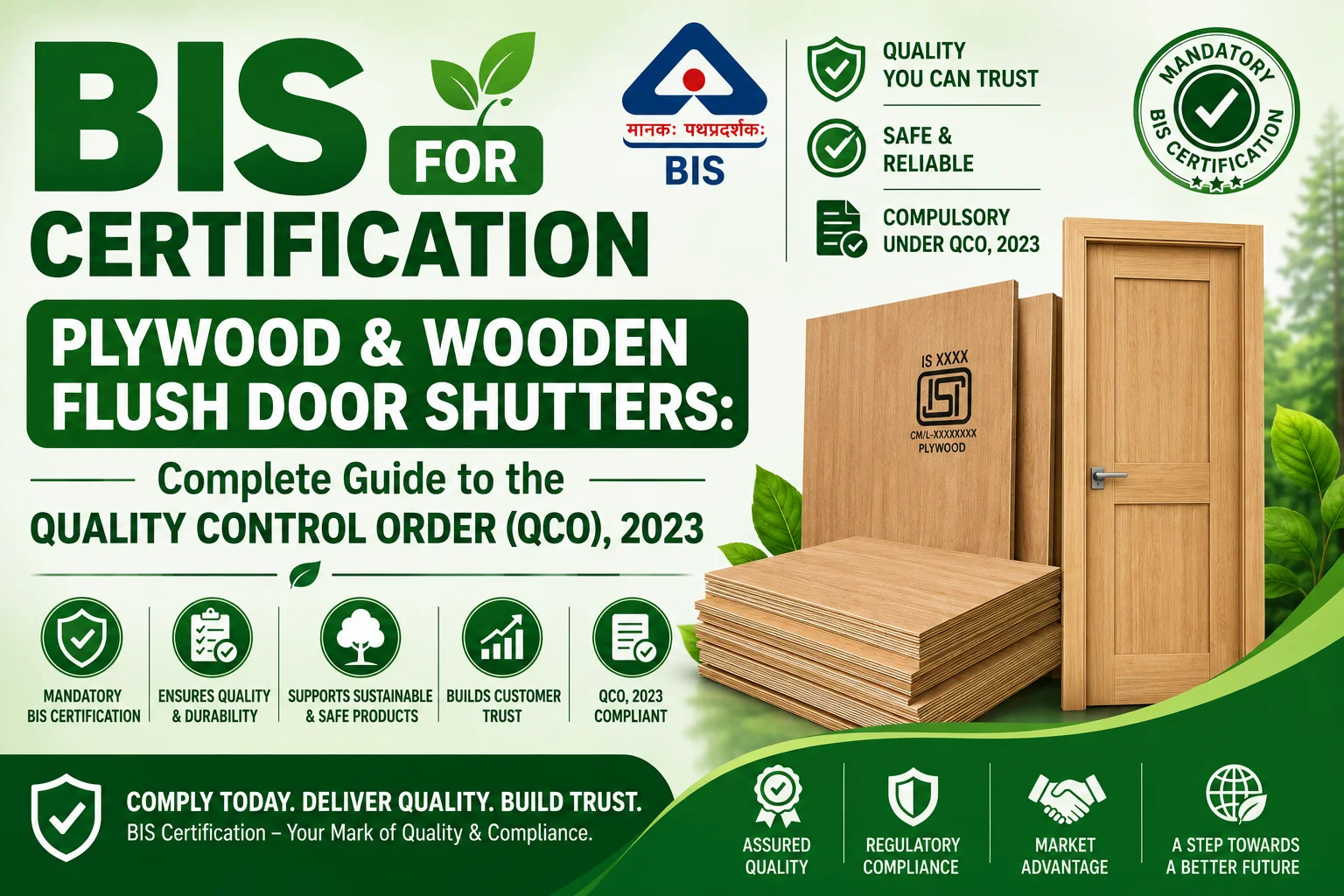
Is Your Plywood or Flush Door Manufacturing Business Ready for Mandatory BIS Certification?
India’s construction and furniture industries rely heavily on plywood and wooden flush door shutters. To ensure consistent quality, durability, and consumer safety, the Government of India has made BIS certification mandatory for specified plywood and wooden flush door shutter products through the Plywood and Wooden Flush Door Shutters (Quality Control) Order, 2023.
If you are an Indian manufacturer or a foreign manufacturer planning to supply these products in the Indian market, understanding the BIS requirements is essential. Non-compliance can result in legal action, disruption of sales, and reputational damage.
At Kar Parivartan, we provide complete BIS certification consultancy services, helping manufacturers obtain their BIS licence efficiently while ensuring full regulatory compliance.
What is the Plywood and Wooden Flush Door Shutters (Quality Control) Order, 2023?
The Department for Promotion of Industry and Internal Trade (DPIIT), Ministry of Commerce & Industry, issued the Plywood and Wooden Flush Door Shutters (Quality Control) Order, 2023 on 29 August 2023. The Order mandates that the specified products must conform to the applicable Indian Standards and bear the BIS Standard Mark (ISI Mark) under a valid BIS licence granted under Scheme-I of the BIS Conformity Assessment Regulations, 2018. Products manufactured domestically for export are exempt from the Order.
Implementation Timeline
The implementation date varies based on the category of enterprise:
| Category | Effective From |
| Large Enterprises | 6 months from the notification date |
| Small Enterprises | 9 months from the notification date |
| Micro Enterprises | 12 months from the notification date |
The notification was issued on 29 August 2023, with staggered implementation for MSMEs.
Products Covered Under the QCO
The Order applies to Plywood and Wooden Flush Door Shutters covered under the following Indian Standards:
| Product | Indian Standard |
| Plywood for General Purposes | IS 303:1989 |
| Wooden Flush Door Shutters (Solid Core Type – Plywood Face Panels) | IS 2202 (Part 1):1999 |
| Marine Plywood | IS 710:2010 |
| Fire Retardant Plywood | IS 5509:2021 |
| Veneered Decorative Plywood | IS 1328:1996 |
| Wooden Flush Door Shutters (Cellular & Hollow Core – Particle Board/Hardboard Face Panels) | IS 2191 (Part 2):2022 |
| Wooden Flush Door Shutters (Cellular & Hollow Core – Plywood Face Panels) | IS 2191 (Part 1):2022 |
| Wooden Flush Door Shutters (Solid Core Type – Particle Board/HDF/MDF/Fibre Hardboard Face Panels) | IS 2202 (Part 2):2022 |
| Plywood for Concrete Shuttering Works | IS 4990:2011 |
| Structural Plywood | IS 10701:2012 |
Who Needs BIS Certification?
BIS certification is mandatory for:
- Indian manufacturers of covered plywood products
- Indian manufacturers of wooden flush door shutters
- Foreign manufacturers exporting covered products to India (through the Foreign Manufacturers Certification Scheme – FMCS)
Note: BIS licences are issued only to manufacturers. Importers, distributors, traders, and retailers cannot obtain a manufacturing licence.
Why is BIS Certification Important?
A valid BIS licence enables manufacturers to:
- Comply with Indian regulatory requirements.
- Legally manufacture and sell covered products in India.
- Use the ISI Mark on certified products.
- Improve product quality and customer confidence.
- Participate in government procurement and infrastructure projects.
- Enhance market credibility and brand reputation.
BIS Certification Process
Step 1 – Determine Product Applicability
Identify whether your product falls under the notified QCO and determine the applicable Indian Standard.
Step 2 – Prepare Manufacturing Facility
Ensure your factory has:
- Adequate production facilities
- Quality control systems
- In-house testing equipment as required by the applicable standard
- Qualified technical personnel
Step 3 – Product Testing
Submit product samples to a BIS-recognized laboratory for testing against the applicable Indian Standard.
Step 4 – Documentation
Prepare all necessary documents, including:
- Factory registration documents
- Manufacturing process flow
- Machinery list
- Testing equipment details
- Calibration certificates
- Quality control documents
- Product specifications
- Test reports
- Trademark authorization (if applicable)
Step 5 – Online BIS Application
Submit the BIS application with the required documents and laboratory test reports.
Step 6 – Factory Inspection
BIS officers inspect the manufacturing facility, review quality systems, and verify testing capabilities.
Step 7 – Resolution of Observations
If BIS raises observations during document scrutiny or inspection, the manufacturer must address them within the prescribed timeframe.
Step 8 – Grant of BIS Licence
After successful evaluation, BIS grants the licence, allowing the manufacturer to affix the ISI Mark on certified products.
BIS Certification Timeline
| Manufacturer | Approximate Timeline |
| Indian Manufacturer | 30–45 working days* |
| Foreign Manufacturer (FMCS) | 4–6 months* |
*Timelines may vary depending on document readiness, laboratory testing schedules, factory inspection, and BIS observations.
Documents Required
Commonly required documents include:
- Company incorporation or factory registration certificate
- GST registration
- Manufacturing process flow chart
- Factory layout
- List of machinery
- List of testing equipment
- Calibration certificates
- Product specifications and drawings
- Raw material details
- Quality manual
- BIS laboratory test reports
- Authorized signatory documents
- Trademark authorization (if applicable)
Additional documents may be requested depending on the product and manufacturing setup.
Consequences of Non-Compliance
Failure to comply with the Quality Control Order may result in:
- Prohibition on manufacturing or selling the notified products in India.
- Seizure or detention of non-compliant products by enforcement authorities.
- Monetary penalties and prosecution under the Bureau of Indian Standards Act, 2016.
- Suspension of business operations involving the covered products.
- Loss of customer trust and commercial opportunities.
- Delays in supplying products to infrastructure, government, and institutional projects.
The QCO specifically states that violations are punishable under the provisions of the BIS Act, 2016.
How Kar Parivartan Can Help
At Kar Parivartan, we offer complete BIS consultancy services, including:
- Product applicability assessment
- Identification of the correct Indian Standard
- Documentation preparation
- Coordination with BIS-recognized laboratories
- BIS application filing
- Factory audit preparation
- Assistance in responding to BIS queries
- FMCS support for foreign manufacturers
- Renewal and post-certification compliance services
Our experienced team works closely with manufacturers to simplify the certification process and minimize delays.
Frequently Asked Questions (FAQs)
Is BIS Certification mandatory for plywood and wooden flush door shutters?
Yes. The specified products covered under the Quality Control Order, 2023 must comply with the applicable Indian Standards and bear the BIS Standard Mark under a valid licence.
Which products are covered?
The Order covers various categories of plywood and wooden flush door shutters, including general-purpose plywood, marine plywood, fire-retardant plywood, decorative plywood, structural plywood, and specified flush door shutters.
Does the Order apply to export products?
No. Products manufactured domestically exclusively for export are exempt from the Order.
Who can obtain the BIS licence?
Only manufacturers are eligible for the BIS manufacturing licence. Traders and importers cannot obtain the licence in their own name.
How long does the certification process take?
Typically:
- Indian manufacturers: 30–45 working days
- Foreign manufacturers: 4–6 months
Actual timelines depend on testing, inspections, and BIS review.
What happens if a manufacturer does not comply?
Non-compliance may lead to penalties under the BIS Act, product seizure, prohibition on sale, and other enforcement actions.
Can Kar Parivartan manage the complete BIS certification process?
Yes. We provide end-to-end assistance—from applicability assessment and documentation to laboratory coordination, application filing, audit support, and post-certification compliance.
Contact Kar Parivartan
If you manufacture plywood or wooden flush door shutters and need assistance with BIS certification, our experts are ready to help.
Email: bis.sales@karparivartan.com
Phone: +91-7428718855


