

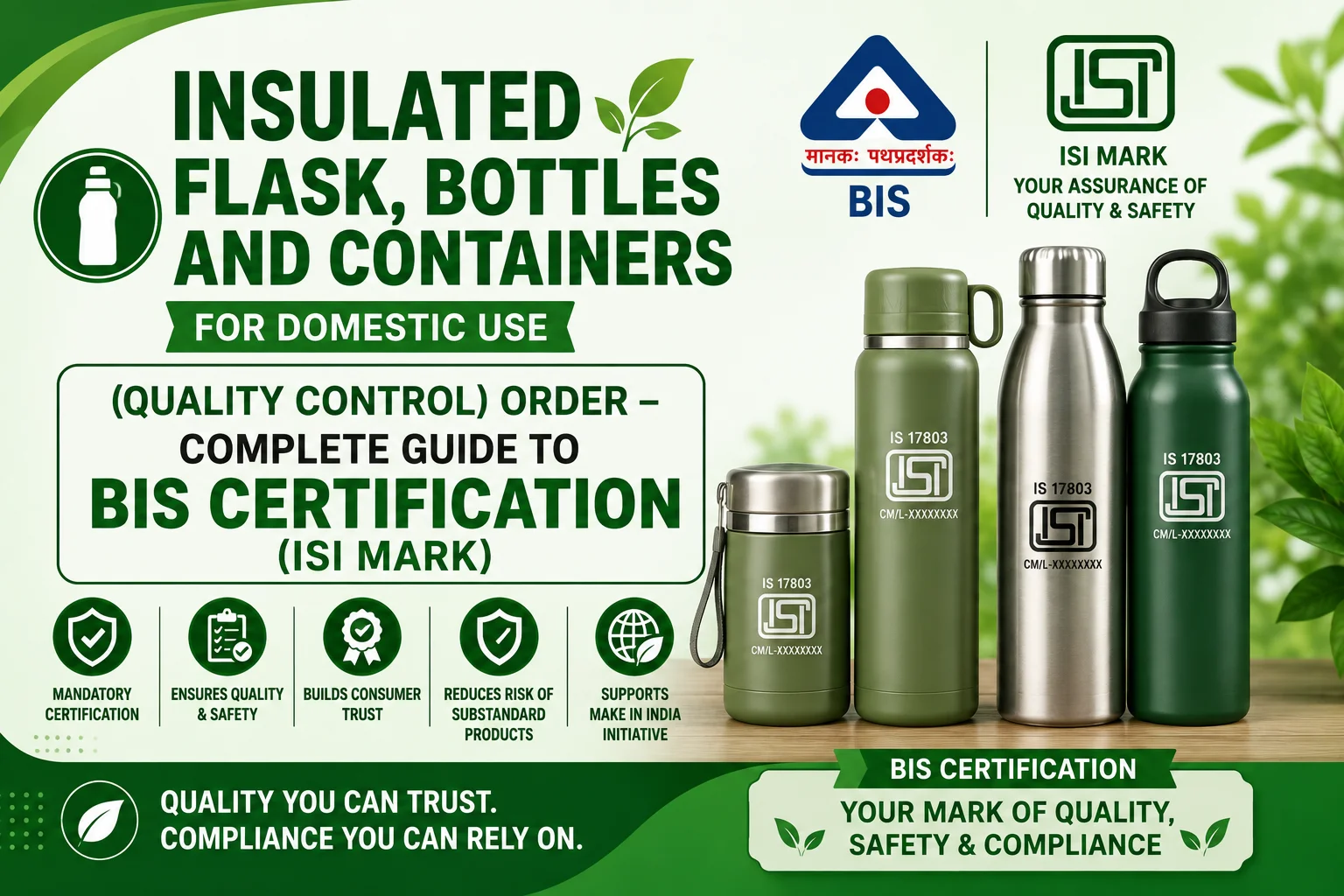
The Government of India has made BIS Certification (ISI Mark) mandatory for Insulated Flasks, Bottles, and Containers for Domestic Use through the Insulated Flask, Bottles and Containers for Domestic Use (Quality Control) Order, 2024, issued by the Department for Promotion of Industry and Internal Trade (DPIIT), Ministry of Commerce & Industry.
The 2024 Order supersedes the earlier 2023 notification and mandates that notified products conform to the applicable Indian Standards and bear the Standard Mark (ISI Mark) under Scheme-I of Schedule-II of the BIS (Conformity Assessment) Regulations, 2018.
A subsequent Amendment Order dated 29 August 2024 introduced a special provision allowing eligible manufacturers and importers to sell declared stock manufactured or imported before the commencement of the Order for up to six months, subject to a Chartered Accountant-certified declaration to BIS.
If you are manufacturing or exporting insulated flasks, vacuum bottles, or insulated food containers for the Indian market, obtaining a BIS License is essential to ensure regulatory compliance.
What is the Insulated Flask, Bottles and Containers for Domestic Use (Quality Control) Order?
The Quality Control Order (QCO) has been issued to improve product quality, consumer safety, and standardization in the Indian market.
Under this Order:
- Products must conform to the applicable Indian Standards.
- Products must bear the ISI Mark.
- BIS Certification is granted under Scheme-I.
- BIS is the certification and enforcement authority.
- Goods manufactured exclusively for export are exempt.
Implementation Timeline
The original 2023 notification provided phased implementation based on enterprise size:
| Enterprise Category | Effective Timeline |
| General Manufacturers | 6 months from notification |
| Small Enterprises | 9 months from notification |
| Micro Enterprises | 12 months from notification |
The 2024 Order, which superseded the 2023 Order, revised the implementation timelines:
| Enterprise Category | Effective Timeline |
| General Manufacturers | 3 months from publication |
| Small Enterprises | 6 months from publication |
| Micro Enterprises | 9 months from publication |
Latest Amendment – August 2024
The Amendment Order provides relief for manufacturers and importers by permitting the sale or display of stock manufactured domestically or imported before the commencement of the 2024 Order, for a period of six months, provided that a declaration certified by a Chartered Accountant is submitted to BIS.
Products Covered
The Order applies to:
- Insulated Flasks for Domestic Use
- Domestic Stainless Steel Vacuum Flask/Bottles
- Insulated Containers for Food Storage
Applicable Indian Standards
| Product | Applicable Indian Standard |
| Insulated Flask | IS 17790:2022 |
| Domestic Stainless Steel Vacuum Flask/Bottle | IS 17526:2021 |
| Insulated Container for Food Storage | IS 17569:2021 |
The latest version of these Indian Standards, including amendments notified by BIS from time to time, will apply.
Who is Required to Obtain BIS Certification?
The QCO applies to:
- Indian manufacturers
- Foreign manufacturers exporting to India
- OEM manufacturers
- Brand owners manufacturing through third parties
- Manufacturers supplying to e-commerce platforms
- Manufacturers participating in government tenders
Important: BIS manufacturing licences are issued only to manufacturers. Importers and traders cannot obtain a BIS manufacturing licence in their own name.
Products Exempted
According to the notifications, the following are exempt:
- Goods manufactured exclusively for export.
- Certain eligible Udyam-registered enterprises meeting the investment and turnover thresholds specified in the Order.
- Declared pre-commencement stock covered by the August 2024 Amendment, subject to the prescribed conditions.
Step-by-Step BIS Certification Procedure
Step 1 – Product Applicability Assessment
Determine whether your insulated flask, bottle, or container falls within the scope of the QCO and the applicable Indian Standard.
Step 2 – Documentation Preparation
Prepare:
- Factory registration documents
- Manufacturing process
- Machinery details
- Quality control plan
- Testing facility details
- Product specifications
- Trademark documents (if applicable)
- Authorized signatory details
Step 3 – Product Testing
Samples are tested in a BIS-recognized laboratory as per the applicable Indian Standard.
Step 4 – BIS Application Filing
Submit:
- Test reports
- Manufacturing details
- Technical documents
- Declarations
- Application forms
Step 5 – Factory Inspection
BIS may verify:
- Manufacturing process
- Production capability
- Quality control arrangements
- In-house testing facilities
- Product consistency
Step 6 – Grant of BIS Licence
After satisfactory review of the application, test reports, and inspection findings (where applicable), BIS grants the licence to use the ISI Mark.
Estimated Certification Timeline
Indian Manufacturers
Approximately 30–45 working days, subject to complete documentation, testing, and BIS processing.
Foreign Manufacturers (FMCS)
Approximately 4–6 months, including application review, factory inspection, and licence issuance.
Documents Required
Typical documents include:
- Factory Registration Certificate
- Company Registration
- Manufacturing Process Flow Chart
- Machinery List
- Test Equipment Details
- Calibration Certificates
- Product Drawings
- Technical Specifications
- Laboratory Test Reports
- Trademark Authorization (if applicable)
- Authorized Signatory Authorization
Benefits of BIS Certification
- Compliance with Indian regulations
- Legal sale of products in India
- Enhanced consumer confidence
- Improved product quality assurance
- Better opportunities in institutional and government procurement
- Increased market credibility
Consequences of Non-Compliance
Failure to comply with the QCO may result in:
- Prohibition on manufacture, import, sale, or distribution of notified products
- Penalties under the Bureau of Indian Standards Act, 2016.
- Regulatory enforcement action
- Business disruption and loss of market access
How Kar Parivartan Can Help
Kar Parivartan provides comprehensive BIS certification services for both Indian and foreign manufacturers:
- Product applicability assessment
- Identification of applicable Indian Standards
- Documentation support
- Coordination with BIS-recognized laboratories
- BIS application filing
- Factory inspection assistance
- BIS query management
- Licence grant support
- Renewal and post-certification compliance
Our experienced consultants help businesses navigate the BIS certification process efficiently and confidently.
Frequently Asked Questions (FAQs)
1. Is BIS Certification mandatory for insulated flasks and bottles?
Yes. Products covered under the QCO must comply with the applicable Indian Standards and bear the BIS Standard Mark (ISI Mark).
2. Which Indian Standards apply?
- IS 17790:2022
- IS 17526:2021
- IS 17569:2021
3. Which BIS scheme applies?
Scheme-I of Schedule-II of the BIS (Conformity Assessment) Regulations, 2018.
4. Can importers apply for a BIS licence?
No. BIS manufacturing licences are issued only to manufacturers.
5. Are export products covered?
No. Products manufactured exclusively for export are exempt.
6. What relief was introduced by the August 2024 Amendment?
Eligible manufacturers and importers may sell declared stock manufactured or imported before the commencement of the 2024 Order for up to six months, subject to submitting a Chartered Accountant-certified declaration to BIS.
7. Is factory inspection part of the certification process?
The QCO requires certification under Scheme-I; factory inspection may form part of the BIS licensing process.
8. How long does the certification process take?
Typically 30–45 working days for Indian manufacturers and 4–6 months for foreign manufacturers, depending on documentation, testing, and BIS processing.
9. Who is the certification and enforcement authority?
The Bureau of Indian Standards (BIS) is the certification and enforcement authority under the QCO.
10. How can Kar Parivartan help?
Kar Parivartan provides end-to-end support—from product applicability and documentation to laboratory coordination, BIS application filing, inspection support, and post-licensing compliance.
Contact Kar Parivartan
Need BIS Certification for Insulated Flasks, Bottles, or Containers?
Our compliance experts are here to assist you with a smooth and efficient certification process.
📞 Mobile: 7428718855
📧 Email: bis.sales@karparivartan.com
Kar Parivartan – Your Trusted Partner for BIS Certification & Regulatory Compliance


